
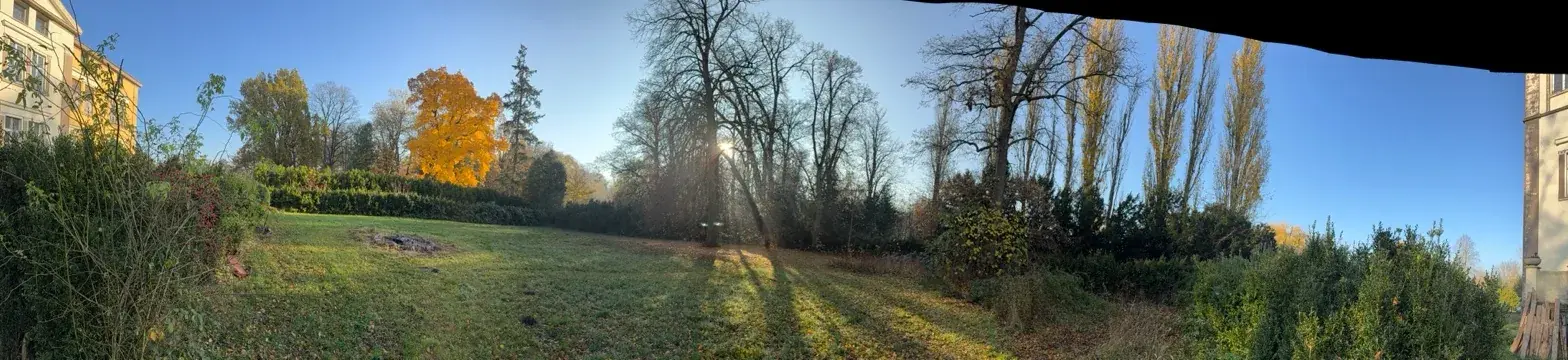
When Peter Joseph Lenné drew up the embellishment plan for the Gültz estate in 1840, he created one of those landscape gardens that still rank among the most important in northern Germany today. The Lenné park in Gültz extends to the south and east of the manor house – 19th-century garden art in the Tollense valley.
Peter Joseph Lenné and Gültz
Peter Joseph Lenné (1789–1866) was the most important German landscape gardener of the 19th century. As Director General of the Royal Prussian Gardens, he designed the Tiergarten in Berlin, the Pfaueninsel and parts of Sanssouci Park in Potsdam, among others. That he also produced a design for the Pomeranian estate of Gültz shows the standing enjoyed by the von Maltzahn family’s property.
The region around Gültz is one of the landscapes with the highest concentration of Lenné parks in Germany. Further Lenné designs in the surrounding area can be found in Ivenack, Kummerow and Basedow – together they form a unique cultural landscape.
A walk through the park
The park was laid out in the English landscape style: no geometric flower beds, but gently winding paths, sightlines and the artful staging of water, meadow and groups of trees.
The manor pond
To the south-east of the manor house lies the manor pond – a tranquil body of water that forms an open clearing towards the manor on its north-western bank. The southern and eastern banks are lined by a dense belt of trees; a path leads through the small wood on the southern bank. This is also where our glamping tent stands during the season.
The ice cellar
A short distance from the manor house stands an old ice cellar – indispensable in the 19th century for keeping food cool. The brick-built vaulted cellar is still well preserved and is one of the most atmospheric corners of the park.
The magnolia
Just behind the manor house, a stately old magnolia catches the eye. A rare sight in northern Germany – it benefits from the park’s sheltered microclimate.
The trees
The historic trees include red horse chestnuts, plane trees, pyramidal oaks and numerous other species, deliberately chosen for their form and autumn colour. Many trees are over 200 years old.
The outbuilding
To the north of the manor house stands the ruin of the hunting trophy house of 1872, listed in the building plans as a poultry house – a small half-timbered building on a high fieldstone base. The building is one of the estate’s historic outbuildings and is awaiting restoration.
Who owns the park today
In all honesty: today only a very small part of the historic park belongs to Schloss Gültz. The larger part is owned by the municipality of Gültz and by private owners. In 2010 Hochschule Neubrandenburg carried out a detailed survey of the condition of the listed garden – silted-up ponds, overgrown sightlines, a deer park that has turned into woodland – identified ways of preserving it, and updated the objectives with students in the 2023/24 winter semester. Little of this has been implemented so far. We look after our part on our own; more on this on the park page.
Visiting the park
The Lenné park is open all year round. Particularly recommended are the guided park walks during the MittsommerRemise in June (2026 review) and our group tours by prior arrangement.
During the season from May to October you can also go glamping in the park – a rare opportunity to wake up in a Lenné park. More about the grounds, the sightlines and the historic plans on the Lenné park page.
Schloss Gültz, Parkstraße 12, 17089 Gültz. Contact and directions.