History
Schloss Gültz – a gem of late neoclassical architecture in the former Demmin district, Province of Pomerania
📍 Historical location
Schloss Gültz lies in the former Demmin district of the Prussian Province of Pomerania. Gültz belonged to Pomerania until 1945 and only became part of Mecklenburg after the Second World War. Today the property is located in the Mecklenburgische Seenplatte district, Mecklenburg-Western Pomerania.

The von Maltzahn coat of arms
The divided ancestral coat of arms shows on the dexter side, on blue, two couped golden hares’ heads one above the other, and on the sinister side, on gold, against the dividing line, an uprooted red vine with a red bunch of grapes between two red leaves. On the helm, with blue-and-gold mantling on the dexter and red-and-gold on the sinister, stand seven golden pales before a peacock fan of seven feathers. The heraldic colours are blue and gold.
The von Maltzahn family belongs to the ancient nobility (Uradel) of Mecklenburg and Pomerania and is documented in records since 1194. Around 1900 the Maltzahns owned estates totalling more than 44,000 hectares.
– Neither fearful nor reckless, but everything in moderation
Ancestral proof tablets of the Order of St John
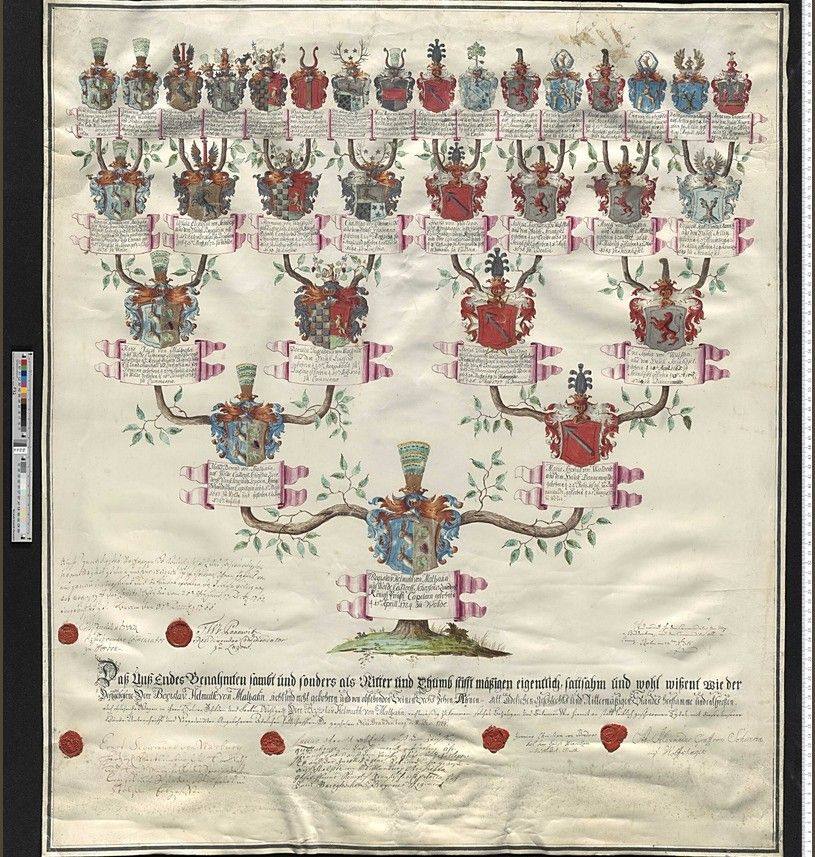
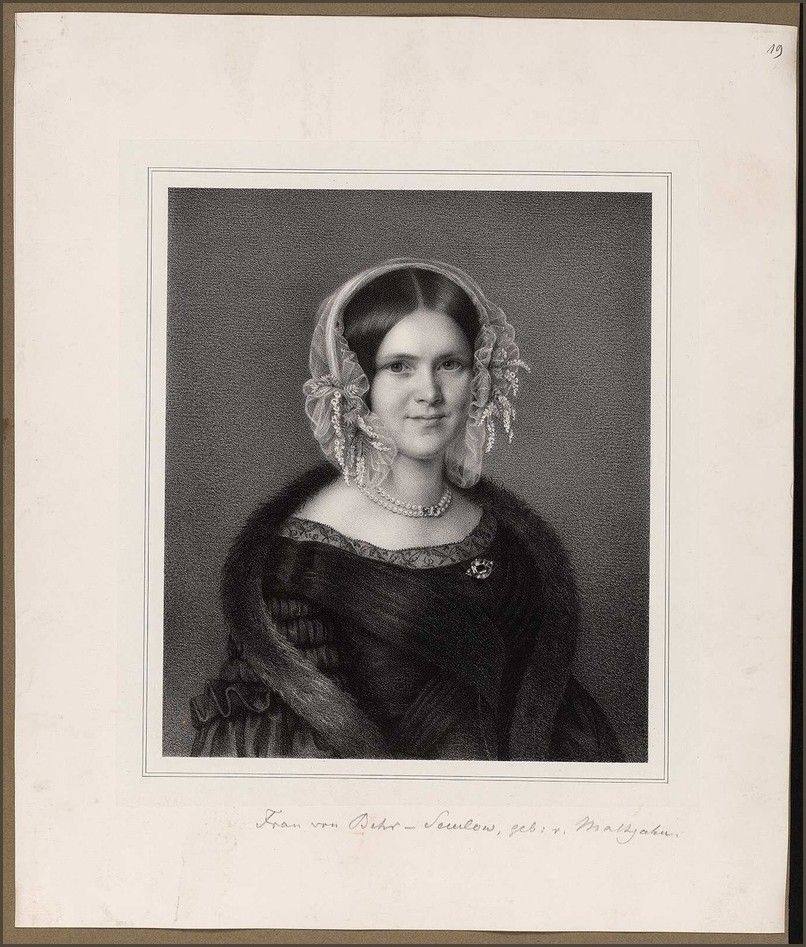
Anyone wishing to be admitted to the Order of St John had to prove noble descent with a coloured pedigree. Two of these “Aufschwörungstafeln” (ancestral proof tablets) for members of the von Maltzahn family have survived in the Geheimes Staatsarchiv Preußischer Kulturbesitz – they come from the related houses of Wolde and Rothmannshagen. Around 1800 Rothmannshagen also belonged to the Gültz branch: Helmuth Dietrich von Maltzahn (b. 1763), grandfather of the man who built the manor, was lord of Rothmannshagen, Gültz and Prützen.

The von Maltzahn-Gültz family
Two generations shaped Schloss Gültz and left their mark on German history
How the “House of Gültz” came about
As a branch of the family in its own right, the House of Gültz begins with Axel Heinrich Ludwig von Maltzahn (* 8 November 1808 in Gültz), the youngest son of Helmuth Dietrich. He studied law in Bonn and Berlin and passed the assessor examination in 1836. In March of the same year his father and his elder brother Eduard died; Axel took over Gültz and Hermannshöh at a valuation of 240,800 thalers and left the judicial service. On 28 November 1838 he married Auguste von Lützow (1820–1891) in Schwerin, the daughter of the Mecklenburg minister of state Ludwig von Lützow, and moved with her to Gültz. In 1840 he commissioned Lenné to draw up an improvement plan for the park, and in 1841 he became Landrat (district administrator) of the Demmin district – only to die a few weeks later, on 12 February 1841, of typhoid fever at the age of 32. His only son Helmuth was just one year old.
In 1849 the young widow married the district administrator Hermann von Heyden of Leistenow in Gültz; this is how the von Heyden stepbrothers came into Helmuth’s life. From 1847 he was taught by the private tutor Julius Lappe, who was pastor in Gültz from 1851 to 1887 and remained a lifelong friend. “Aunt Auguste”, as she was known everywhere in her later years, died in Demmin in 1891 and was buried in the Gültz family vault beside her first husband. In May 1891 the Demminer Tageblatt described her funeral in detail: the service in the house where she died in Demmin, the procession through Treptower Straße and Anklamer Straße with the officer corps of the uhlans, clergy of the Demmin and Treptow synods, deaconesses and the boards of the Elisabeth Foundation, the women’s association and the infirmary. Her grandson Gerhard von Maltzahn carried her cross of merit on a cushion at the head of the procession. At the station the coffin was lifted into a railway carriage and taken to Gültz. In his address the pastor called her a “deaconess by the grace of God”; many of the poor and sick, he said, could say of themselves: “We have lost a mother.” (Demminer Tageblatt, 60th year, no. 110, 14 May 1891; transcript from 1992, Archiv Schloss Gültz)
Source: Berthold Schmidt, Geschichte des Geschlechts von Maltzan und von Maltzahn, section “Das Haus Gültz”, pp. 93–108.
Helmuth Freiherr von Maltzahn-Gültz


Studied law in Erlangen, Heidelberg (Corps Vandalia, Senior at the age of 18) and Berlin; study trips to Switzerland, southern France and Italy, and in 1862 three months travelling through England and Scotland with Robert von Puttkamer. Trainee in the civil administration (Regierungsreferendar) in Koblenz, Wetzlar, Anklam and Stettin, Regierungsassessor in 1866. One-year volunteer in 1859/60 with the 2nd Guards Uhlan Regiment; in 1866 and 1870/71 an officer in the “Queen’s” Cuirassier Regiment in Pasewalk, severely wounded at Beaune-la-Rolande on 28 November 1870 (Iron Cross 2nd Class). The Pasewalk cuirassiers. Builder of Schloss Gültz (1868–1872). Member of the Reichstag for the Anklam-Demmin constituency (1871–1888), chairman of the Budget Committee from 1884. Secretary of State at the Imperial Treasury (1888–1893) on Bismarck’s recommendation. Oberpräsident (Governor) of the Province of Pomerania in Stettin (1900–1911). Hereditary Marshal of Old Western Pomerania (1909) – the last. Founder of the Historical Commission for Pomerania (1911). Twice an honorary doctor of the University of Greifswald: Dr. jur. h. c. on 18 January 1901, for the bicentenary of the Kingdom of Prussia, and D. theol. h. c. in 1921 “for his activity in the church and his steadfast stance during the turmoil of the revolution” (B. Schmidt; Universitätsarchiv Greifswald). Order of St John: Knight of Honour 1875, Knight of Justice 1883, Commander of the Pomeranian Association 1894, Chancellor of the Order from 1916.
He owned the knight’s estate of Gültz (1,100 ha), Schossow (579 ha), Werder (730 ha) and Wodarg (924 ha) – in total more than 3,300 hectares in the Demmin district.
Royal Prussian Privy Councillor (Wirklicher Geheimer Rat)
Oberpräsident of the Province of Pomerania
Axel Freiherr von Maltzahn
Eldest son of the Oberpräsident, born while the family still lived in the old half-timbered house. Katharineum in Lübeck, Abitur in 1886 at the Joachimsthalsches Gymnasium in Berlin, studied in Heidelberg (Corps Vandalia) and Berlin; one-year volunteer in 1890/91 with the “Queen’s” Cuirassier Regiment in Pasewalk, later cavalry captain (Rittmeister) of the reserve there. Landrat (district administrator) of the Grimmen district (1900–1911; Stahlbrode harbour, railway to Loitz 1906; resigned after the Becker trial of 1910/11), 1912 at the Oberpräsidium in Magdeburg, from 1914 Senior Privy Government Councillor (Geheimer Oberregierungsrat) and counsellor in the Prussian Ministry of Agriculture; 1914/15 commander of an ammunition column on the Western and Eastern Fronts (Iron Cross). From 1919 lord of Hermannshöh, from 1923 at Gültz. Stages of his life in the archive · Order of St John: Knight of Honour 1899 (then Regierungsassessor in Bergen on Rügen), Honorary Commander of the Pomeranian Association (1923). A versatile mind: a connoisseur of Horace, mathematician, stargazer, violinist and Wagnerian.
Married Helene von Platen in 1898. Six children – their daughter Gisela (* 18 December 1901 in Grimmen) died on 3 January 1902 – among them his son Helmuth, who ran the estate until 1945. Helmuth’s son Axel (1932–2024), born and baptised in Gültz, remained attached to the house to the very end – Michael Schneider was fortunate enough to meet him in person.
Privy Government Councillor
and counsellor in the Ministry
of Agriculture, Domains and Forests
Berlin-Lichterfelde, Bahnstraße 24
The children of Helmuth and Anna von Maltzahn
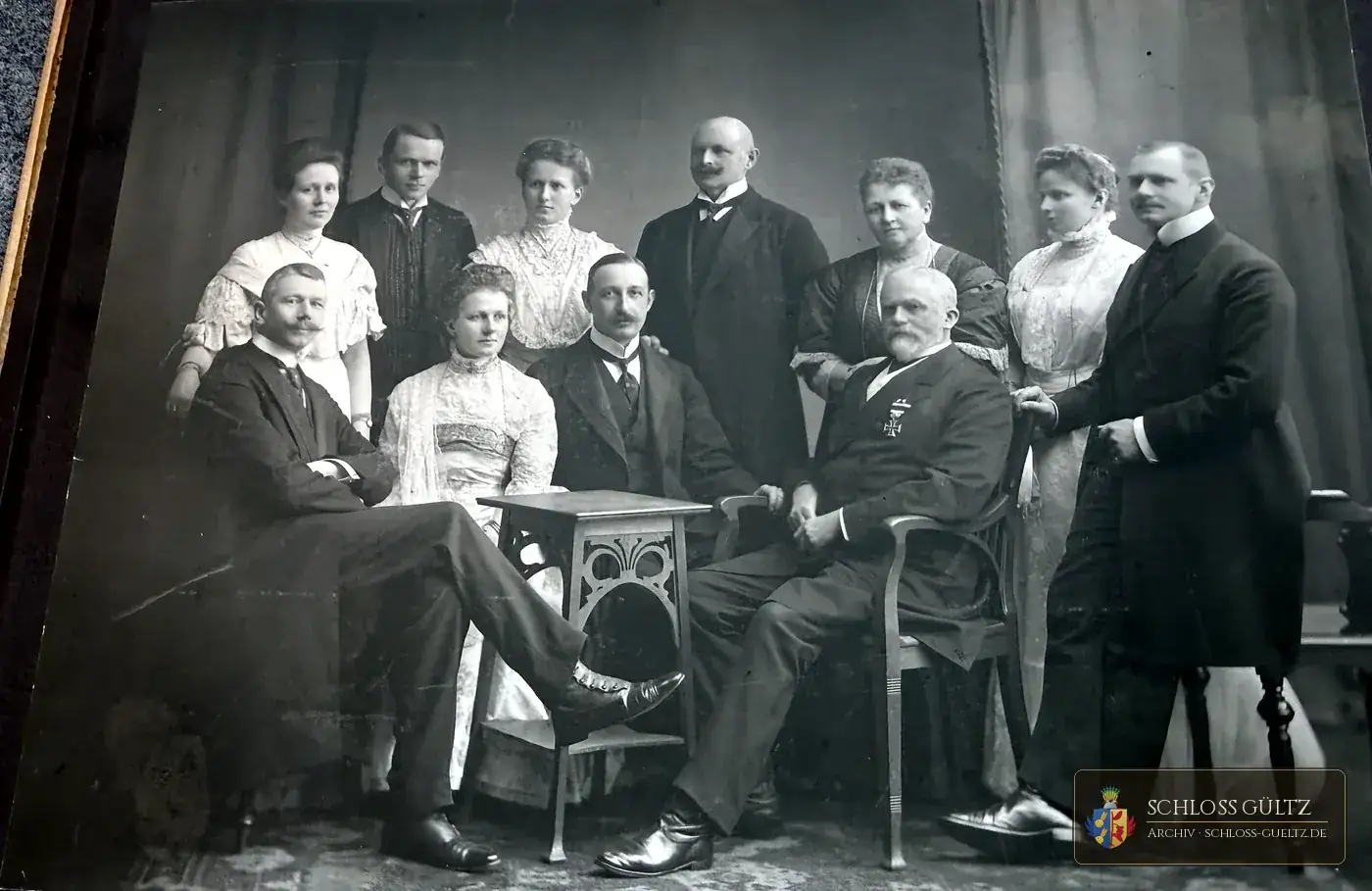
Helmuth von Maltzahn and Anna von Rohrscheidt married in Erfurt on 22 February 1867. They had six children; their son Christoph died in October 1872, two days after his birth. Five grew up – three sons and two daughters. Axel, Agnes and Helmuth were born in the old half-timbered house, Elsbeth and Gerhard in the new manor.
Axel
Heir to Gültz. District Administrator (Landrat) of the district of Grimmen, in 1912 government councillor (Regierungsrat) in Magdeburg, from 1914 privy senior government councillor (Geheimer Oberregierungsrat) in the Prussian Ministry of Agriculture. Six children (Gisela, * 18 December 1901, † 3 January 1902); his son Helmuth ran the estate until 1945.
Agnes
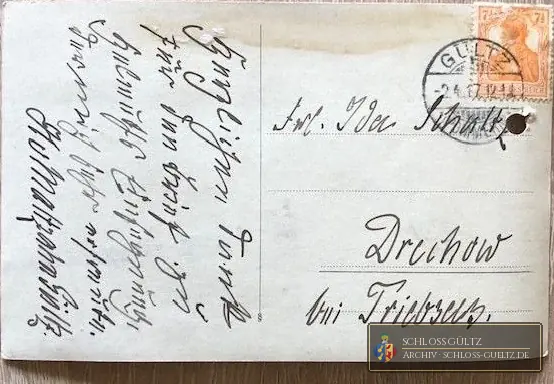
In 1887 she married into the Western Pomeranian noble family von Gadow. Her husband was a retired cavalry captain (Rittmeister a. D.) and lord of Drechow near Tribsees, and from 1914 an Honorary Knight of the Order of St John.
Helmuth
Administrative lawyer: in 1899 junior government official (Regierungsassessor) in Prenzlau, 1904–1914 District Administrator (Landrat) of the district of Prenzlau, then senior councillor to the Oberpräsident (Oberpräsidialrat) in Potsdam. From 1919 owner of the knight’s estate of Schossow near Treptow an der Tollense. Honorary Commander of the Order of St John (1953). In 1914/15 cavalry captain of the reserve in the “Queen’s” Cuirassier Regiment (Kürassier-Regiment “Königin”), commandant of the headquarters of the XXIII Reserve Corps in Flanders.
Elsbeth
Her husband Servaz von Gerlach, a son of the District Administrator Friedrich von Gerlach, was a retired major and owner of the knight’s estate of Rohrbeck in the Neumark, and from 1918 an Honorary Knight of the Order of St John. In 1909 Elsbeth took over from her father the estate of Crampe in the district of Arnswalde, which he had reforested.
Gerhard
Royal Prussian cavalry captain of the reserve in the “Queen’s” Cuirassier Regiment (previously an active officer there), lord of Wodarg and Werder – his father had acquired both estates in 1881. Twelve children, among them Günther, born in Wodarg in 1910.
Sources: Berthold Schmidt, Geschichte des Geschlechts von Maltzan und von Maltzahn, section “Das Haus Gültz”, pp. 105–108; Wikipedia articles on Helmuth von Maltzahn (Oberpräsident), Axel von Maltzahn (Landrat, 1868), Helmuth von Maltzahn (Verwaltungsjurist) and Günther von Maltzahn. Details that cannot be reliably documented have been omitted.
A greeting from Schossow, 1927

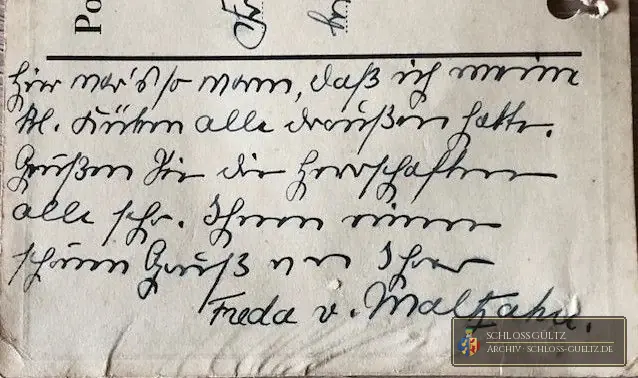
Freda von Maltzahn née von Arnim (1889–1963), married since 1912 to Helmuth von Maltzahn, the second son of the man who built the manor, writes from Schossow – postal address “Tützpatz Kr. Demmin” – to “Ida”, probably the same Ida Schultz in Drechow to whom a card from Gültz had already been sent in 1917 (see the picture postcards further down): she thanks her for a recipe they intend to try at Easter and recalls the days in Drechow, on the estate of her sister-in-law Agnes von Gadow, whose cooking had kept everyone full for three days afterwards. Two small cards, ten years apart, showing how closely the houses of Gültz, Schossow and Drechow were bound together.
Two lives from the family
Schossow was part of the property of the man who built the manor; from 1919 his son Helmuth lived there with Freda von Arnim. From this branch – the “House of Schossow” in the family’s numbering – came two people whose paths led far beyond Pomerania: Helmuth’s son-in-law and his grandson.
Kurt Freiherr von Plettenberg
From 1937 President of the Court Chamber (Hofkammerpräsident) of the House of Schaumburg-Lippe in Bückeburg, from 1941 head of the General Administration of the formerly reigning Prussian royal house. He belonged to the inner circle of the conspirators of 20 July 1944 and was involved in the preparations for the coup. Arrested on 3 March 1945, on his way to interrogation at Gestapo headquarters he threw himself to his death from a fourth-floor window – so as not to betray, under torture, fellow conspirators who had not yet been discovered. His father-in-law Helmuth von Maltzahn-Schossow likewise died in Bückeburg, in 1959.
Paul Freiherr von Maltzahn
Son of Hans-Axel Freiherr von Maltzahn (* 1913, missing since 1944) and the Dutchwoman Anna Mathilde van Stockum, grandson of Helmuth of Schossow and great-grandson of the man who built the manor; Arianne von Plettenberg was his aunt. Born in Demmin a few months before the end of the war – his father never returned from it – he studied law, history and Arabic studies in Heidelberg, Munich and Hamburg and at the Institut d'études politiques in Paris – and in 1964 joined a student corps in Heidelberg (Vandalo-Guestphalia), just as the builder of the manor had done in Heidelberg a century earlier. After entering the Foreign Service in 1970, his career led him almost entirely through the Arab and Islamic world: attaché in Ireland, press officer in Beirut, cultural affairs officer in Paris, 1980–1984 Deputy Head of Mission in Damascus, then at the Federal Foreign Office in Bonn (cultural and education policy), in 1989 Deputy Head of Mission in Algiers, 1991–1996 head of the organisation division of the Central Department, then Minister at the embassy in London.
Then came three ambassadorial posts in succession: Cairo (2000–2003), Tehran (2003–2006) – at a tense time, when an Iranian newspaper reported his recall as early as 2004 and the government denied it the following day – and Jakarta, for Indonesia and East Timor (2006–2009). From autumn 2009 to summer 2010 he headed the German Embassy in Baghdad, during the months of the American troop withdrawal.
From September 2010 he led the German Council on Foreign Relations (Deutsche Gesellschaft für Auswärtige Politik) in Berlin, latterly as Secretary General until 2014. There he helped to build up the Middle East programme and brought state guests in for talks – in 2013, for instance, the Iranian Foreign Minister Ali Akbar Salehi, in the midst of the negotiations on the nuclear agreement. In its obituary the DGAP honoured him as an outstanding diplomat and a passionate foreign-policy expert – and recalled his humour and his humanity. He died on Whit Monday, 21 May 2018, aged 73, in Boldevitz on Rügen – back in Western Pomerania, where he had been born.
Sources: Wikipedia, articles “Kurt von Plettenberg” and “Paul Freiherr von Maltzahn” (no. 1667 in the family numbering, “Haus Schossow”); DGAP, “Die DGAP trauert um Paul Freiherr von Maltzahn” (2018); politik&kommunikation, “Von Maltzahn leitet Geschäfte der DGAP” (2010); Genealogisches Handbuch der Freiherrlichen Häuser A, vol. II (GHdA 13), Glücksburg 1956, pp. 287–292; Maltza(h)nscher Familienverband (ed.), Maltza(h)n 1945–2019, Rostock 2020.
Connected with the houses of Pomerania, Mecklenburg and the Mark
Through marriage, the House of Gültz was connected over four generations with eleven other noble families, from Mecklenburg to the Neumark. This overview lists only connections that can be documented.
The House of Gültz is founded · c. 1808–1849
von Brockhusen
Axel Heinrich Ludwig von Maltzahn (1808–1841), the founder of the House of Gültz, was the son of Wilhelmine von Maltzahn née von Brockhusen.
von Lützow
⚭ 28 November 1838 in Schwerin: Axel marries Auguste von Lützow (1820–1891), daughter of the Mecklenburg-Schwerin Minister of State Ludwig von Lützow.
von Brandenstein
Auguste’s mother Sophie was born Freiin von Brandenstein (1796–1876). She was the grandmother of the man who built the manor.
von Heyden
⚭ 1849 in Gültz: the widowed Auguste marries the District Administrator Hermann von Heyden of Leistenow. His sons became the stepbrothers of the young Helmuth.
The builder · 1867
von Rohrscheidt
⚭ 22 February 1867 in Erfurt: Helmuth von Maltzahn (1840–1923) marries Anna von Rohrscheidt (1847–1913). The couple had six children.
The builder’s children · 1887–1912
von Gadow
⚭ 1887 in Gültz: Agnes marries August von Gadow (1861–1929), retired cavalry captain and lord of Drechow near Tribsees.
von Gerlach
⚭ 1893 in Gültz: Elsbeth marries Servaz von Gerlach, retired major and lord of Rohrbeck in the Neumark.
von Platen
⚭ 17 May 1898 in Schaprode on Rügen: Axel, the heir to Gültz, marries Helene von Platen (1879–1942) of the House of Poggenhof, the “Rose of Rügen”. Her mother Helene née von der Lancken came from Lanckensburg and died in Poggenhof in 1915. More in the archive
von Borcke
⚭ 1907: Gerhard, lord of Wodarg and Werder, marries Helene von Borcke (1884–1946) of the House of Demnitz and Millnitz.
von Arnim
⚭ 1912: Helmuth, later lord of Schossow, marries Freda von Arnim (1889–1963).
The grandchildren’s generation · 1934–1945
von Plettenberg
⚭ 5 September 1934 in Schossow: Arianne von Maltzahn (1914–1974), Helmuth’s daughter, marries Kurt von Plettenberg. He belonged to the resistance of 20 July 1944. After his arrest in March 1945 he took his own life at Gestapo headquarters in Berlin so as not to betray his fellow conspirators.
Counts von Platen-Hallermund
Helmuth von Maltzahn (1900–1984), Axel’s son and, until 1945, the last lord of Gültz, was married to Alexandra Reichsgräfin von Platen-Hallermund. Their son is the historian Christoph Freiherr von Maltzahn (* 1943 in Greifswald). Thus father and son both married into the House of Platen.
Sources: Berthold Schmidt, Geschichte des Geschlechts von Maltzan und von Maltzahn, section “Das Haus Gültz”; Wikipedia articles on Axel von Maltzahn (Landrat, 1808 and 1868), Helmuth von Maltzahn (Oberpräsident and Verwaltungsjurist), Günther von Maltzahn, Kurt von Plettenberg and Christoph von Maltzahn. For the period up to 1945 also: Maltza(h)nscher Familienverein (ed.), Die Maltza(h)n 1194–1945. Der Lebensweg einer ostdeutschen Adelsfamilie, Cologne 1979.


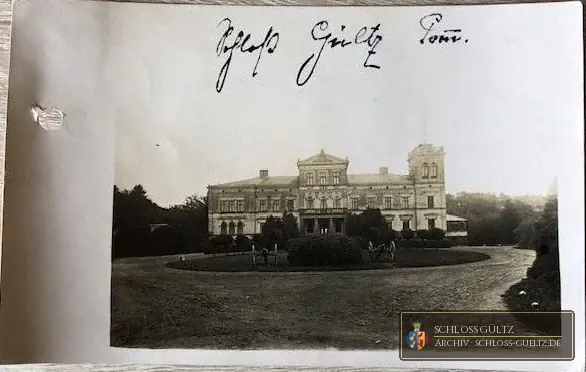
Picture postcard “Schloss Gülz (Pommern)”, 1911
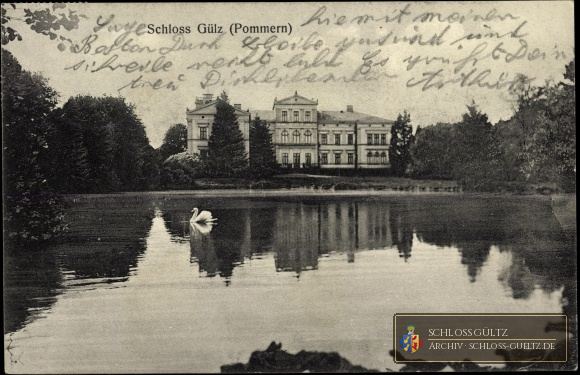
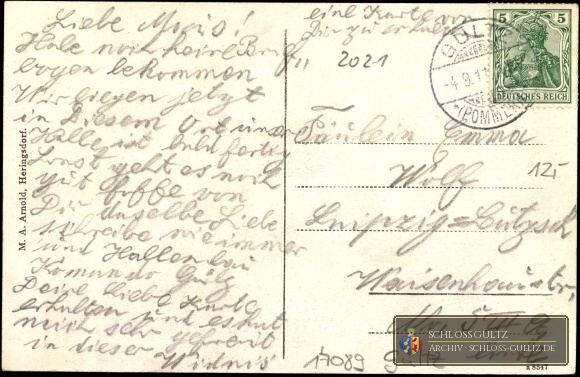
One of the early photographic picture postcards of the manor. It shows the house some forty years after its completion – still with its original façade articulation and the pond bank that was open at the time. Michael Schneider Collection.
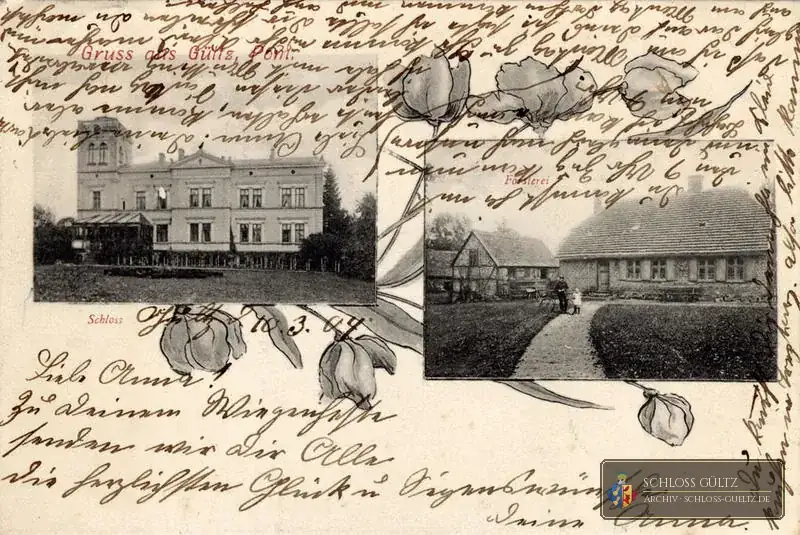
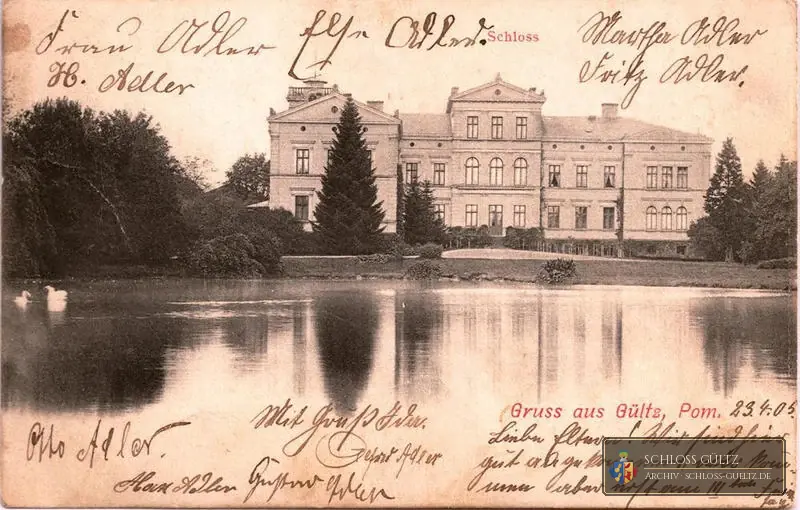
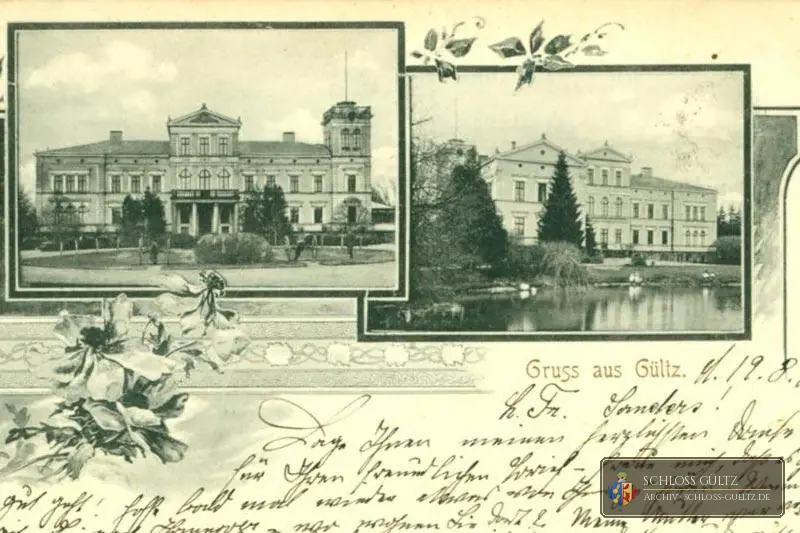
Picture postcards and greetings, c. 1900 to 1917

“Gültz i/Pomm.” – manor house and inn
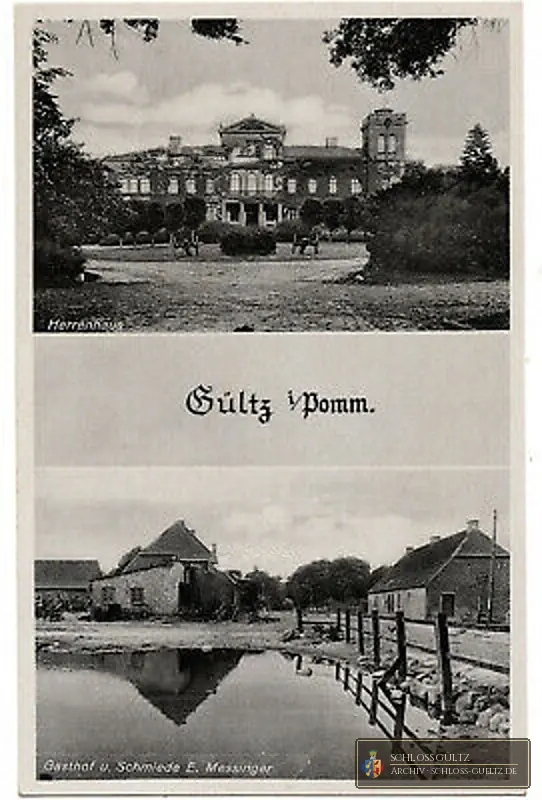
A photo card that brings manor and village together: above, the “Herrenhaus” (manor house) behind the wide drive, with tower and portico, carts in front; below, “Gasthof u. Schmiede E. Messinger” (E. Messinger’s inn and smithy), its gable reflected in the village pond, beside it a farmstead and the wooden fence by the water.
The card is undated; the photograph and the Fraktur title suggest the period between the World Wars. If you know more about the Messinger inn, we would be glad to hear from you.

The cards from 1904 and 1905 show the house a good thirty years after the family moved in, still with its original façade articulation. The forester’s house, which on the 1904 card stands on an equal footing beside the manor, belonged to the estate – two thirds of the timber for building the manor had already come from the Gültz woods, the Rehhagen.
From the builder’s memoirs
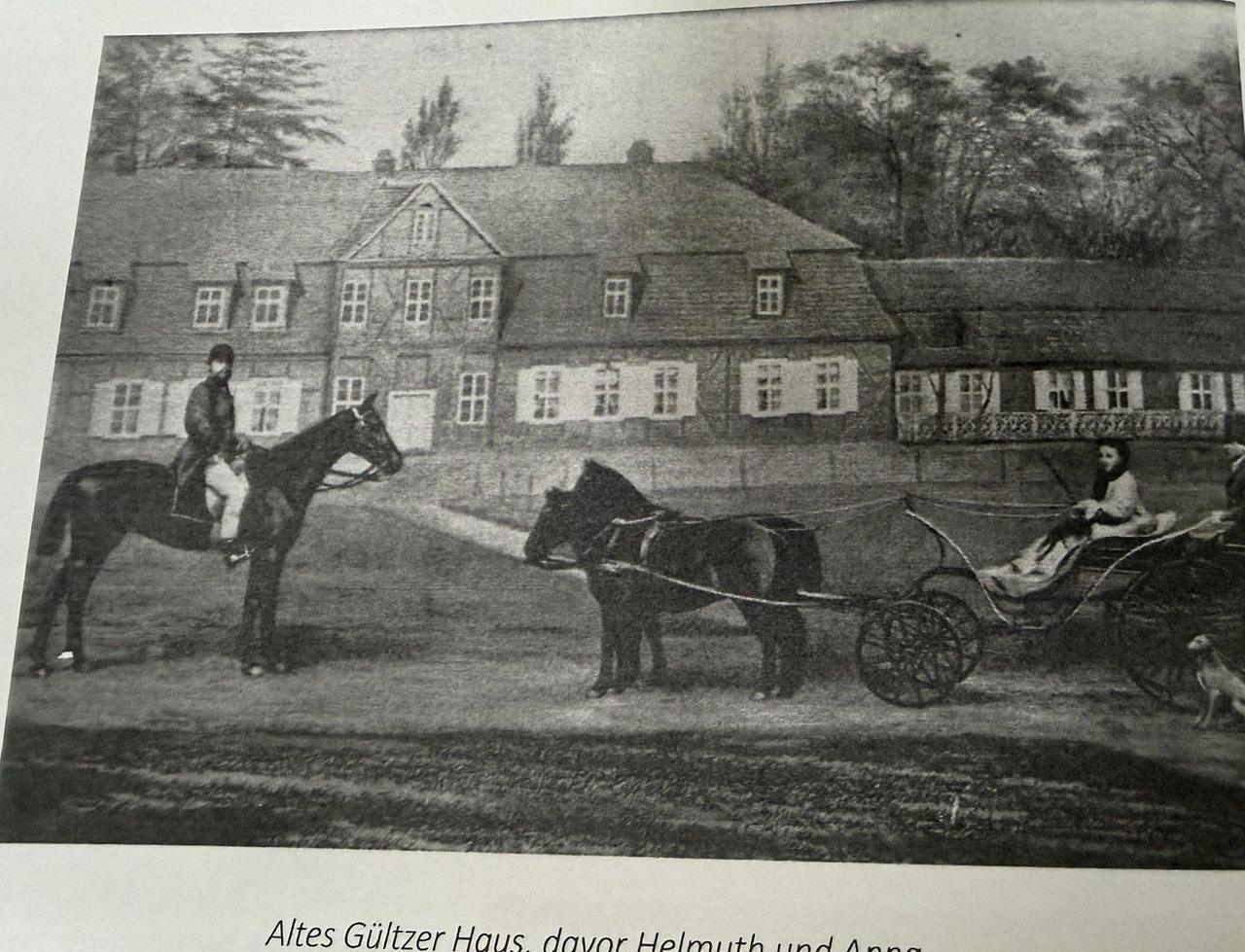
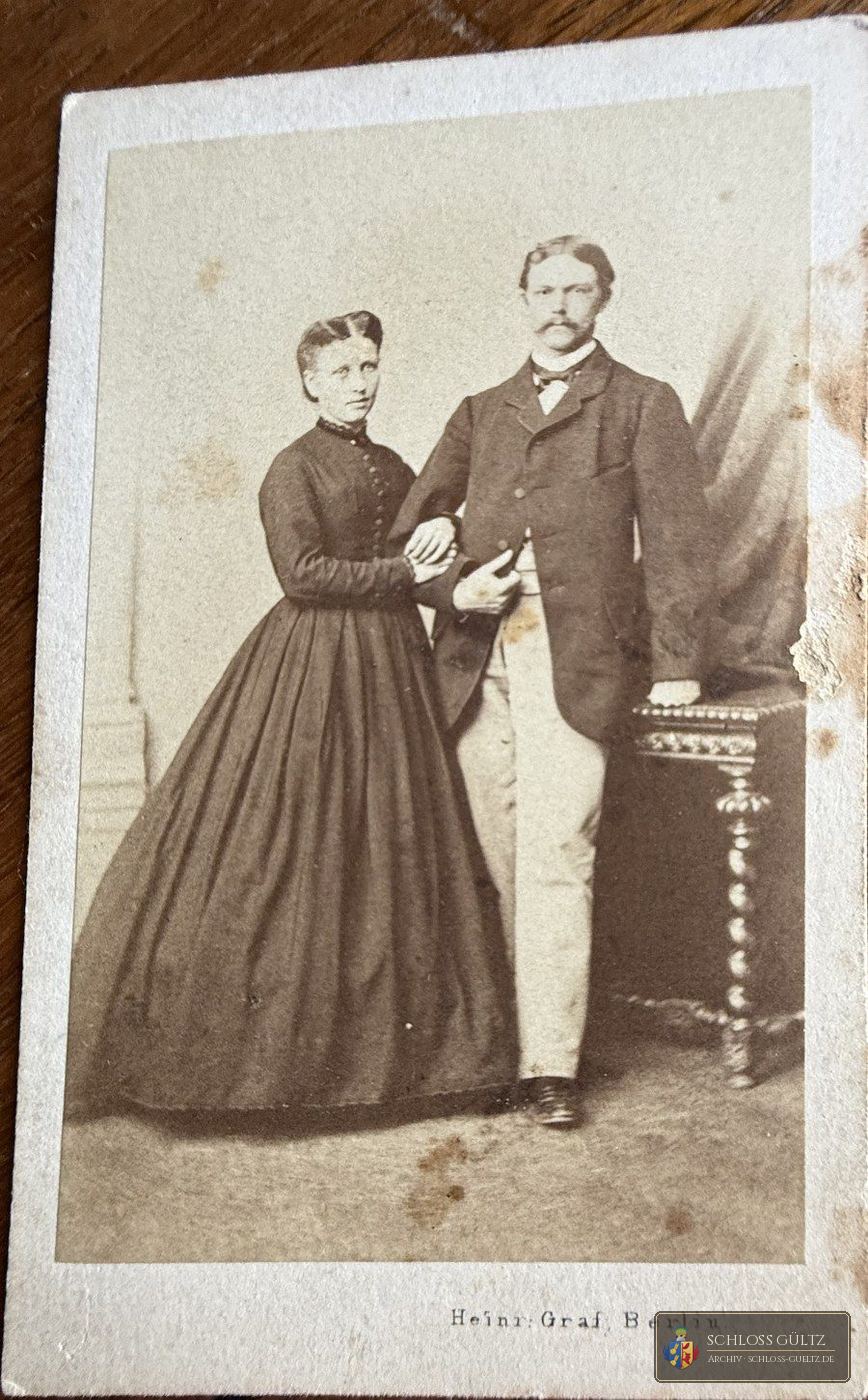
In 1916 Helmuth von Maltzahn dictated his “Erinnerungen 1893–1900 mit Rückblicken auf frühere und Ausblicken auf spätere Jahre” (Memoirs 1893–1900, with retrospectives on earlier years and prospects of later ones). The typescript was never printed; it describes the building of the house so precisely that one might still be standing on the building site. The quotations follow the original.
“The old house was a half-timbered building with brick infill. The unrendered walls, only half a brick thick, gave inadequate protection against the weather; the snow drove through, and in a strong wind we had to flee from windward to leeward into the most sheltered room. … In our dining room, the so-called hall, there was an ants’ nest in the outer wall … There were of course mice in great numbers too; we had made some of them quite tame with crumbs scattered for them.”
“I first drew sketches of floor plans, then got in touch with various master builders and finally decided to entrust the building to the Mecklenburg architect Baurat Daniel, after I had inspected the house he had recently built for Count Schulenburg in Tressow …”
“While searching for foundation stones, however, we tackled a stone lying behind the sand pit that protruded only slightly above the surface, and which on being dug out proved to be a quite unusually large block of granite. … almost all the window surrounds were made from the Gültz block; it supplied 86 side pieces, 39 lintels and 19 sills.”
The cornices, the columns of the porch and the two polished black columns in the hall are of sandstone from Nebra on the Unstrut, brought by water as far as Demmin. The rendering was done with hydraulic lime from Brodhagen near Rostock; two thirds of the building timber came from the family’s own woods, the Rehhagen.
“For the stucco work in the hall there was at that time only a single man in Europe, an Italian named de Thoma, whose men were able to execute this so-called stucco lucido. The work here was carried out by two Italians, a Piedmontese and a Neapolitan, who had previously worked in Stockholm.”
Before moving, the family held a celebration for the craftsmen in the cleared hall of the old house; the craftsmen of the area came with their banners. Then a squadron of the Demmin Uhlans was quartered there – and with it the Hereditary Grand Duke of Mecklenburg-Strelitz. The officers slept in the completed new building before the family themselves moved in.
“Now get yourself a couple of French cannons for the drive,” his cousin Rudolph Maltzahn of Vollrathsruh advised him in the Reichstag in the summer of 1873. The Ministry of War let him have two captured bronze guns for a total of 446 thalers; two teams of draught horses from the building works collected them in Neubrandenburg, and at the entrance to the village the schoolchildren gave them a ceremonial welcome.
Alongside the Mirror Hall, a “miniature version of its namesake at Versailles”, the house was given a red and a green salon. Shortly after the family moved in, dry rot broke out in the hall: all the parquet had to come out, and the floor was relaid, this time on a ventilated void, with air grilles beneath the windows – “since then nothing has appeared again”.
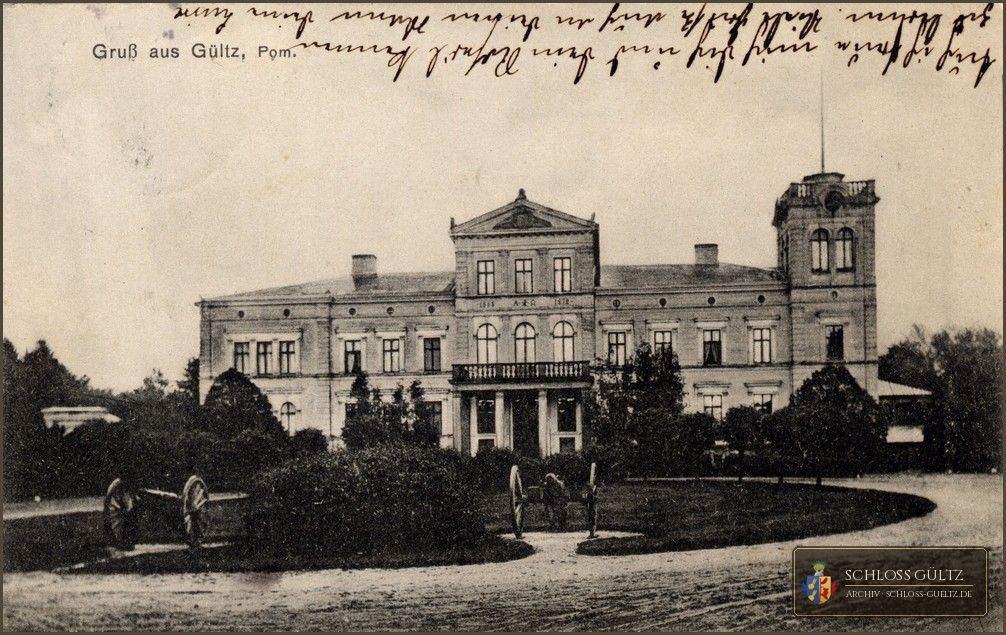
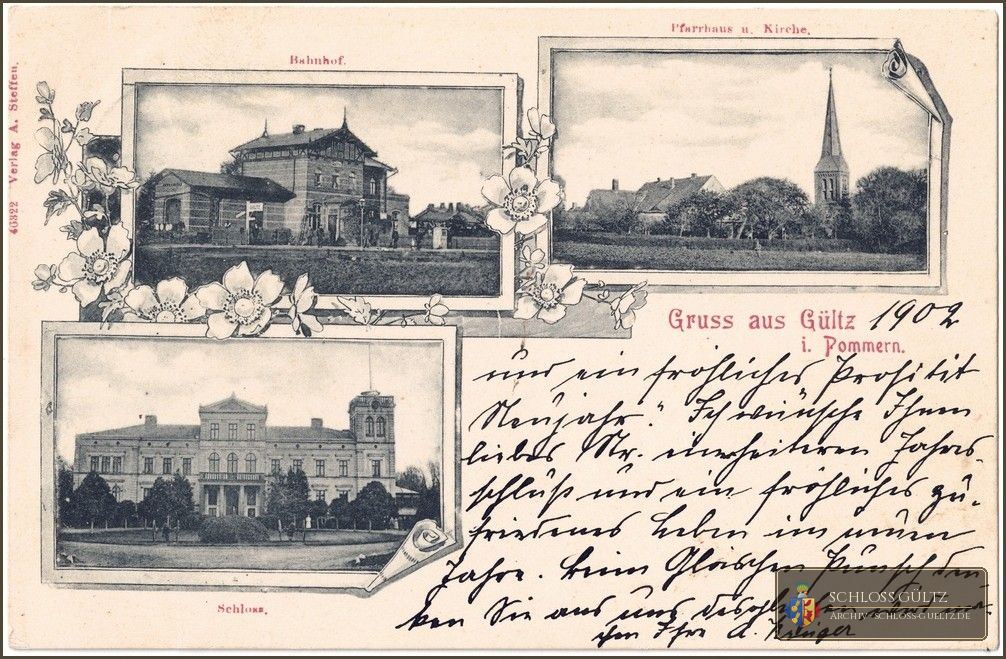
Sources: Helmuth Frhr. von Maltzahn-Gültz, Erinnerungen 1893–1900 mit Rückblicken auf frühere und Ausblicken auf spätere Jahre, written down in 1916, typescript, unpublished; Lars Franke, “Mit einem Spiegelsaal und zwei Salons – Schloss Gültz bei Altentreptow”, series “Zu Gast im Schloss”, Nordkurier, 28/29 July 2001 (salons, comparison with Versailles).
The earliest photographs of the house
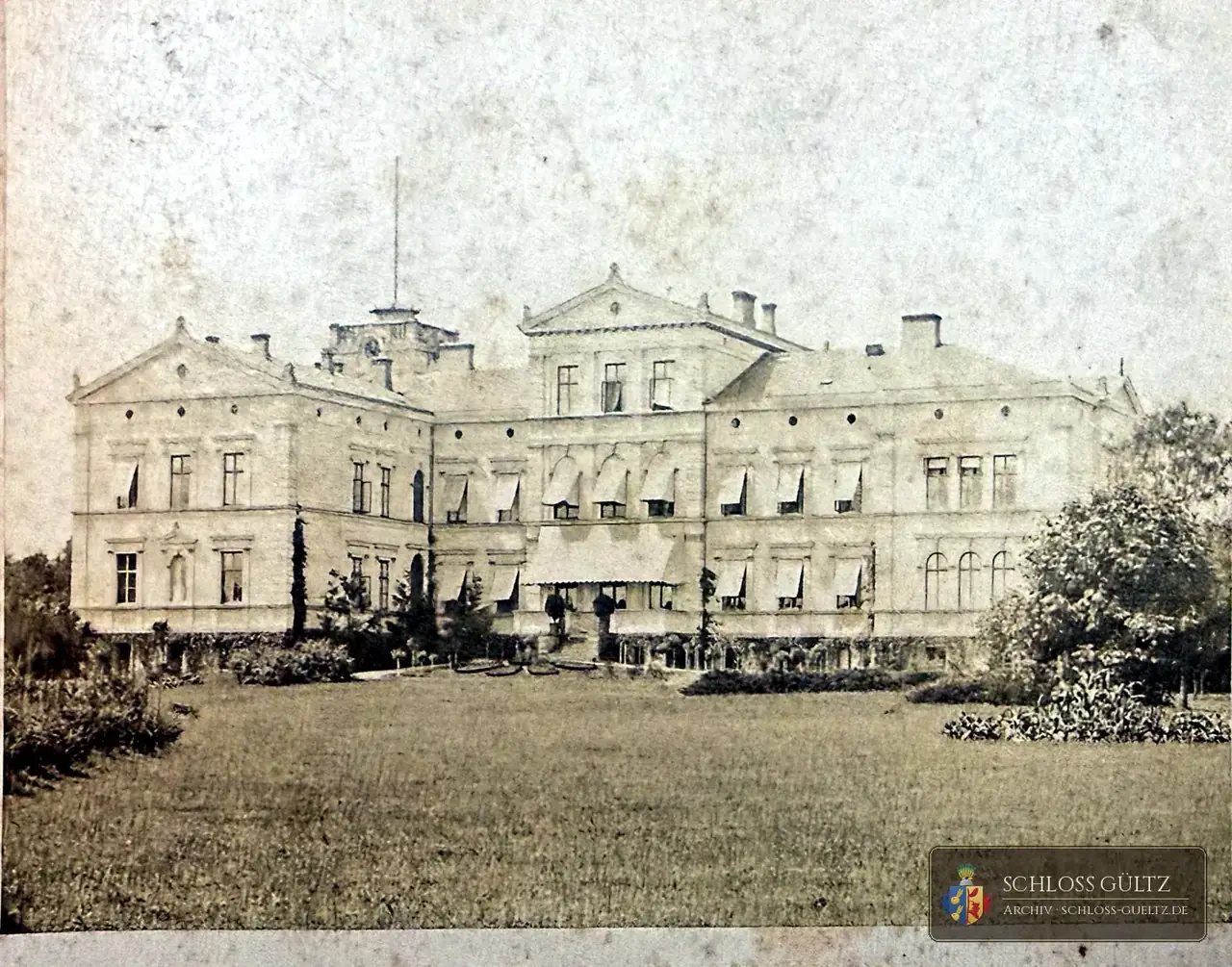
Two cabinet photographs from a Berlin studio for architectural and landscape photography show the house when the young trees in front of the courtyard side were still small – probably the oldest surviving photographs. Clearly visible: the tower with its clock and balustrade, the awnings at the windows on the park side and the portico with balcony, as designed by Baurat Daniel.


Georg Daniel (1829–1913)
When Maltzahn was looking for his architect, the choice fell on a man who had just proved his skill on the great building sites of the north. Georg Daniel, son of the mayor of Rehna, studied from 1846 at the Polytechnic School in Hanover, worked in Munich in the studio of Friedrich Bürklein and attended the Academy of Fine Arts from 1851. From 1854 to 1857 he worked on the remodelling of Schwerin Palace – where the Grand Duke came to value him – and then spent three years in the Vienna office of Franz Jakob Kreuter. In 1861 he returned to Mecklenburg as a building supervisor (Baukondukteur).
With the remodelling of the palace and church at Ivenack (1863–1871) he turned to prestigious country architecture; Gültz (1868–1872) and the manor house at Vanselow (c. 1870) followed. For Gültz, Daniel drew up his designs on the basis of floor-plan sketches that the client had drawn himself – Maltzahn had decided on him after visiting the house of Count Schulenburg at Tressow, which Daniel had built shortly before. From 1874 to 1880 Daniel headed the building administration in Mecklenburg-Strelitz, and thereafter, until 1911, that in Schwerin. Among his best-known works are the Schwerin Court Theatre (1882–1886) and the tower of Schwerin Cathedral (1889–1893); in Gültz he also remodelled the church in 1879.
In 1924, eleven years after Daniel’s death, Privy Senior Building Officer Johann Friedrich Pries wrote about “Die Baumeister Mecklenburgs und ihre Werke” (The Master Builders of Mecklenburg and Their Works) in Mecklenburg, the journal of the Heimatbund. Pries had deputised in office for Daniel when he was already over eighty and knew him well. To him, Daniel was “a man who, like few others, dominated the whole field of building construction in the country for decades, or more correctly in both Mecklenburgs”.
“Daniel did not follow any one artistic movement exclusively, but rather sought in each individual case to adapt the style to the task. … yet he did not subject himself so much to the constraints of style that he would have placed beauty behind stylistic correctness.”
Among Daniel’s works, Pries names – alongside the tower of Schwerin Cathedral and the town church in Malchow – explicitly “several rural manor houses in south-eastern Mecklenburg and in Pomerania”. Gültz is one of these manor houses in Pomerania, even though Pries does not mention it by name. He praises Daniel as a champion of local brick building and recalls that Ratzeburg Cathedral was restored to Daniel’s plans and reconsecrated in 1881. And he preserves a small scene: when the very elderly man fell ill once again, he was annoyed “that he was once more held back by illness, it was only 75 years ago that he had had to suffer with the measles” – Pries calls him “one of the greatest masters of the art of living”.
All of Georg Daniel’s buildings →
Sources: Joh. Friedr. Pries, “Die Baumeister Mecklenburgs und ihre Werke”, in: Mecklenburg. Zeitschrift des Heimatbundes Mecklenburg 19 (1924), no. 1 (May), pp. 1–20, here pp. 17–20; Wikipedia, article “Georg Daniel”; Architektenbiografien (glass-portal), list of works including “1868–1872 Gültz/Pommern, Parkstraße 12: Herrenhaus (Schloß); erhalten”; Helmuth Frhr. von Maltzahn-Gültz, Erinnerungen, 1916 (choice of architect).
The rooms before 1945
The family chronicle preserves two treasures: a series of interior photographs from before the war – and floor plans of every storey, drawn from memory and labelled with the names the rooms bore within the family. They show a house in which people lived, worked and celebrated. The photographers are unknown.
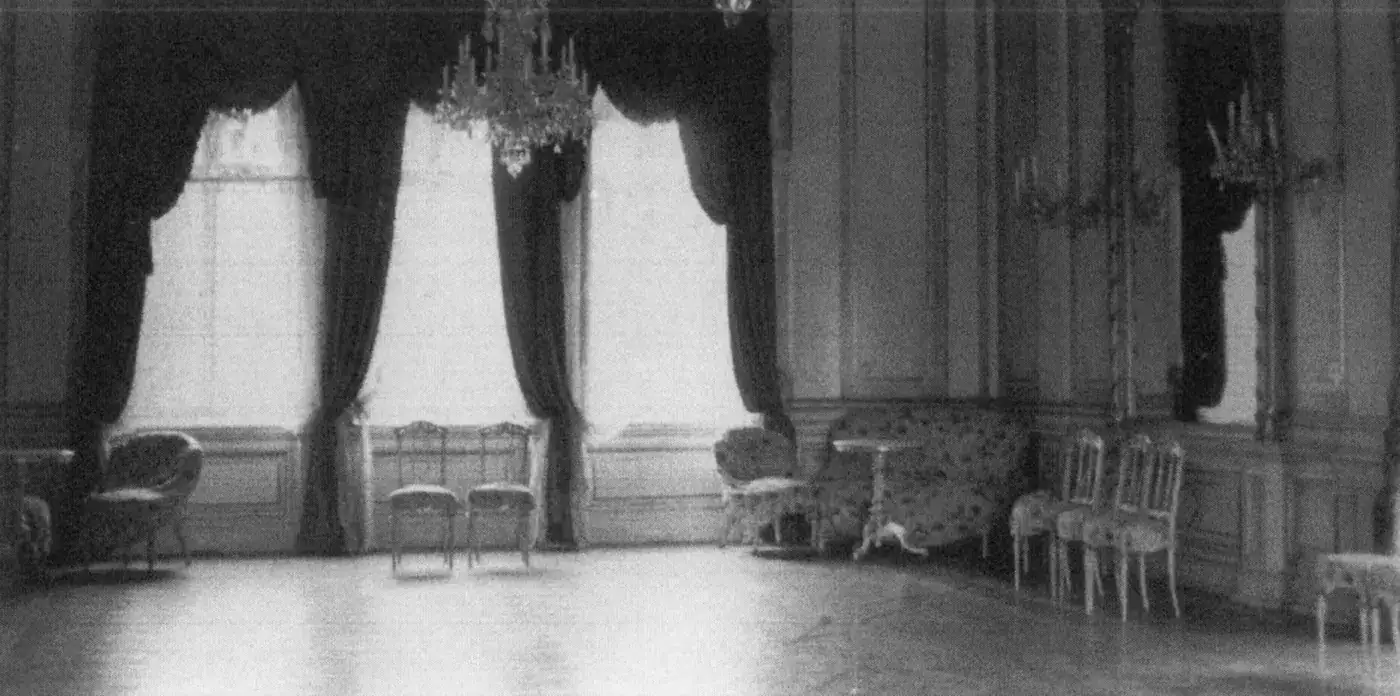


Hall · dining room with servery · hall cloakroom · entrance hall with staircase · garden room with terrace to the park · Blue Salon · first and second gentlemen’s studies · library with glass veranda · small archive with iron spiral staircase · boudoir · parents’ bedroom · nursery · playroom · wardrobe room and bathroom
Large and small corridors · central salon, right and left salons · balcony room · Prince’s Room · the guest rooms “Little Cherry Wood” and “Little Ivy Wood” · “Little Olympus” · tower room · schoolroom · Junker’s room · maids’ room · the room of Aunt Francke, the governess · office and archive
Under the roof the “Great Olympus”, further chambers and the smokehouse; in the granite fieldstone cellar the kitchen, utility rooms, wine cellar and fruit cellar.
The “Prince’s Room” recalls the first guest of the house, the Hereditary Grand Duke of Mecklenburg-Strelitz (1872). The floor plans in the chronicle are expressly “not to scale” and drawn from memory; during the hotel conversion of 2000–2004 the layout of the rooms was partly altered. Source: unpublished family chronicle “Gültz – Aus dem Leben meiner Vorfahren”, pp. 95–101 (floor plans and photographs, private collection).
What was lost – and what remained
Around 2000, before the hotel conversion began, a conservation brief recorded what the house looked like after the war, the years of refugee resettlement and three decades as a vocational school – and what was still known about its earlier appearance. Today it is one of the most important sources for the restoration. The list “Preserved” reflects the situation around 2000; we are checking room by room what of it survived the hotel conversion.
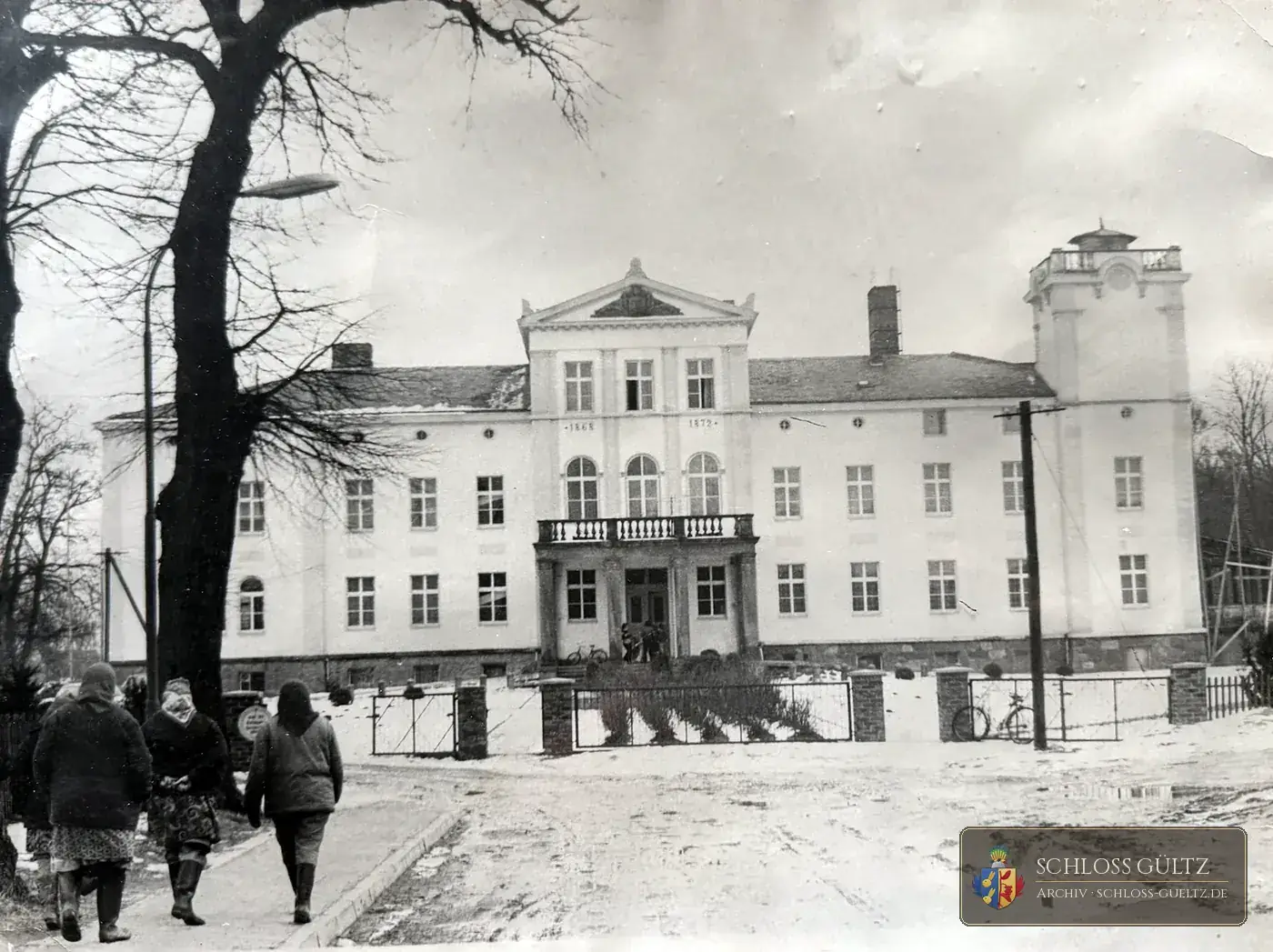
- the striking clock in the tower and the flagpole on its top
- the glass veranda west of the tower, used as a palm house – like the pheasantry, probably demolished during the GDR era
- the fireplace in the entrance hall, made of the same black stone as the columns
- the sculptures of the four seasons in the niches of the stairwell
- the slate covering of the roof
- the stucco elements above the windows – removed when the façade was first painted yellow and brown around 1980; until then it had merely been rendered and was overgrown with Virginia creeper and ivy
- a coloured leaded-glass window that was still in the house until 1999
- the black floor tiles with yellow floral ornaments in the hall – the same tiles once lay on the terrace overlooking the manor pond
- the front door in the columned portal
- the parquet flooring on the ground floor
- the wooden ceilings in the library and dining room, the stucco ceilings in the terrace room
- the Mirror Hall with its two gilded wall mirrors
- in the boudoir, probably the last window dating from the time of construction, with its old fastening and inner wooden shutters
- the barrel and groin vaults in the basement, where the kitchen, servants’ hall, laundry and wine cellar once were; a small dumb waiter carried the food upstairs
On 2 March 2023 the State Office for Culture and Monument Preservation, the lower monument protection authority and the building control authority inspected the individually listed monuments of the estate together with the owner – the manor house, the poultry house and the ice cellar. The finding: the high quality of the interior design is particularly evident in the still untouched state rooms at the rear of the ground floor and in the great hall with its stucco, wall decoration and framed mirrors. A restorer is to examine window reveals with metal-leaf overlays and the wall paintings behind the mirrored surfaces; the restoration of the hall is being planned in detail in close consultation with the conservation authorities. The ice cellar is in good condition.
Sources: Conservation brief for Schloss Gültz, written by the then owners, Annex 2 to the planning by the architecture and planning office R. Furchner, Peitz (c. 2000); file note by the lower monument protection authority of the district of Mecklenburgische Seenplatte on the site visit of 2 March 2023.
Maltzahn and Bismarck
As a member of the Reichstag, Helmuth von Maltzahn belonged from 1871 to the Chancellor’s conservative camp; in 1888 Bismarck brought him into the imperial government as State Secretary of the Imperial Treasury. What developed was more than an official relationship: even after Bismarck’s dismissal in March 1890, Maltzahn stood by him. When the fallen Chancellor travelled to Vienna in June 1892 for the wedding of his son Herbert – the Emperor had asked Vienna not to grant him an audience – Maltzahn and his wife were at the Berlin station to greet him, the only State Secretary there; no Prussian minister was present. For a serving State Secretary this was a gesture not without political risk. In 1893 Maltzahn resigned over differences with Bismarck’s successor Caprivi. The friendship lasted until Bismarck’s death in 1898; Maltzahn recorded it in 1915 in his own memoirs, in which he reproduces Bismarck’s letters to him verbatim.
“I beg Your Excellency for your friendly assistance in the form of some information on a few formal questions concerning the issuing of my pension receipt … The goodwill you have always shown me allows me to count on your indulgence. In friendly devotion, yours, v. Bismarck”
“I would be very happy if I were granted permission … to visit Your Serene Highness for a day, at Friedrichsruh, Varzin or wherever else Your Serene Highness might command. … A letter will reach me here until the 21st of this month, however, and thereafter at ‘Gültz in Pomerania’.”
“I shall be glad any day to receive your visit … You should spend the night in Stettin, where the accommodation will be better than in Köslin. In any case, we shall be heartily pleased to see you here.”
Maltzahn visits the 82-year-old Prince with his sons. Bismarck’s doctor had advised against it, but Bismarck insists on receiving them. When Maltzahn rises to speak at table, Bismarck stands up, walks around the table, embraces and kisses his guest.
Source: Helmuth Freiherr von Maltzahn, in: Erich Marcks / Karl Alexander von Müller (eds.), Erinnerungen an Bismarck. Aufzeichnungen von Mitarbeitern und Freunden des Fürsten, J. G. Cotta'sche Buchhandlung Nachfolger, Stuttgart/Berlin 1915, pp. 89–118 (letters quoted in the spelling of the original).
Witness to the events of 1918
Even in old age Maltzahn remained an authority among the old Prussian ruling class. In the Prussian Privy State Archives (Geheimes Staatsarchiv Preußischer Kulturbesitz), the papers of Emperor Wilhelm II include records concerning the Emperor’s crossing into Holland in November 1918 – among them an account written down by Maltzahn-Gültz of Field Marshal von Hindenburg’s statements on the background to this step (Potsdam, 15 February 1922), as well as later copies and statements by third parties from 1953 referring to a declaration he had dictated.
GStA PK, BPH, Rep. 53 Kaiser Wilhelm II., Nr. 238 (information from the archive dated 19 January 2026). These documents have yet to be evaluated.
The last days in Gültz, 1944/45
On the morning after 20 July 1944 a Wehrmacht vehicle drives up the avenue: the last lord of the manor, Helmuth von Maltzahn (1900–1984), is arrested and held by the Gestapo in Greifswald until 17 September – together with his brother Jürgen and his uncle Helmuth of Schossow. In the winter of 1944/45 the manor becomes a collection point for refugees – up to 200 people in the house, plus SS and military police billeted there. The lady of the house, Alexandra von Maltzahn, née Reichsgräfin von Platen-Hallermund, takes the children to Ellerbruch in Lower Saxony under a pretext and does not leave Gültz herself until 23 April 1945. On the night of 30 April to 1 May the Red Army arrives; during the looting, the library and archive go up in flames.
Axel Freiherr von Maltzahn a. d. H. Gültz
He was the last child of the family to be born and baptised in Gültz – and he never let go of the house. When the manor acquired a new owner in 2019, a connection developed that came to mean more to both sides than an exchange about history: many long telephone conversations in which he looked on his Pomeranian homeland with an alert eye and followed the restoration with keen interest – and a visit to Freudenstadt, which had become his home, only a few weeks before his death.
His anecdotes about the Gültz of his childhood, his humour and his warmth make him unforgettable to me. Much of what this page says about life in the house before 1945 is owed to his stories.
As a child in 1943, Axel von Maltzahn witnessed two bronze bells being taken down from the Gültz church tower to be melted down for armaments – the church had already had to give up its bells in the First World War. Sixty years later he donated a bronze bell to the parish once again; around 2004 it was hung in the tower in place of the three steel bells that had hung there until then. At the same time, some thirty members of the family came to Gültz to see the restored family burial plot in the cemetery: barely cared for until reunification, its wrought-iron fence collapsed, it had been restored at the instigation of a cousin. As early as the beginning of the 1990s the siblings had had their parents, the last lord of the manor and his wife, reinterred in Gültz – and in doing so had rediscovered the old ancestral vault beneath the burial plot.
Source: Christina Weinreich, “Bronze-Glocke erklingt wieder”, Nordkurier, c. 2004.
From the Archive
For many milestones in the timeline there are detailed articles with letters, photographs and sources – arranged by theme.
- Elected five times – Helmuth von Maltzahn and the Reichstag elections in Demmin-Anklam 1871–1881
- The House of Gültz in the family chronicle of 1925
- How Gültz came to the Maltzahns – Sir Berend, a fire and a feud (1484–1497)
- Axel Freiherr von Maltzahn (1868–1931) – milestones of a life
Timeline
First documentary mention
Bernhardus de Mulsan is the first member of the family named in the records – a vassal of the Bishop of Ratzeburg.
First hides of land in “Gültzow”
On 3 October 1484 Claus Smecker and his wife Gertrud Bylow pledge their holdings in the village of Gültz to Marshal Bernd Maltzan of Wolde and Osten – the family’s first documented acquisition in Gültz (family chronicle). According to the “Lebensbilder aus dem Geschlechte Maltzan” (1871), Berend bought “the village of Gülz from Schmecker for 1,200 Sundish marks”. Shortly afterwards his nephew Jacob Voß burned down the farmstead at Gültz in a feud. The full story in the archive →
Gültz in the possession of the Maltzahns
Otto von Maltzahn sells Gültz to Behrend von Maltzahn for 2,250 guilders (the Lebensbilder of 1871 give 2,150 gold guilders for Otto’s rights to Gültz, Schossow and Wolde). From then on the estate remains in the family – with interruptions – for almost 450 years (Landeshauptarchiv Schwerin, 9.1-1 No. 200).
First thoughts of a new building
Albrecht Axel von Maltzahn, district administrator and hereditary marshal of the estates, is already considering replacing the old manor house – a timber-framed building with brick infill only half a brick thick. Parts of it survive to this day as farm buildings.
Prützen and its church
In 1754 the hereditary marshal Axel Albrecht von Maltzahn acquires the village of Prützen, which until then had belonged to the Amt Klempenow, in exchange for Gnewezow and the noble share of Kaslin. He settles ten farmers there and has the church rebuilt. The brick building with its timber-framed roof turret of 1758 (1754 according to Berthold Schmidt) still stands today; the pulpit altar from the first half of the 18th century, the pews and the west gallery have survived. Until 1945 Prützen, like Seltz, was a daughter church of the church at Gültz – the lords of the manor of Gültz were its patrons. The pulpit altar, pews and gallery date from the time of the Maltzahns. Whether Prützen also holds coats of arms, tomb slabs or inscriptions of the family is not recorded in the monument inventories.
The House of Gültz
After the deaths of his father and brother, Axel Heinrich Ludwig von Maltzahn (1808–1841) takes over Gültz and Hermannshöh. In 1838 he marries Auguste von Lützow and moves with her to Gültz; on 6 January 1840 their only son Helmuth is born here.
Lenné park laid out
Commissioned by Axel von Maltzahn, the Prussian director of gardens Peter Joseph Lenné designs an “embellishment plan” for the estate park – one of eleven plans he draws up that year for estates in the Pomeranian Tollense valley (Sabine Bock, Pommern 2/2025, p. 19).
An early death
Shortly after his appointment as district administrator of the District of Demmin, Axel von Maltzahn dies on 12 February 1841 at the age of 32. Guardians manage the estates for his one-year-old son.
Marriage and takeover
On 22 February 1867 Helmuth von Maltzahn marries Anna von Rohrscheidt in Erfurt, leaves the civil service and takes over the running of Gültz himself. The young couple move into the old timber-framed house.
Building the manor house
Helmuth Freiherr von Maltzahn has the neoclassical manor house built by the Mecklenburg building officer Georg Daniel to his own floor-plan sketches. The basement is made of massive glacial boulders; 144 stone pieces for the windows are cut from a single block of granite. During the war of 1870/71 construction is halted.
Entry into the Reichstag
At the age of 31, Helmuth von Maltzahn is elected to the first German Reichstag for the Anklam-Demmin constituency – with 76.9 per cent of the vote. By 1881 he wins the constituency four more times. The election results
Moving in and inauguration
In the summer of 1872 the family moves into the new house – inaugurated with a celebration, a parade of the craftsmen, music and flags. The first to stay there, however, were others: during manoeuvres a squadron of uhlans was stationed in the village, and its officers – among them the Hereditary Grand Duke of Mecklenburg-Strelitz – were quartered in the not yet occupied manor. One room has been called the “Prince’s Room” ever since. More on the Demmin uhlans
Two cannons for the driveway
At the suggestion of his cousin Rudolph Maltzahn, the man who built the manor receives two captured French bronze guns from the Ministry of War for 446 thalers. On postcards from around 1910 they stand on the roundel in front of the courtyard side.
Gültz gets a railway station
On 1 December 1877 the Nordbahn between Neubrandenburg and Demmin is opened. Maltzahn had subscribed to shares in the company – on condition that Gültz receive a fully fledged station. Most of the money was lost in the Gründerkrach crash, but the station came all the same, and with it the long-sought paved road: “the best investment I have ever made”. In November 1877 a district deputy, “Freiherr von Maltzahn of Gültz”, briefly served as acting head of the Demmin district office. More on the railway and the estates
The church is remodelled
Together with building officer Daniel, Maltzahn remodels the church at Gültz: an apse to the east, a solid tower with a slate spire in place of the wooden one of 1675 – ten metres taller than the old one. The carved pulpit of the 16th/17th century is uncovered, and the tombstone of Marshal Achim Moltzan from Demmin is set into the north wall. The monument inventory of 1898 confirms that the pulpit was “excellently restored in 1879 by building officer Daniels of Neustrelitz” and counts it among the most valuable pieces in the district. The church in the 1898 inventory
1,099 hectares
The Handbuch des Grundbesitzes lists the knight’s estate of Gültz at 1,099.30 hectares, farmed by the owner himself. Together with Herrmannshöh, Schossow, Werder and Wodarg, Maltzahn owns some 4,260 hectares in the District of Demmin. In 1892 the estate keeps 51 horses, 140 cattle and 1,600 sheep – the acreage remains almost unchanged until 1939. Gültz in figures
State Secretary under Bismarck
On Bismarck’s recommendation, Maltzahn becomes State Secretary of the Reich Treasury. After Bismarck’s fall in 1890 he is one of the few to remain loyal to him – in 1893 he resigns over differences with Caprivi.
The light railway reaches the estates
On 23 January 1897 the Demmin light railway (750 mm) opens its first line, followed in June by the branch to Treptow an der Tollense – with stations on the Maltzahn estates of Wodarg and Werder. In 1913 the western line adds a station at Schossow. In 1945 the entire network is dismantled as reparations.
Oberpräsident of Pomerania
As the highest administrative official of the province, Maltzahn resides in Stettin Castle, where every winter he gives two grand balls for the city and the province. He promotes trade, light railways and coastal protection, christens the battleship “Pommern” in 1905 and founds the Historical Commission for Pomerania in 1911.
The commission went back to a memorandum written in 1901 by Martin Wehrmann, a grammar-school professor in Stettin; the Greifswald historian Ernst Bernheim was also among its driving forces. The plan was only realised through Maltzahn’s initiative as Oberpräsident. According to the biographical portrait of 1936, the “Historische Kommission für die Provinz Pommern” was founded on 13 May 1911 under his chairmanship. He led it until 1920 and then handed the chair over to Landeshauptmann Sarnow. Its first publications appeared in 1913. The commission still exists today. The University of Greifswald had already awarded him an honorary doctorate in law in 1901, on the 200th anniversary of the Prussian royal coronation; in 1921 – “to his great joy”, as the family chronicle puts it – an honorary doctorate in theology followed for his work for the church. On his retirement as Oberpräsident in 1911 a special celebration was held, to which the Faculty of Law was invited.
Three sons at the front
On 11 October 1914 Helmuth, the youngest son of the manor’s builder, is the last of the three brothers to go to war. His father notes in Gültz: “My 3 sons, 2 sons-in-law and 3 grandsons … are now all with the troops.” More in the archive →
Axel takes over the estates
On 1 July 1919 Helmuth von Maltzahn hands over the estates of Gültz and Hermannshöh with Marienhöhe to his eldest son Axel. Axel lives at first in Hermannshöh, and from autumn 1920 in his newly built manor house there.
Death of Helmuth von Maltzahn
On 11 February 1923 Helmuth von Maltzahn dies in Gültz at the age of 83 – Chancellor of the Order of St John to the last. On 15 February he is laid to rest in the family burial ground beside his wife Anna († 1913); the Kaiser sends his son, Prince Oskar of Prussia. The family burial site also includes the tomb slab with the relief figure of the Land Marshal Achim von Moltzahn of Osten († 1565).
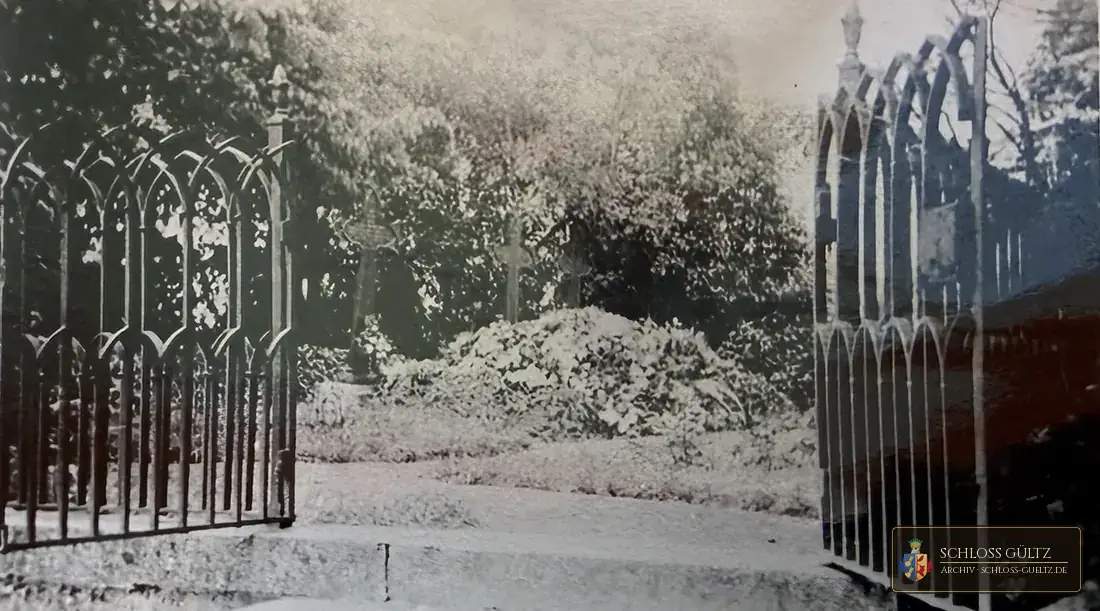

Two photographs from a family album in the Schloss Gültz archive, with their original captions. The album does not reveal whose mother is meant by “Mama”. The most likely candidate is Anna von Maltzahn née von Rohrscheidt († 1913), whose children may have compiled it; this is not documented.
Axel von Maltzahn in Gültz
On 26 October 1923 Axel moves into the manor with his family. He guides the estates through the years of inflation; as patron of the church he donates new bells. For his 60th birthday on 17 February 1928, the “stars of the Great Bear” come to Gültz in a short festive play. Axel dies on 3 March 1931 and is laid to rest in the family burial ground on 7 March in the presence of Crown Princess Cecilie. More in the archive →
Baptism in Gültz
On 10 February 1932 Axel Freiherr von Maltzahn of the House of Gültz is born – entered as No. 1 of the year 1932 in the baptismal register of the parish of Gültz–Hermannshöhe, with twelve godparents from the Pomeranian and Mecklenburg nobility. As the last child of the family to be born in Gültz, he kept up his connection to the house throughout his life (see “In Memoriam” above). He died on 6 September 2024 in Freudenstadt as an Honorary Knight of the Order of St John; in lieu of flowers, the family asked for donations to the church at Gültz.
Handover to the next generation
In 1938 Gültz and Hermannshöh with Marienhöhe pass by contract to Axel’s eldest son Helmuth (1900–1984); in 1940 the widow Helene exchanges homes with him and moves to Hermannshöh. She dies there in June 1942 and is laid to rest beside Axel in the Gültz family burial ground.
Arrest after 20 July
Helmuth von Maltzahn the Younger is arrested on the morning after the assassination attempt and held by the Gestapo in Greifswald until 17 September; the estates are placed under compulsory administration. More in the archive
Expropriation
The last lord of the manor, Helmuth Freiherr von Maltzahn (1900–1984), is expropriated without compensation in the course of the land reform; since February 1945 he has been a Soviet prisoner of war, not returning until 1948. His wife left Gültz on 23 April 1945. On 29 April neighbouring Altentreptow is spared thanks to white sheets hung from the church tower; on 30 April German troops blow up the bridges in Demmin; during the night of 1 May the Red Army enters Gültz, and the library and estate archive are burnt in the looting. After the war up to 48 refugee families are quartered in the manor house – a list from September 1948, later found during clearing work, records 41 households; from 1960 it serves as an agricultural vocational school – with the Mirror Hall as a gymnasium, a use it survived remarkably unscathed.
Gültz becomes a municipality in its own right
On 1 January 1951 Gültz is separated from the neighbouring municipality of Gnevkow and once again forms a municipality of its own. The station on the Neubrandenburg–Stralsund line, about one kilometre from the village, has not existed since the 1990s.
Renovation in GDR times
The BBS “Georg Ewald” – an agricultural vocational school with boarding facilities – undergoes a comprehensive renovation. The house had already been converted for school use from the 1960s onwards: connecting doors were bricked up to create classrooms, the attic was converted into rooms for apprentices, and central heating with a continuous chimney was installed. Around 1980 the façade receives a yellow and brown coat of paint for the first time; in the process the stucco elements above the windows disappear, and columns and sandstone are painted over.
School closed, house empty
In 1991 the vocational school closes. The house is used by the municipality for a while and from 1993 stands empty apart from occasional lettings. In 1999 the District of Demmin puts the property up for sale.
Hotel conversion – historic fabric destroyed
In 1999 Barbara and Manfred Lyssy from Lower Lusatia acquire the house; with the approval of the responsible monuments authority, Schloss Gültz is converted into a hotel with 20 rooms and a café. Historic interiors are irretrievably altered and the original room structure partly destroyed. The venture ends in bankruptcy. From this period date the as-built plans “Schloßhotel Gültz” by the architecture and planning office of Rosemarie Fürchner, dated October 2000 (lower ground floor, ground floor, upper floor, attic and section, scale 1:100). They record 24 rooms on the ground floor, among them the Mirror Hall, dining room, terrace room, entrance hall and café; the rooms there are around 4 metres high. All floor plans in the archive →
First compulsory auction
The manor is bought at a compulsory auction, but neither use nor repair follows. In the years that follow, further historic fittings are lost; the building stands empty and falls increasingly into decay.
Decay & vandalism
Some 70 windows are smashed. Water pours in unchecked and the plaster falls away. The former gem of Prussian architecture is in danger of being lost for ever.
The rescue – purchase at compulsory auction
In 2019 Michael Schneider – trained historian and lawyer, classic car restorer and free spirit – acquires Schloss Gültz at the second compulsory auction, initially together with speculators. In 2020 he takes the property entirely into his own hands. With his own funds and the firm resolve to save this unique gem from final ruin, he carefully begins the restoration.
The monument conservators on site
On 2 March 2023 the State Office for Culture and Monument Preservation, the lower monument protection authority and the building control authority inspect the manor house, poultry house and ice cellar together with the owner. In May the authority certifies that the poultry house – our hunting trophy house – is of “supra-regional significance” and welcomes its restoration.
A work in progress – not finished yet
Glamping by the manor pond, guided tours, the MittsommerRemise, the first events in the Mirror Hall – Schloss Gültz is coming back to life. The restoration continues, step by step. A friends’ association is being founded.
The rescue
What no one protected for decades was in danger of vanishing for ever. Between 2000 and 2004 Schloss Gültz was converted into a hotel – with the express approval of the monuments authority. Historic stucco ceilings were torn open, room layouts destroyed and the original furnishings irretrievably altered. When the hotel project ended in bankruptcy, there was no change of course – only the next chapter of failure.
In 2004 the manor changed hands at the first compulsory auction – but it was not preserved. Historic fittings disappeared and the building was left to decay. By 2019 some 70 windows had been smashed. Rain and frost got in unchecked. The monument was slowly dying.
Acquired in 2019 at the second compulsory auction – initially side by side with speculators. Then, in the middle of the coronavirus pandemic, came the decisive step: in 2020 Michael Schneider takes the house entirely into his own hands. And so the rescue began. With his own capital, without public funding, without compromising on faithfulness to the monument. Schloss Gültz lives.
The hunting trophy house
Officially, the little building is a registered individual listed monument under § 2 and § 5 of the Monument Protection Act of Mecklenburg-Vorpommern (Denkmalschutzgesetz M-V) – under the name “Geflügelstall” (poultry house). In May 2023 the lower monument protection authority wrote that the building is “an integral part of the estate complex, which once consisted of many buildings” and is distinguished “by its striking construction. As one of the few surviving buildings of the ‘poultry house’ type, it is of supra-regional significance.” Its preservation and use are therefore of particular interest to monument conservation; the project and its funding were expressly welcomed. We call it the hunting trophy house because the estate’s hunting trophies were displayed here – both names refer to the same building in the estate park, a few steps from the manor.
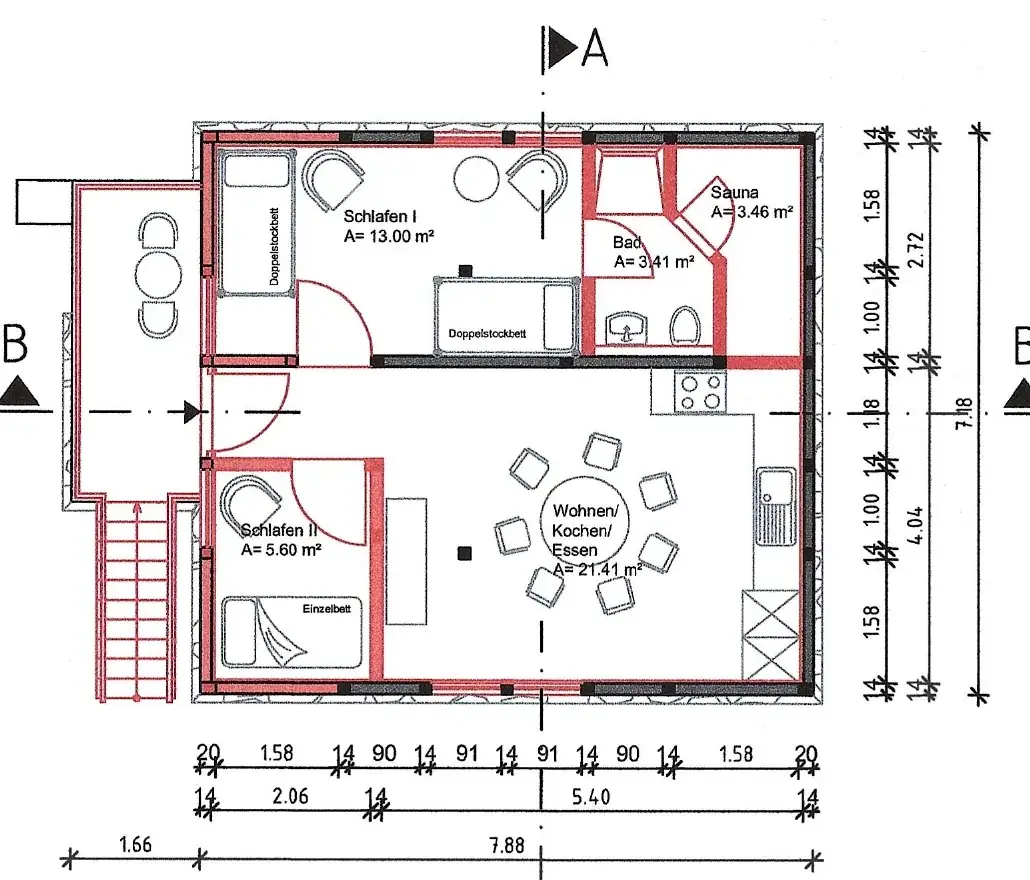
A few steps north of the manor stands the small hunting trophy house, built in 1872 – the same year as the manor itself – to display the estate’s hunting trophies: a timber-framed building on a mighty base of glacial boulders, its panels filled with brick laid in meander patterns, with sawn decorative boarding beneath the gable. The rear has collapsed and the roof is secured only with tarpaulins. In 2023 the little house was very nearly saved once before: our plan to convert it into a “Fahrradschloss” (cycle castle) – holiday accommodation for touring cyclists – won an award in the funding programme of the association Schlösser und Gärten in Deutschland; however, the funds were tied to LEADER co-financing, which was refused, and so could not be drawn down. The 2023 design plans are complete: upstairs in the timber-framed storey a holiday flat with two bedrooms, a kitchen-living room, bathroom and small sauna; in the fieldstone base a wine cellar; and photovoltaics on the south side of the roof for the heating. For 2026/2027, emergency stabilisation and roof repairs are now planned using our own resources – first the roof, then the timber frame and infill panels. The photographs show the condition before work began.


This is how the monument conservators photographed the building in 1995 and 2001. At that time it was still intact – with complete timber framing, bricked infill panels and an undamaged roof. The comparison shows how much has been lost since then, and at the same time it provides the best model for the restoration.
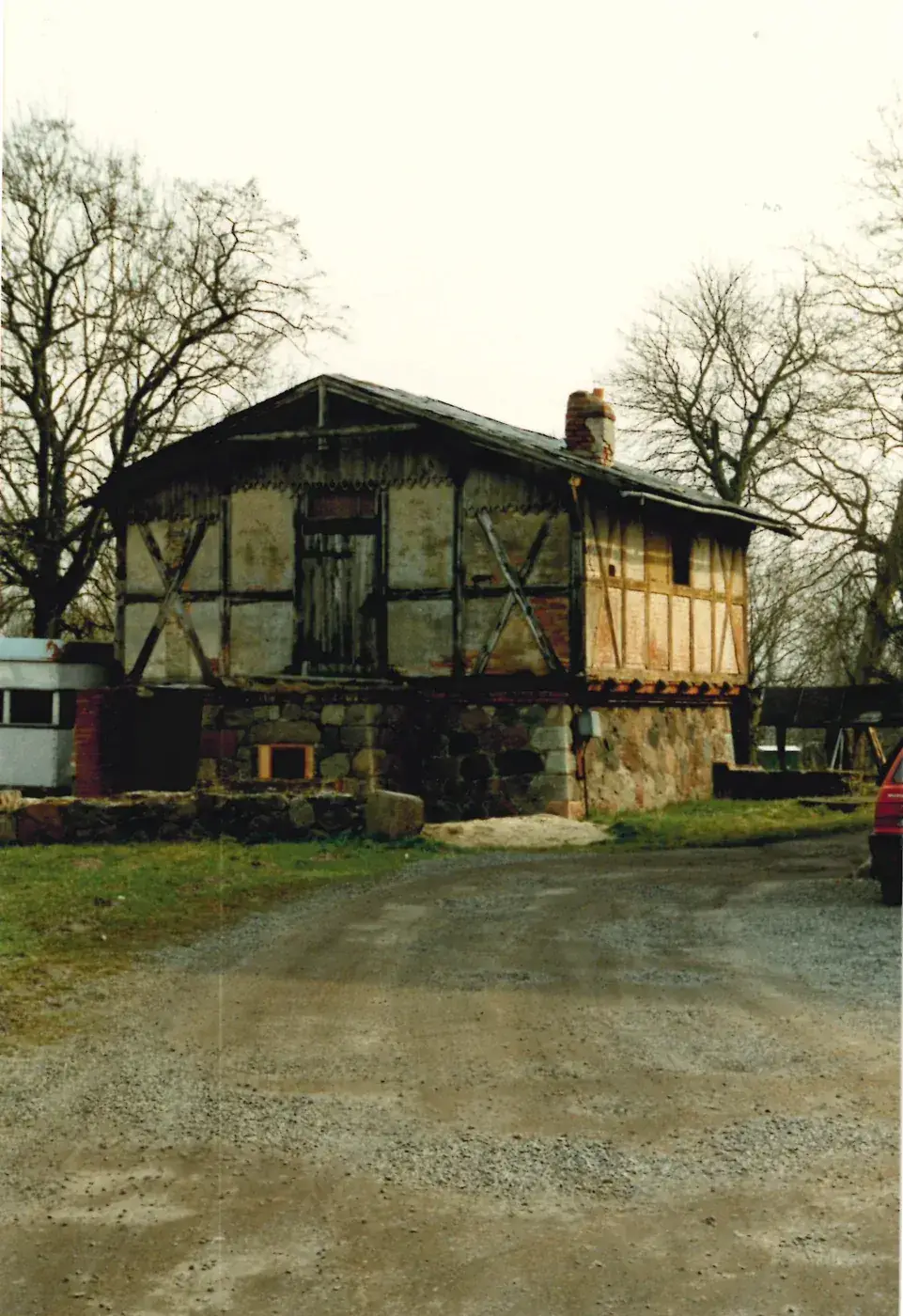
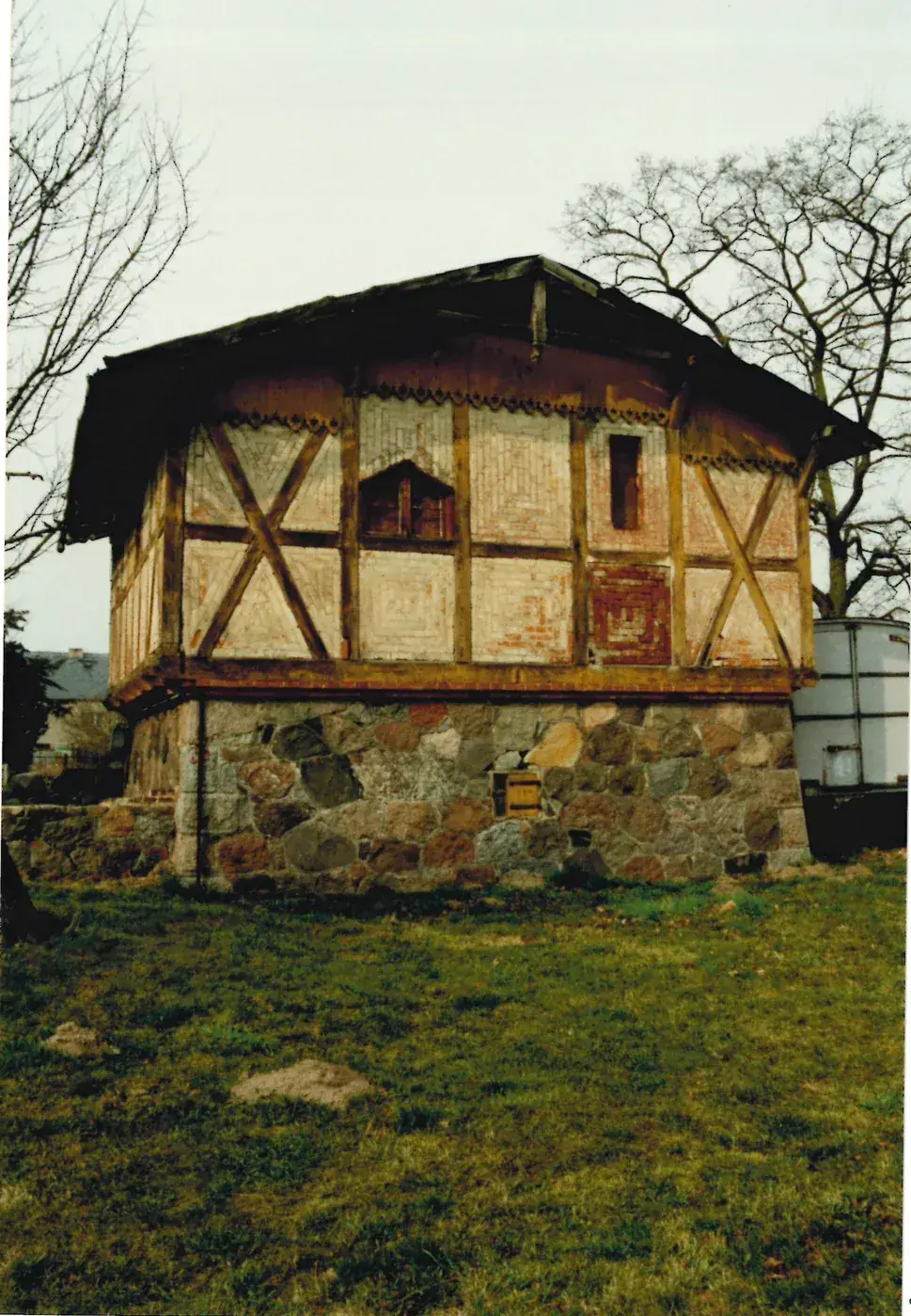

Photos: Landesamt für Kultur und Denkmalpflege Mecklenburg-Vorpommern, monument inventory (District of Altentreptow, film 3880, March 1995; District of Demmin, film 8379, 28 August 2001). Letter from the lower monument protection authority of the District of Mecklenburgische Seenplatte dated 8 May 2023, ref. 1532/2023-118.

Sources & literature
Archival material & primary sources
- • Peter Joseph Lenné: Verschönerungsplan für Gültz, SPSG Berlin-Brandenburg, Planslg. 3483 (1840)
- • Königlich Preußische Landesaufnahme: Messtischblatt 2245 Gültz, 1:25,000 (1886)
- • Landeshauptarchiv Schwerin: Gutsarchiv Gültz, holdings 2.22-10; Verkauf der strittigen Güter, auch Gültze, durch Otto von Maltzahn an Behrend von Maltzahn, 1496, LHAS 9.1-1 No. 200
- • Bundesarchiv Berlin: Personalakten Helmuth von Maltzahn, R 1501
- • Geheimes Staatsarchiv Preußischer Kulturbesitz: BPH, Rep. 53 Kaiser Wilhelm II., Nr. 238 (notes on Wilhelm II’s crossing into Holland, incl. Frhr. von Maltzahn-Gültz, 1922) and X. HA, Rep. 9 Johanniterorden, Maltzahn pedigree boards
- • Letter from Helmuth Frhr. von Maltzahn-Gültz to Otto Fürst von Bismarck, Berlin, 14 August 1890 (autograph, 4 pages), Bismarck-Archiv Friedrichsruh, fols. 141–144
- • Karlsbad spa visitors’ list no. 10 of 13 April 1897, no. 651; Hygiea no. 8 (1897), p. 6; Linzer Tages-Post of 16 September 1888; Linzer Volksblatt of 8 September 1910; Sport & Salon, January 1905 (Chapter of the Order of St John in Berlin) (ANNO, Austrian National Library)
- • Historical picture postcards of Gültz (1902, c. 1910, 1911, publisher Arnhold, Heringsdorf): Michael Schneider collection; further cards from 1904 (manor house and forester’s lodge), 1905 (park side) and Schossow 1927 (Freda v. Maltzahn); watercolour of the pond side, artist unknown
- • Helmuth Frhr. von Maltzahn-Gültz: Erinnerungen 1893–1900 mit Rückblicken auf frühere und Ausblicken auf spätere Jahre, written down in 1916, typescript (unpublished)
- • Unpublished family chronicle Gültz – Aus dem Leben meiner Vorfahren. Entwicklungen, Begebenheiten, Erlebnisse, Ernstes und Heiteres (private collection), including floor plans and interior photographs pp. 95–101, chapter on 1944/45 from p. 102; together with the notes Die letzte Zeit in Gültz 1944/45 und die erste Zeit in Ellerbruch by a son of the last lord of the manor
- • Protestant parish of Gültz–Hermannshöhe: Taufregister (baptismal register), year 1932, no. 1 (extract)
- • Picture postcard “Gültz i. Pomm. – Forsthaus”, undated; photograph of the courtyard side in winter, GDR period (framed print, private collection); wood engraving “Portraits from the German Reichstag: 30. Helmut Frhr. v. Maltzahn-Gültz” from an illustrated magazine
- • Picture postcard “Gültz i/Pomm.” showing the manor house as well as the inn and smithy of E. Messinger, undated (interwar period)
- • Von Maltzahn family archive: carte de visite from the studio of Heinr. Graf, Berlin (Helmuth and Anna von Maltzahn); illustration “Old Gültz House” from the unpublished family chronicle (private collection)
Academic literature
- • Alexander Duncker: Die ländlichen Wohnsitze, Schlösser und Residenzen der ritterschaftlichen Grundbesitzer in der preußischen Monarchie, vol. XIII, sheet 763: Gültz, Berlin 1873
- • Helmuth Frhr. von Maltzahn(-Schossow): Helmuth Freiherr von Maltzahn-Gültz 1840–1923, in: Pommersche Lebensbilder, ed. by the Historische Kommission für Pommern, vol. II, Stettin 1936, pp. 266–280
- • Berthold Schmidt: Geschichte des Geschlechts von Maltzan und von Maltzahn, 4 vols., Schleiz 1907–1925 – therein “Das Haus Gültz”, pp. 93–108
- • Frank Wilhelm: Befreiung und Zusammenbruch, in: Heimat Kurier (Nordkurier), special supplement marking the 75th anniversary of the end of the war, 5 May 2020
- • Wikipedia, article “Gültz” (accessed 12 October 2026): separation from Gnevkow in 1951, railway station, tomb slab of Landmarschall Achim von Moltzahn of Osten († 1565) in the family burial ground
- • Martin Stolzenau: Helmuth Freiherr von Maltzahn. Vor 100 Jahren gestorben – Umsichtiger Politiker und Gründer der Historischen Kommission Pommerns, in: Preußische Allgemeine Zeitung, 19 February 2023 (note: the “last owner Helene Luise” named there is not correct for 1945 – she died in 1942; however, she is still listed as owner in the estate directory of 1939)
- • Sabine Bock: Peter Joseph Lenné und das pommersche Tollensetal – Ein Frühwerk der preußischen Landesverschönerung, in: Pommern – Zeitschrift für Kultur und Geschichte, vol. 64, issue 2/2025, pp. 18–23
- • Erich Marcks, Karl Alexander von Müller (eds.): Erinnerungen an Bismarck. Aufzeichnungen von Mitarbeitern und Freunden des Fürsten, Stuttgart/Berlin 1915 – therein Helmuth Frhr. von Maltzahn, pp. 89–118
- • Lutz Mecke, Norman Kühn: Gültz – Schlosspark. Bestandserfassung – Entwurf – Erhaltung, master’s thesis, Hochschule Neubrandenburg, 2011
- • Hochschule Wismar, Faculty of Design: Ländliche Gestaltungsräume – Strategien für den Bestand, module PM 09 Refurbishment and Monument Conservation, dossier “Gültzer Schloss – Gültz / Analyse und Information”, summer semester 2024 (unpublished)
- • Helmuth Frhr. von Maltzahn (1900–1984): Lebenslauf Axel Frhr. von Maltzahns (1868–1931), typescript, 7 pp. (private collection, copy in the Schloss Gültz archive)
- • “Aus den Erinnerungen des H. v. Maltzahn, Gültz”, instalment in the “Heimatgeschichtliches” (local history) column of a regional newspaper, c. 1990 (extracts from the 1916 memoirs, photo: Kurt Krüger)
- • Christina Weinreich: Bronze-Glocke erklingt wieder, in: Nordkurier, c. 2004
- • Lars Franke: Mit einem Spiegelsaal und zwei Salons – Schloss Gültz bei Altentreptow, series “Zu Gast im Schloss”, in: Nordkurier, 28/29 July 2001 (with quotations from Helmuth von Maltzahn’s memoirs)
- • Hubertus Neuschäffer: Vorpommerns Schlösser und Herrenhäuser, Husum 1993
- • Hugo Lemcke (ed.): Die Bau- und Kunstdenkmäler des Regierungsbezirks Stettin, issue I: Der Kreis Demmin, Stettin 1898, pp. 23–25 (Gültz church, fig. 17 pulpit), pp. 14 and 85 (tomb slab of Achim Moltzan, fig. 12), pp. 40, 45, 78 (Prützen, Seltz, Wodarg)
- • Hans-Heinz Schütt: Auf historischen Spuren – Herrenhäuser in Mecklenburg-Vorpommern, Schwerin 2001
Reference works & genealogy
- • Gothaisches Genealogisches Taschenbuch der Freiherrlichen Häuser, Gotha 1848–1942
- • Deutsches Geschlechterbuch, vol. 58: Mecklenburgisches Geschlechterbuch, 1928
- • Nikolai Scheuring: Liste der Ehrenritter des Johanniterordens 1853–1918, as of July 2021 (Helmuth Frhr. v. Maltzahn of Gültz 1875; Axel Frhr. v. Maltzahn 20 February 1899; August v. Gadow of Drechow 16 February 1914; Servatius v. Gerlach of Rohrbeck 25 February 1918)
- • Universitätsarchiv Greifswald (Ariadne archive portal): Jur. Fak. 154 (honorary doctorate of Helmut Frhr. v. Maltzahn, 18 Jan. 1901); Jur. Fak. 325 (“Dr. Freiherr von Maltzahn (Gültz/Abschiedsfeier)”); Theol. Fak. I-85 (proceedings on honorary doctorates 1900/01: Maltzahn et al.); Theol. Fak. I-110 (honorary doctorates with letters of thanks 1920/21, including Helmut Frhr. v. Maltzahn of Gültz)
- • Adolf Diestelkamp: Die Historische Kommission für Pommern, in: Zeitschrift für Ostforschung (Mitteilungen); Nils Jörn / Haik Thomas Porada (eds.): Die Historische Kommission für Pommern 1911–2011, Cologne 2013
- • Dreizehn Moltzansche Geschlechts-Tafeln, Neubrandenburg 1841 (Evers), table 10: younger Pomeranian line of Osten, Sarow, Kummerow and Wolde, including Axel Albrecht v. Moltzan “appears 1720, 1729” and the brothers Bogislaff Helmuth and Dietrich Christof (1740)
- • Joh. Friedr. Pries: Die Baumeister Mecklenburgs und ihre Werke, in: Mecklenburg. Zeitschrift des Heimatbundes Mecklenburg 19 (1924), no. 1, pp. 1–20 (appraisal of Georg Daniel pp. 17 f.)
- • Georg Daniel (1829–1913): Wikipedia, article “Georg Daniel”; architects’ biographies with catalogue of works (glass-portal.hier-im-netz.de)
- • Ernst Heinrich Kneschke: Neues allgemeines deutsches Adels-Lexicon, vol. 6, Leipzig 1865
- • Leopold Freiherr von Ledebur: Adelslexicon der Preußischen Monarchie, Berlin 1855
- • P. Ellerholz: Handbuch des Grundbesitzes im Deutschen Reiche, I. Preußen, II. Lieferung: Provinz Pommern, 2nd ed., Berlin 1884, pp. 114–123 (Demmin district)
- • C. Leuchs: Adressbuch aller Länder der Erde, vol. 12: Pommern, 7th ed. 1885–1888, Nuremberg, pp. 59 f.
- • Pommersches Güter-Adressbuch, Stettin: Friedrich Nagel (Paul Niekammer) 1892, pp. 17–25 (Demmin district); Niekammers Güter-Adressbuch Pommern, 8th ed. 1928 and subsequent edition (probably 1939)
- • A. Phillips: Die Reichstags-Wahlen von 1867 bis 1883, Berlin 1883, p. 29 (Demmin-Anklam constituency) and list of members
Official documents
- • Landesamt für Kultur und Denkmalpflege M-V: Denkmalliste Landkreis Mecklenburgische Seenplatte, Schwerin 2023
- • Landkreis Mecklenburgische Seenplatte: Anhörung zur Unterschutzstellung des Schlossparks Gültz, ref. 310/21, 25 March 2021
- • Denkmalpflegerische Zielstellung für Schloss Gültz, drawn up by the owners at the time, annex 2 to the plans of the architecture and planning office R. Furchner, Peitz (c. 2000)
- • Landesamt für Kultur und Denkmalpflege M-V: Denkmalinventar, Fotodokumentation Gültz, Geflügelstall (Gut), film 3880 (March 1995) and film 8379 (28 August 2001)
- • Landkreis Mecklenburgische Seenplatte, lower monument protection authority: Aktenvermerk Ortstermin Gutsanlage Gültz (Gutshaus, Geflügelstall, Eiskeller), 2 March 2023; letter on the restoration of the poultry house, ref. 1532/2023-118, 8 May 2023
- • Liegenschaftskataster Mecklenburg-Vorpommern: land parcel record, cadastral district of Gültz, Flur 14 (manor house grounds)
Historical cartography
- • Königl. Preuß. Landesaufnahme: Messtischblatt 2245 Gültz, first edition, surveyed by First Lieutenant La Baume (1886)
- • Leibniz-Institut für Länderkunde: Blatt 856 Gültz, second edition (1898)
- • McMaster University Library, Canada: Blatt 2245 Gültz, wartime edition (1941)
- • UC Berkeley Library, USA: Blatt 2245 Gültz, final edition (1944)
- • Deutsche Digitale Bibliothek / University of Greifswald: digitised Messtischblätter (ordnance survey maps)
- • MAPSTER / igrek.amzp.pl (Poland): topographic maps of eastern Germany
Historical aerial photographs
- • Herder-Institut Marburg: Schrägluftbild-Sammlung (oblique aerial photograph collection), Hansa-Luftbild (1920s–1940s)
- • Geoportal MV: Digitale Orthophotos 1953, 1991, 2023
Online resources
- • gutshaeuser.de – documentation of the manor houses of Mecklenburg-Vorpommern
- • baltic-manors.eu – network of Baltic manor houses (MittsommerRemise)
- • spsg.de – Stiftung Preußische Schlösser und Gärten Berlin-Brandenburg (Lenné archive)
Note: This account is based on historical sources and academic literature. For additions or corrections, please contact us.