
Estate directories are dry works of reference: tables of hectares, marks and head counts, intended for authorities, traders and farmers. That is precisely why they are so valuable for the history of an estate. They record the same things at regular intervals – and so show what changed and what did not. For Gültz we now have four volumes: 1884, 1892, 1928 and 1939, plus a trade directory from 1885/88. We have already analysed the 1928 edition in our post on the railway and agriculture; here we add the others.
1884: 1,099 hectares, farmed by the owner
The Handbuch des Grundbesitzes im Deutschen Reiche by P. Ellerholz, Pomerania volume, second edition (Berlin 1884), lists for each estate the areas by type of land use, the net land-tax yield, owner, tenant, transport links and ancillary businesses. For Gültz it records:
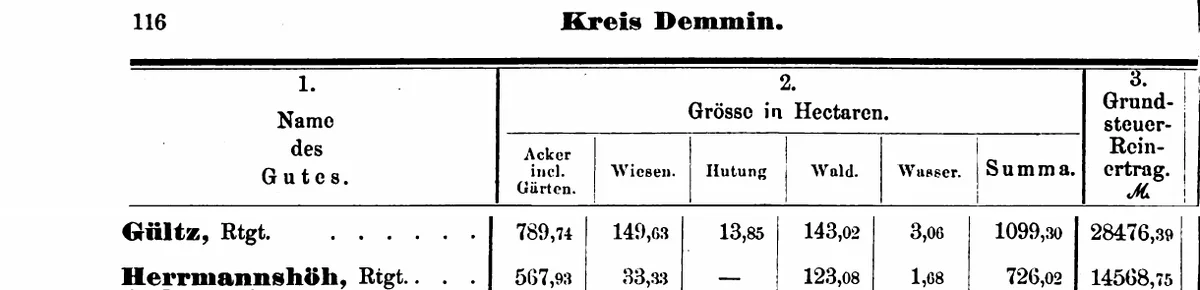
| Knight’s estate of Gültz, 1884 | Hectares |
|---|---|
| Arable land including gardens | 789,74 |
| Meadows | 149,63 |
| Rough grazing | 13,85 |
| Woodland | 143,02 |
| Water | 3,06 |
| Total | 1.099,30 |
| Net land-tax yield | 28,476.39 marks |
The owner entered is “Hellmuth Baron v. Maltzahn”; no tenant or administrator is listed: the man who built the manor farmed the estate himself. Post office, telegraph and railway station were in the village (“Gültz P.T.E.”), and the description of the district states: “The railway stations in the district are: Treptow a. T., Gültz, Sternfeld, Demmin.”
Gültz was not the only estate owned by the man who built the manor. The same volume lists four further estates in the district of Demmin under his name:
| Estate (1884) | Area | Net yield | Note in the handbook |
|---|---|---|---|
| Gültz | 1,099.30 ha | 28.476,39 M | – |
| Herrmannshöh | 726.02 ha | 14.568,75 M | “Particularly fine cattle” |
| Schossow | 579.01 ha | 13.577,82 M | “Truly excellent cattle breeding, Dutch breed” |
| Werder | 729.89 ha | 19.298,49 M | Brickworks |
| Wodarg | 1,123.85 ha | 19.639,56 M | Water mill |
| in total | 4,258.07 ha | 95.561,01 M |
1885/88: Gültz as a postal station
The trade directory by C. Leuchs (volume 12: Pomerania, 1885–1888 edition) gives for each estate only the owner and the nearest postal station. Under “Further estate owners in the district of Demmin” it simply states: “Gültz: Hellmuth v. Maltzahn.” Something else is more revealing. Besides Herrmannshöh and Schossow, the neighbouring estates of Barkow, Seltz and Tützpatz also carry the addition “(Gültz)” – their post came via Gültz. With its railway station, post office and telegraph, the village had been the transport hub of the area since 1877.
1892: the sheep estate
The Pommersche Güter-Adressbuch of 1892, edited by Paul Niekammer and published by Friedrich Nagel in Stettin, is the first edition of the series to which the 1928 and 1939 volumes also belong. It is the first to list livestock numbers.

| Estate (1892) | Area | Horses | Cattle (cows) | Sheep | Facilities |
|---|---|---|---|---|---|
| Gültz | 1,100 ha | 51 | 140 (109) | 1.600 | – |
| Herrmannshöhe | 726 ha | 44 | 117 (100) | 1.300 | – |
| Schossow | 579 ha | 37 | 78 (56) | 850 | – |
| Werder | 730 ha | 38 | 116 (90) | 700 | Brickworks |
| Wodarg | 1,123 ha | 48 | 126 (80) | 1.100 | Water mill |
| in total | 4,258 ha | 218 | 577 (435) | 5.550 |
The owner of all five estates is “von Maltzahn, Helmuth, Freiherr”, with the addition “auf Gültz” for the neighbouring estates; the competent local court is Treptow an der Tollense. Areas and net yield match the 1884 figures to the mark. Both volumes draw on the same official land-tax assessment and thus confirm one another. The pigs are listed in a column at the edge of the page, which is cut off in the digitised copy for Gültz and Herrmannshöhe.
1928 and 1939: the modern farm
In 1928 Axel von Maltzahn was the owner and his son Helmuth the manager at Gültz; the figures are given in our post on the railway and agriculture. In the following edition – judging by its contents, that of 1939 – Axel’s widow Helene, née von Platen, is entered as owner, her son Helmuth as general agent, together with a manager. Gültz now has a telephone line (“Treptow/Toll. 209”), and the directory records horse breeding, herd-book cattle, seed multiplication of cereals, clover and grass seed, three Lanz Bulldog tractors, three PTO-driven binders and a field railway. Hermannshöh with Marienhöhe covers 852 hectares.
Gültz over time
| Gültz estate | 1884 | 1892 | 1928 | 1939 |
|---|---|---|---|---|
| Area | 1,099.30 ha | 1,100 ha | 1,099 ha | 1,103 ha |
| Horses | – | 51 | 96 | 82 |
| Cattle (cows) | – | 140 (109) | 141 | 186 (83) |
| Sheep | – | 1.600 | 953 | 970 |
| Pigs | – | illegible | 236 | 250 |
| Management | Owner himself | Owner himself | Son as manager | General agent and manager |
Three things stand out. First, Gültz remained practically the same size for more than fifty years, around 1,100 hectares: it was neither divided nor significantly enlarged. Second, the farm changed in character. In 1892 Gültz was a sheep estate with 1,600 animals; by 1928 the flock had fallen to under a thousand, while pig keeping grew and the number of horses almost doubled. Third, mechanisation arrived: in 1939 there were three tractors on the farm alongside 82 horses.
Open questions
- In 1884 and 1892 Wodarg has around 1,123 hectares; in 1928, as “Wodarg mit Kessiner Wassermühle”, only 929 hectares. Whether land was given up or the estate was reshaped in the meantime, we do not know.
- We infer the year of publication of the latest volume from its contents (the owner is the widow of Axel, who died in 1931). We do not yet have the title page.
- We are still missing the 1914 edition. It would show the period when the builder of the manor was Oberpräsident (Governor) of the Province of Pomerania in Stettin.
Sources: P. Ellerholz, Handbuch des Grundbesitzes im Deutschen Reiche, I. Preußen, II. Lieferung: Provinz Pommern, 2nd ed., Berlin: Nicolai 1884, pp. 114–123 (copy Bayerische Staatsbibliothek); C. Leuchs, Adressbuch aller Länder der Erde der Kaufleute, Fabrikanten, Gewerbtreibenden, Gutsbesitzer, vol. 12: Pommern, 7th ed. 1885–1888, Nuremberg, pp. 59 f.; Pommersches Güter-Adressbuch, Stettin: Friedrich Nagel (Paul Niekammer) 1892, pp. 17–25 (copy library of the Deutsches Museum); Niekammers Güter-Adressbuch Pommern, 8th ed. 1928 and subsequent edition (probably 1939), district of Demmin, entry Gültz. Digitised copies from Google Books and Pomorska Biblioteka Cyfrowa, public domain; figures checked by Schloss Gültz against the scans, totals recalculated.