
Anyone travelling today on the regional express between Neubrandenburg and Demmin rolls past Gültz – without stopping. A hundred and fifty years ago things were different. The village owed its own railway station to the builder of the manor. And in other respects too, over three generations the Freiherren von Maltzahn-Gültz held positions where decisions were made about railways, ports and agriculture in Western Pomerania. We have gathered together what can be documented – and say just as clearly what cannot.
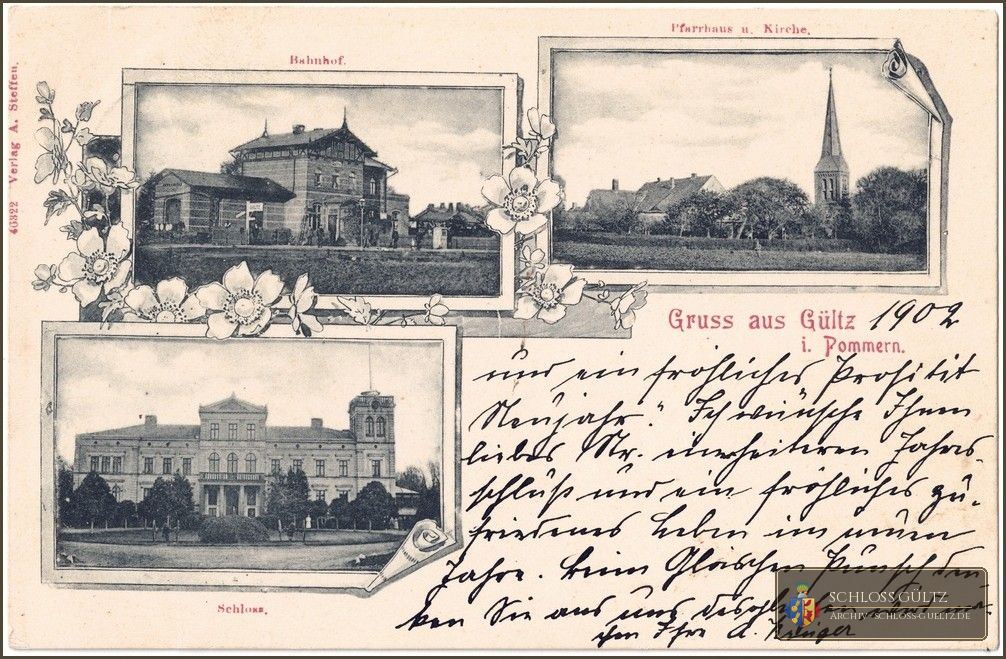
1877: How Gültz Got Its Railway Station
The railway from Berlin via Neustrelitz and Neubrandenburg to Stralsund – the Berliner Nordbahn (Berlin Northern Railway) – was the brainchild of Stralsund merchants. As early as 1844 they had joined forces to campaign for the line; for decades the Prussian ministry refused. Only in 1870 did Prussia and Mecklenburg-Strelitz grant the concession to a newly founded Berliner Nord-Eisenbahn-Gesellschaft. The route did not run via the small country town of Loitz, although the ground there would have been more favourable, but via the garrison town of Demmin – and therefore via Treptow an der Tollense, past Gültz.
Helmuth von Maltzahn (1840–1923), member of the Reichstag for Anklam-Demmin since 1871, subscribed for shares in the company – on one condition: Gültz was to receive a full railway station. This is how he recorded it in 1916 in his never-published memoirs. The company was caught up in the maelstrom of the Gründerzeit boom. In early 1873 the liberal deputy Eduard Lasker denounced the Nordbahn in the Prussian House of Representatives as a prime example of dubious concession awards; its main backers sat in the House of Lords, where Prince Putbus made public statements about his relationship with the Nordbahn. In 1874/75 the company was dissolved, and the Prussian state took over the half-finished line and completed it. Maltzahn’s money was largely lost. But the station came – and with it the long-sought metalled road. His verdict:
“… the best investment I ever made.”
On 1 December 1877 the Neubrandenburg–Demmin section was opened, and on 1 January 1878 the line through to Stralsund. Gültz station lay a good one and a half kilometres north-east of the village, at kilometre 157.4 of the Nordbahn. The family chronicle tells how convenient the connection was: after Maltzahn became State Secretary of the Imperial Treasury in 1888, a telephone call to Berlin was enough for the express train to make a special stop at Gültz (more on this in the family milestones).
A Family Office at the Decisive Moment
From 1867/68 the Landrat (district administrator) of the Demmin district was Wilhelm von Heyden (1839–1920) of Cadow – Maltzahn’s stepbrother and almost his exact contemporary: Helmuth’s mother had married Heyden’s father, the Demmin Landrat Hermann von Heyden, as her second husband in 1849. In November 1877 Heyden moved to Stettin as Landesdirektor, at the head of the Pomeranian provincial administration. For the interim period the district’s list of Landräte records a “district deputy Freiherr von Maltzahn of Gültz”, who ran the district office on an acting basis until the new Landrat, Wilhelm von Müffling, took over on 14 November 1877. In all likelihood this was the lord of the manor himself. For a few days, then, the district administration lay in his hands – a good two weeks before the first train passed through Gültz. It is no more than a pleasing coincidence, however: by 1877 nobody in the district office was deciding anything about the construction of the state railway.
1897 and 1913: The Light Railway Reaches the Estates
Following the Prussian Light Railways Act of 1892, the villages and estates away from the main line also wanted to be connected to the rails. On 14 March 1895 the Demminer Kleinbahnen AG (Demmin Light Railways company) was founded; construction and operation were taken on by the Stettin firm Lenz & Co. Of the initial share capital of 1,532,000 marks, the Demmin district held 39.2 per cent, the Provincial Association of Pomerania 27 per cent and Lenz & Co. the remainder. The gauge was narrow – 750 millimetres – partly because the province only granted a construction subsidy for that gauge.
The line was deliberately built where the large estates lay. On 23 January 1897 the first train ran from Demmin via Schmarsow to Jarmen, and from 5 June 1897 passenger trains also ran on the second branch as far as Treptow an der Tollense. On this branch lay two Maltzahn estates with their own station: Wodarg, which Helmuth von Maltzahn had acquired in 1881 and which was later farmed by his youngest son Gerhard, and Werder, where, according to the estate directory, the light-railway station stood just a hundred metres from the farmyard. Shortly before Treptow the railway crossed the Tollense on a 220-metre steel viaduct – the longest bridge structure on any of the Pomeranian light railways.
In 1913 came the Demmin West Railway, prompted above all by the Stavenhagen sugar factory, which wanted to bring in more beet from a wider area. Its branch from Metschow to Altentreptow stopped at Schossow – here, too, about a hundred metres from the estate, which from 1919 was farmed by Helmuth von Maltzahn the Younger. Gültz itself needed no light railway: it had had its station on the main line since 1877.
Whether the builder of the manor had a hand in the founding in 1895, we do not know. After resigning as State Secretary he lived in Gültz again from 1893 to 1899 and had known the Demmin district assembly since the 1870s; however, no evidence of a role in the light railway has yet been found. After the Second World War the Soviet occupying power had the entire narrow-gauge network dismantled in May 1945 and removed as reparations. What remains are embankments, a few bridges and the station buildings in Demmin and Schmarsow.
1900–1911: Father and son in office
As Oberpräsident (Governor) of the Province of Pomerania (1900–1911), Helmuth von Maltzahn was the highest state official in the province. His biographer expressly counts railway construction throughout the province among the fields that benefited from “the knowledge and energy of this man” – alongside trade, shipping companies and coastal protection. His term of office saw the founding of the light-railway department of the provincial association on 1 April 1910, which from then on operated almost all the Pomeranian light railways, including those of Demmin. Personally, he championed a line on the coast: according to the biographical portrait his son wrote in 1936, he succeeded “after years of effort” in pushing through a rail link to the Zingst and the Darß, in order to save the population there from economic ruin and emigration. The Darß railway from Barth via Zingst to Prerow opened on 1 December 1910 – a few months before his retirement. The railways were built, however, not by the Oberpräsident but by the self-governing districts and province; he exercised state supervision. For Gültz, Stettin was the centre in any case: the district of Demmin belonged to the administrative region of Stettin, and the regional government and the Oberpräsidium sat in the same city – and now a landowner from their own district resided in Stettin Castle. The neighbouring district of Grimmen, by contrast, belonged to the administrative region of Stralsund until 1932.
At the same time his eldest son Axel von Maltzahn (1868–1931) was Landrat (district administrator) of the district of Grimmen – on an acting basis from 3 January 1900, permanently from 24 September 1901. His term of office saw the construction of the harbour at Stahlbrode on the Strelasund and the railway to Loitz. Loitz had sought a rail connection in vain since the 1840s; only after the turn of the century, with money from the district of Grimmen, the province, the town and the Loitz starch factory, was it possible to build a branch line from the Northern Railway station Toitz-Rustow to the harbour on the Peene. It opened on 8 September 1906. As Landrat, Axel chaired the district assembly and the district committee, through which the district’s share in the railway also passed.
His years in Grimmen also had a political side, which made headlines across Germany at the time. In the files of the Prussian Ministry of the Interior, his swift permanent appointment in 1901 is expressly justified by the forthcoming Reichstag election in the Greifswald-Grimmen constituency; the Landrat was regarded at that time as the government’s electoral agent. In 1910/11 a trial took place before the Greifswald Regional Court with the liberal landowner Arthur Becker of Bartmannshagen, who accused the Landrat of discriminating against the Liberals and the labour movement. Becker was convicted of insulting a public official; in the proceedings, however, matters came to light that occupied the Reichstag and the Prussian House of Representatives – such as pressure on innkeepers in whose halls the Liberals had met. Axel von Maltzahn left the office of Landrat in 1911 – according to the literature, as a result of the trial – and in 1912 went to the Oberpräsidium in Magdeburg as a Regierungsrat (government councillor). We tell this because it belongs to an honest picture – and because it shows how closely administration and politics were intertwined in the countryside at the time.
What was kept on the estates: horses, sheep, cattle
How large the family’s farming was is shown by a sober reference work: Niekammer’s Landwirtschaftliches Güter-Adreßbuch der Provinz Pommern of 1928, which records the area and livestock of every estate. At that time five estates in the district of Demmin belonged to the family:

| Estate | Owner in 1928 | Area | Horses | Cattle | Sheep | Pigs |
|---|---|---|---|---|---|---|
| Gültz | Axel | 1,099 ha | 96 | 141 | 953 | 236 |
| Hermannshöh with Marienhöhe | Axel | 849 ha | 83 | 161 | 844 | 350 |
| Wodarg with Kessin water mill | Gerhard | 929 ha | 90 (incl. 25 foals) | 225 | 600 | 50 |
| Werder | Gerhard | 752 ha | 80 (incl. 26 foals) | 212 | 450 | 120 |
| Schossow | Helmuth the Younger | 582 ha | 67 | 136 | 664 | 200 |
| total | 4,211 ha | 416 | 875 | 3.511 | 956 |
More than 400 horses and some 3,500 sheep – these were large numbers, even compared with the neighbouring estates. The horses were above all working animals: in 1928 ploughing, harrowing and hauling were still mostly done with teams. The fact that Wodarg and Werder together had 51 foals, however, shows that Gerhard von Maltzahn also engaged in horse breeding there. The flocks of sheep of Gültz and Hermannshöh, together almost 1,800 animals, were among the larger ones in the area; wool and mutton had been an important mainstay on the light soils of Western Pomerania for generations. The directory also listed Werder as a seed farm with potato breeding – the new variety “Werdersche Frühe” was developed there – and Schossow as a breeding farm for black-pied lowland cattle in the Pomeranian herd book. The figures are a snapshot from 1928. What things looked like in 1884, 1892 and 1939 is shown in the article Gültz in figures; we are still missing the 1914 edition.
And the sugar factories?
Beet sugar had been big business in Western Pomerania since the 1880s, and the railways served it directly. The Demmin sugar factory was founded in 1883 as a joint-stock company by Demmin merchants and began work in October 1884; in the same year, 1883, the Pomeranian sugar factory was established in Anklam. The Jarmen sugar factory had its own siding on the Demmin East Railway, and the factory in Stavenhagen was the driving force behind the West Railway. Typical of such factories were shares that obliged their holders to grow and deliver sugar beet – large landowners in the area were therefore often shareholders at the same time.
Whether the Maltzahns of Gültz also held beet shares or sat on a supervisory board, we have so far not been able to establish. The 1928 estate directory mentions no sugar-beet contract for their estates, and the name does not appear in the company records accessible so far. The best lead is the archive of the Demmin sugar factory, which has since returned to Demmin and is likely to contain share registers from the period up to 1964.
There is nevertheless a connection to sugar, at national level. As State Secretary of the Imperial Treasury, Helmuth von Maltzahn pushed through the reform of the sugar tax at the beginning of the 1890s (Act of 1891). Until then the beet had been taxed; in future the tax was to be borne by the sugar sold in Germany. This earned him a reputation among some farmers as an enemy of agriculture, especially in the Province of Saxony, the main growing area. His son countered in 1936 that the reform had proved beneficial: “In the coastal provinces one sugar factory after another was founded, and beet growing and grain yields increased.” The builder of Gültz thus shaped the sugar industry of Western Pomerania as a legislator rather than as a shareholder.
Hunting
With more than a thousand hectares and 154 hectares of its own woodland, Gültz was a private hunting district: under Prussian law, every owner of a contiguous area of 300 Morgen (under the hunting regulations of 1907: 75 hectares) was entitled to hunt on it himself. The owners of smaller plots, by contrast, formed a communal hunting district – the forerunner of today’s hunting cooperative. The lords of Gültz therefore hunted on their own land. Axel von Maltzahn was known as a passionate hunter, and as early as the time the manor was built, the hunting trophy house was erected in the park – the building we want to save today.
Networks: Corps Vandalia and the Order of St John
How such paths were smoothed can be seen in two associations the family cultivated over generations.
The Corps Vandalia in Heidelberg, founded in 1842, wore red and gold and was regarded as an exclusive fraternity chiefly of the Mecklenburg nobility and the upper bourgeoisie of Lübeck and Hamburg. In 1882 it moved into the oldest building in Germany purpose-built as a fraternity house. Helmuth von Maltzahn became an active member there and was already Senior at the age of 18; in 1858 his stepbrother Wilhelm von Heyden joined – the same man who later became Landrat in Demmin, Landesdirektor in Stettin and, from 1890 to 1894, Prussian Minister of Agriculture, while Helmuth sat in the Imperial Treasury. Axel (active 1887) and Helmuth the Younger also became Vandals, as did three grandsons later. Notably, in 1934 the Corps refused to introduce the “Aryan paragraph”, was expelled and suspended itself in 1935; in 1950 it merged into Vandalo-Guestphalia.
The Order of St John (Johanniterorden) was the second bond. Helmuth von Maltzahn became a Knight of Honour in 1875, a Knight of Justice in 1883, Kommendator of the Pomeranian Association in 1894 and, in 1916, Chancellor of the Order – until his death. Axel became a Knight of Honour in 1899 and Honorary Kommendator in 1923; the sons-in-law also wore the cross. How personally this network was woven is shown by a postcard from our archive. The Kommendator wrote it to a “Dr. Freiherr v. Maltzahn” – whom he addressed with the familiar “Du”, so probably a relative – in Mühlrädlitz in the district of Lüben in Silesia:
“Many thanks for your letter. I was pleased that you have joined the Pomeranian Association. I hope we shall see each other at the Knights’ Day. Please give my regards to your wife.”
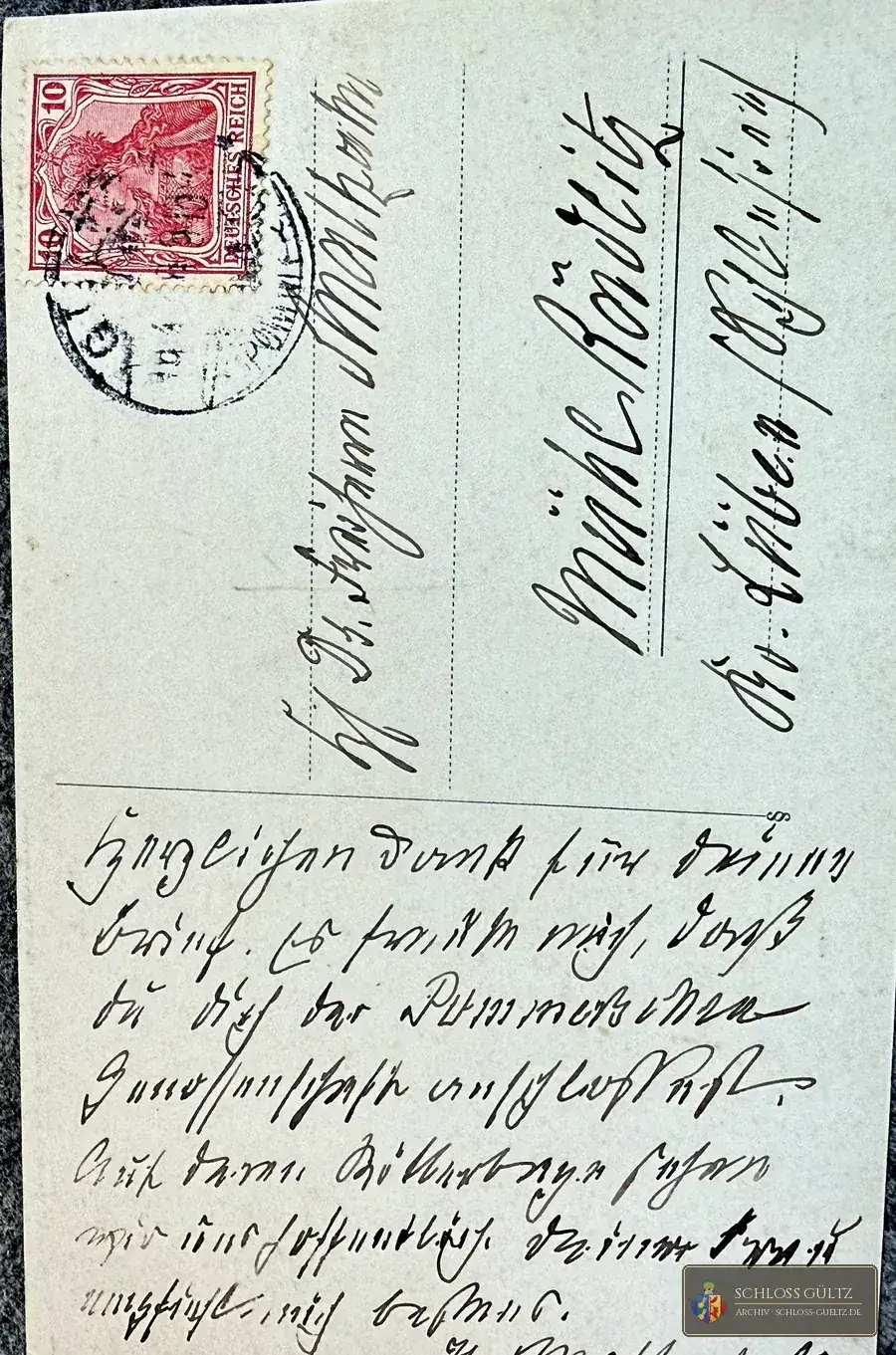
A Maltzahn living in Silesia who joins the Pomeranian Association – perhaps because the family had its roots there – and a “Knights’ Day” at which they would meet again: this is how the Order held the widely branched family together. Around 1921/22 the Knights of St John even met in Gültz – we show a photograph of this in the article On the road and at home. The Order combined the duty of caring for the sick with a sense of rank; it regularly brought landowners, district administrators and senior officials of the province to the same table.
Railway, harbour, beet and herds – much of this was decided not in the ministry but in the district assembly, in the provincial diet, at the Corps evening and after the chapter of the Order. The Maltzahns of Gültz were at home in all these places.
What Cannot Be Documented
One occasionally reads that the family “shaped” or even pushed through the Neubrandenburg–Demmin railway. That is not quite right: the initiative came from Stralsund, the concession of 1870 predated Maltzahn’s time in the Reichstag, and in the end it was the Prussian state that built it. What is documented is the share subscription, Gültz station and the paved road. Also unresolved are a personal role in the founding of the Demmin light railway in 1895 and holdings in sugar factories. If you have any documents on this – shares, letters, minutes – we would be grateful for any information: schlossgueltz@gmx.de.
Read more: History of Schloss Gültz · Axel von Maltzahn – stages of a life · The Demmin Uhlans
Sources: Helmuth Frhr. von Maltzahn (Schossow), “Helmuth Freiherr von Maltzahn-Gültz (1840–1923)”, in: Pommersche Lebensbilder II, Stettin 1936, pp. 266–280 (Darß railway, sugar tax); Wikipedia, “Bahnstrecke Velgast–Prerow”; Helmuth Frhr. von Maltzahn-Gültz, Erinnerungen 1893–1900 mit Rückblicken auf frühere und Ausblicken auf spätere Jahre, typescript 1916 (private collection); unpublished family chronicle “Gültz – Aus dem Leben meiner Vorfahren” (private collection); Niekammer’s Landwirtschaftliches Güter-Adreßbuch, Bd. I: Provinz Pommern, 8th ed., edited by Ernst Seyfert and Hans Wehner, Leipzig 1928, pp. 11, 14, 16 f. (digitised copy Pomorska Biblioteka Cyfrowa, pbc.gda.pl, no. 42019); Rolf Jehke, Territoriale Veränderungen in Deutschland, lists of district administrators of the districts of Demmin and Grimmen (territorial.de, accessed 3 October 2026); Wikipedia, articles “Berliner Nordbahn”, “Demminer Bahnen”, “Bahnstrecke Toitz-Rustow–Loitz”, “Wilhelm von Heyden-Cadow”, “Axel von Maltzahn (Landrat, 1868)”, “Arthur Becker (Politiker, 1862)”, “Corps Vandalia Heidelberg”, “Zuckerfabrik Anklam” (accessed 3 October 2026); Die Grenzboten 1873 (Lasker and the Northern Railway); Handbuch der deutschen Aktiengesellschaften, 1914 (section on sugar factories, digitised copy UB Mannheim); Lysbeth W. Muncy, “The Prussian Landräte in the Last Years of the Monarchy”, Central European History 6 (1973), pp. 299–338, here note 38; index of the stenographic reports of the Reichstag, keyword “Prozeß Becker”; Nordkurier: “Wenn aus Bahngeschichte ein Stück erlebbare Kunst wird” (Loitz) and “Geschichte der Zuckerfabrik wird aufgearbeitet” (Demmin); Albert Gieseler, steam engine database, “Zuckerfabrik Aktien-Gesellschaft in Demmin”; eisenbahn-mv.de, “Bahnhof Gültz”; Kulturportal West-Ost, “Maltzahn-Gültz, Helmuth Freiherr von”; Nikolai Scheuring, Liste der Ehrenritter des Johanniterordens 1853–1918 (2021); Walter Bauchspies/Torsten Berg, Die Demminer Kleinbahnen, EK-Verlag 2004 (further reading).