

The first people to spend the night in the new manor house at Gültz were not its builders. They were cavalry officers from Demmin – and among them an heir to a throne. This is how Helmuth Freiherr von Maltzahn (1840–1923), who had the house built between 1868 and 1872, recorded it in his memoirs, dictated in 1916 and never published. Here we set out what can be documented about this encounter, who the “White Uhlans” from Demmin were, and what price a young Freiherr von Maltzahn paid for this regiment.
Summer 1872: Uhlans in the Unoccupied Manor
In the summer of 1872 the new building was finished. Before moving in, the family gave the craftsmen a party in the cleared-out hall of the old half-timbered house; the craftsmen of the area came with their banners. Then, during manoeuvres, a squadron of the Demmin Uhlans was billeted in Gültz – the men and horses in the village, the officers in the completed but still empty new building. With the squadron came the Hereditary Grand Duke of Mecklenburg-Strelitz. He slept at Gültz before the family itself had moved in.
“… that he had been the first guest in my house.”
According to Maltzahn, the later Grand Duke reminded him of this at almost every meeting. From then on, the room in which the guest had stayed was known in the family as the “Prince’s Room” – the name still appears on the floor plans in the unpublished family chronicle.
Who Was the Guest?
In 1872 the Hereditary Grand Duke of Mecklenburg-Strelitz was Adolf Friedrich (1848–1914), the son of the reigning Grand Duke Friedrich Wilhelm. He was 24 years old at the time and had taken part in the war of 1870/71. Only in 1904 did he succeed to the throne in Neustrelitz as Grand Duke Adolf Friedrich V – in those years Helmuth von Maltzahn was Oberpräsident (Governor) of the Province of Pomerania in Stettin (1900–1911). The two men thus met over the course of decades, and the Grand Duke never forgot the night at Gültz.
It is no coincidence that the heir to the Strelitz throne of all people was riding with a Demmin squadron: from 17 March 1863 until his death on 30 May 1904, the Chef (honorary colonel-in-chief) of the 2nd Pomeranian Uhlan Regiment No. 9 was his father, Grand Duke Friedrich Wilhelm of Mecklenburg-Strelitz. On 2 June 1904 Adolf Friedrich V himself took over this honorary position and held it until his death in 1914. For over half a century, then, the Demmin Uhlans were the “Strelitz” regiment of Western Pomerania. The regimental history reveals in what capacity the Hereditary Grand Duke was present in 1872: an order of 31 December 1871 appointed him Rittmeister à la suite of the regiment. For nine months he served in the 5th Squadron and, according to the chronicle, devoted himself “with pleasure to every branch of the service”; on 6 October 1872 he was transferred in the same capacity to the 2nd Guards Uhlan Regiment. The summer of 1872 at Gültz thus fell precisely within his time at Demmin. For that year the regimental history mentions a brigade exercise near Pasewalk and manoeuvres between Stettin and Tantow – the billeting at Gültz itself is known to us only from Maltzahn’s memoirs.
The “White Uhlans” from Demmin
The 2nd Pomeranian Uhlan Regiment No. 9 was formed on 7 May 1860 from squadrons transferred from other cavalry regiments and received its name on 4 July 1860. At first it was stationed in Anklam, Ueckermünde and Treptow an der Tollense, and from 1862 entirely in Demmin, where the East and West Barracks were built. Because of their white facings – white collars, cuffs and plastrons on the dark blue Ulanka tunic, and on parade a white horsehair plume on the czapka – they were popularly known as the “White Uhlans”. Uhlans were lancers, the light cavalry used for reconnaissance and screening.
The regiment marched to Bohemia in 1866 and to France in 1870/71 (Gravelotte–St. Privat, Siege of Metz). While its horsemen were in the field there, building work at Gültz came to a halt: the house stood under its roof with the windows bricked up until construction could resume after the peace.
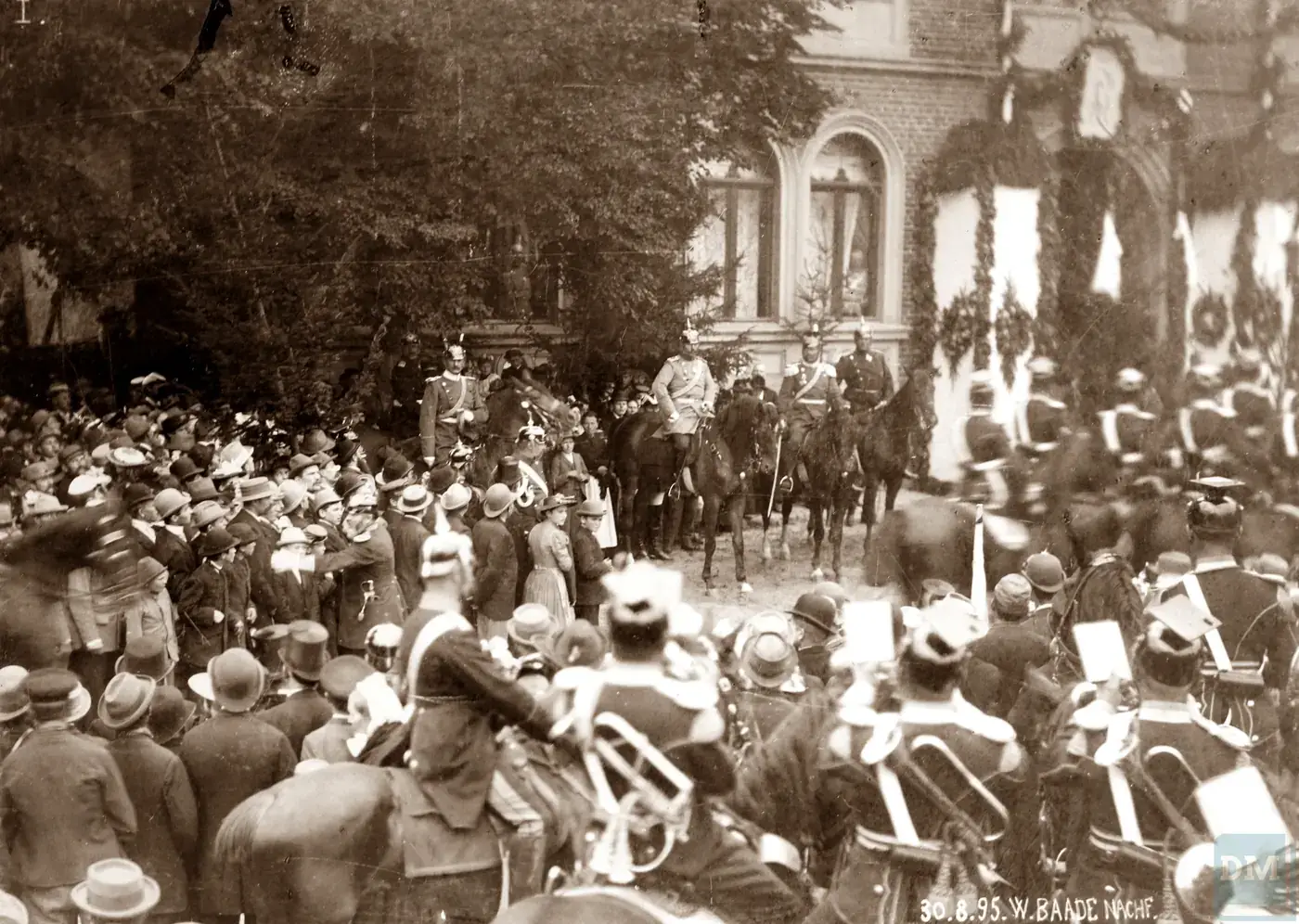
The garrison shaped the small town on the Peene: barracks, officers’ mess, riding arenas, parades. The highlight was the Kaiser’s visit on 30 August 1895, when Wilhelm II had the squadrons ride past him in front of the festively decorated mess – the people of Demmin crowded closely along the roadside.
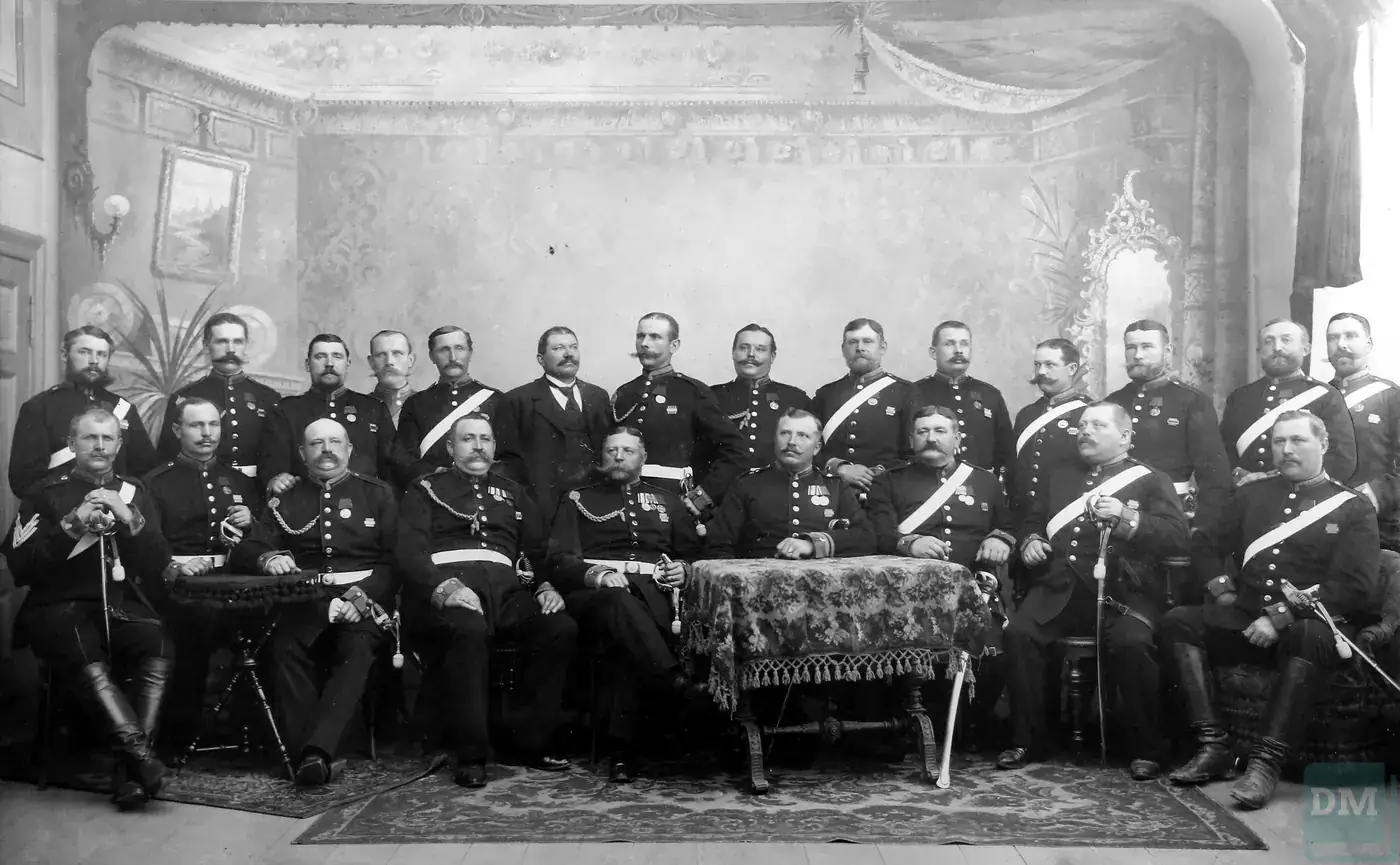

After discharge, reservist pictures like this hung in many farmhouse and townhouse parlours across Western Pomerania. Anyone who had served three years in the cavalry took such a keepsake home – and presumably so did many a young man from the estate villages around Gültz.
And the Builder Himself? A Cuirassier from Pasewalk
Helmuth von Maltzahn was not an uhlan, but he knew service in the saddle from his own experience. In May 1866 he was called up as a Landwehr officer to the Pasewalk Cuirassiers and went through the war of 1866 with them – in the Cuirassier Regiment “Queen” (Pomeranian) No. 2. This regiment, rich in tradition, was stationed in Pasewalk from 1721 to 1919, with brief interruptions; it had borne the name “Queen’s Regiment” since 1810 in memory of Queen Louise, who had been its Chef since 1806. In 1866 the cuirassiers marched to Bohemia and took part, among other actions, in the Battle of Königgrätz and the engagement at Pressburg. In peacetime the Pasewalk Cuirassiers and the Demmin Uhlans together formed the 3rd Cavalry Brigade in Stettin.
In 1870/71, too, Maltzahn took the field with his regiment, now as a reserve officer. On 28 November 1870 he was seriously wounded at Beaune-la-Rolande and was left with a stiffened arm that stayed with him all his life. While he was in the field, building work at Gültz was suspended. So when the Demmin Uhlans moved into his new house in the summer of 1872, it was a war veteran who received their officers. More on this: The Pasewalk Cuirassiers and the Freiherren von Maltzahn-Gültz.
A Maltzahn among the Fallen of 1870
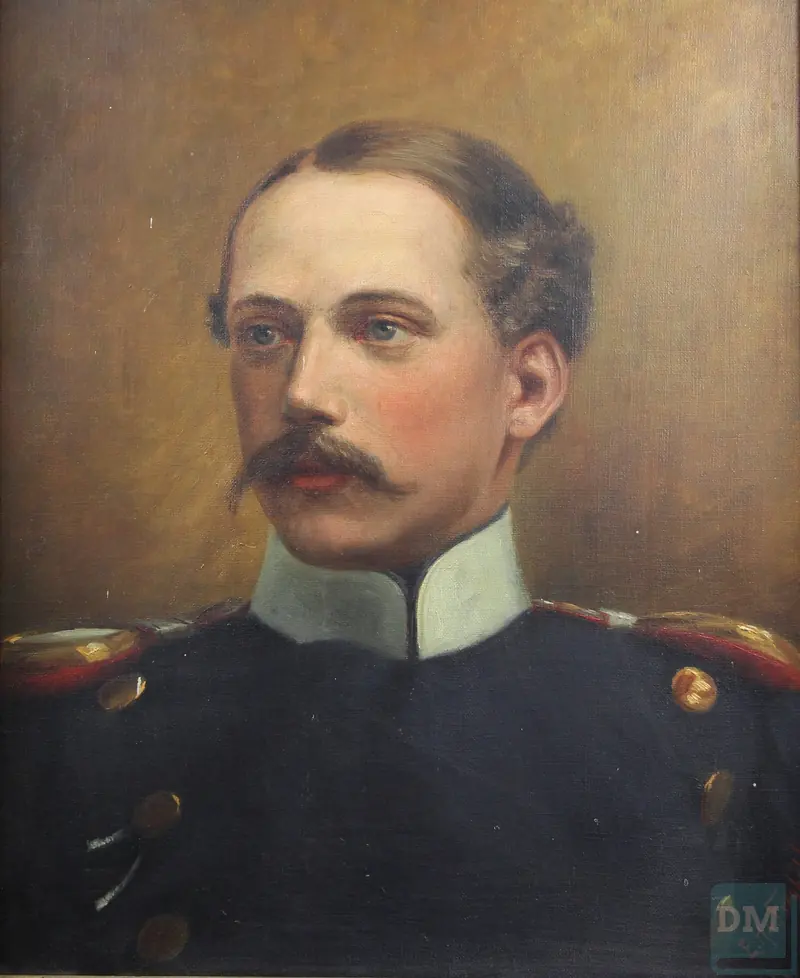
On 20 December 1870 the Demmin Uhlans rode a charge at Monnaie, north of Tours, that ranks among the costliest days in the regiment’s history. At the Château de Meslay those who fell that day included First Lieutenant Carl Friedrich Gustav von Kahlden, Second Lieutenant Detwig von Oertzen, Vice-Sergeant Major Magnus Joachim von Bilow, Hartwig von Voss – and Second Lieutenant Anton Albrecht Friedrich Wilhelm Freiherr von Maltzahn. The regiment had their portraits painted; six of these paintings of officers killed in 1870 are preserved in Demmin today.
The portrait shows the regiment’s peacetime uniform with the white collar that gave the “White Uhlans” their name. According to the Demmin local history society, the lieutenant was born on 28 October 1844 in Kummerow, the son of Rudolph von Maltzahn and Carolina von Kracker; he thus belonged to the Kummerow/Rottmannshagen line and fell at the age of 26. The society knows of no direct connection to Gültz. A Rudolph Maltzahn does, however, also appear in the history of our house: at the suggestion of a cousin of that name, in 1873 the builder received two French guns captured in the war, to stand on the driveway. Whether this was the same Rudolph, the father of the fallen officer, is not certain – but it is conceivable. We are continuing our research.
What Remained of the Regiment
After the First World War the regiment returned to Demmin on 19 November 1918 and was demobilised; in the Reichswehr its tradition was taken over by the 6th Squadron of the 6th Cavalry Regiment in Demmin. Veterans erected the Uhlan Memorial on the western edge of the Sandbergtannen woods near Demmin railway station, with an equestrian statue of an uhlan by Fritz Richter-Elsner, inaugurated on 3 August 1924. In 1946 it was destroyed and buried on the orders of the Soviet occupying power; after 1990 fragments were recovered and re-erected. Anyone following in the footsteps of the uhlans today can combine a visit to the memorial and the Digital Museum of the Demmin local history society from Gültz.
What Cannot Be Documented
Embellished versions of this story are circulating on the internet – including in automatically generated texts. According to these, imperial manoeuvres with billeting were held at Gültz every year, and the Hereditary Grand Duke was the guest of honour “of the Oberpräsident”. Neither is documented: in 1872 Helmuth von Maltzahn was 31 years old and had been a member of the Reichstag since 1871; he only became Oberpräsident in 1900. What has come down to us is a single billeting – and all the more charming for it – in the summer of 1872, in the house not yet lived in.
More on this: History of Schloss Gültz · Milestones of the von Maltzahn-Gültz Family
Our sincere thanks go to the Demminer Heimatverein e. V., which released the images from its Digital Museum for this article and answered our questions on the regimental history. A visit to the Digital Museum is well worthwhile: demminer-heimatgeschichte.de.
Do you have photographs, letters or regimental records of the Demmin Uhlans relating to Gültz or the von Maltzahn family? We are grateful for any information: schlossgueltz@gmx.de
Sources: Helmuth Frhr. von Maltzahn-Gültz, Erinnerungen 1893–1900 mit Rückblicken auf frühere und Ausblicken auf spätere Jahre, typescript 1916 (private collection); unpublished family chronicle “Gültz – Aus dem Leben meiner Vorfahren”, pp. 95–101 (floor plans, “Prinzenzimmer”); Wikipedia, articles “2. Pommersches Ulanen-Regiment Nr. 9”, “Ulanendenkmal (Demmin)” and “Adolf Friedrich V. (Mecklenburg)” (accessed 2 October 2026); Demminer Heimatverein e. V., Digital Museum, “2. Pommersches Ulanen-Regiment Nr. 9” (paintings of the fallen 1870/71); Oskar Dreher, Geschichte des 2. Pommerschen Ulanen-Regiments Nr. 9, 1860–1885, 1885; Friedrich Birkholz, “Maltzahn-Gültz, Helmuth Freiherr von”, Kulturstiftung der deutschen Vertriebenen (Ostdeutsche Biographie); Helmuth Frhr. von Maltzahn, “Helmuth Freiherr von Maltzahn-Gültz”, in: Pommersche Lebensbilder II, Stettin 1936, pp. 266–280; Wikipedia, articles “Kürassier-Regiment ‚Königin‘ (Pommersches) Nr. 2” and “Helmuth von Maltzahn (Oberpräsident)”; Karsten Behrens, Ulanen in Demmin, 2014.