
For the centuries during which the von Maltzahn family lived in Gültz, there are charters, maps and letters. For the final months, there are above all memories that were passed down within the family and later written down. Here we summarise in general terms what took place in and around the house.
An estate in wartime
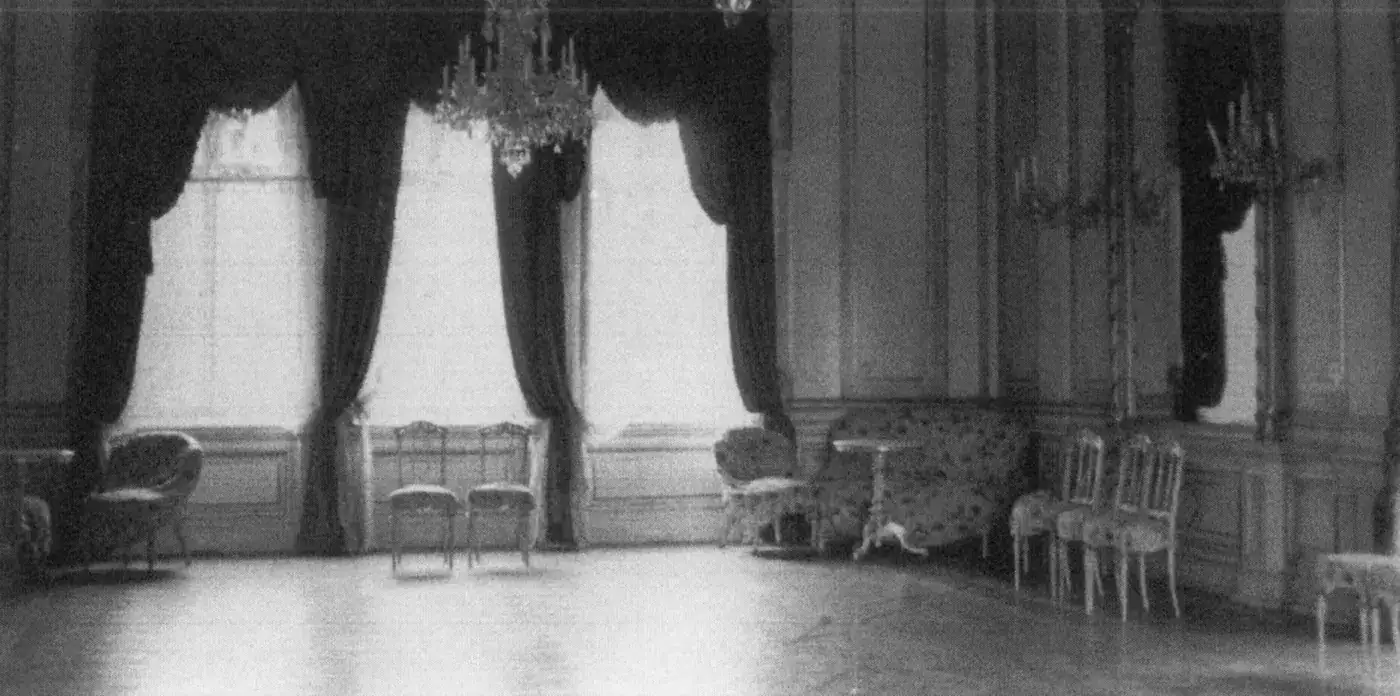
The lord of the manor was Helmuth Freiherr von Maltzahn (1900–1984), a grandson of the man who built the manor. He farmed Gültz and Hermannshöh; from 1940 the family lived in the manor house. As everywhere in the countryside, there was a wartime shortage of labour, fuel and materials; the estate kept running with draught oxen.
Summer 1944
After the failed assassination attempt of 20 July 1944, the lord of the manor at Gültz also came under the scrutiny of the Gestapo: he was arrested and the estates were placed under compulsory administration. He was released in September 1944. At the beginning of 1945 he returned to the Wehrmacht, was taken prisoner by the Soviets in February 1945 and was not released until 1948.
A letter from those weeks has survived. On 6 February 1945 he wrote to his brother from the encircled town of Schneidemühl. He had heard nothing from Gültz since the end of January. Over everything hung “complete uncertainty”. His brother and his family were, of course, welcome to move to Gültz or Hermannshöh. In case he himself did not return, he asked him to look after Gültz and Hermannshöh; if he wished, he could also lease Hermannshöh. From the Wehrmacht report he knew that the Red Army was already at Posen. A few days later Schneidemühl fell.

A house full of strangers
In the last winter of the war the manor became a collection point for refugees in the district of Demmin. At times around 200 people from the East lived in the house and in the farm building, many of them sick, exhausted and hungry. In addition, troops and official agencies were billeted there; the skittle alley in the park served as a store for evacuated files. The burden of providing for everyone fell largely on the lady of the house alone.
The last days of April 1945 in the neighbourhood
On 20 April 1945 the 2nd Belorussian Front under Marshal Rokossovsky began its offensive across the Oder between Stettin and Schwedt. After that, events moved quickly: Prenzlau fell on 27 April, Neubrandenburg on 29 April. Organised German resistance remained only in isolated places. The roads were full of refugee treks from East Prussia and Farther Pomerania, with retreating troops in between.
For the area around Gültz, much was decided on 29 April in Altentreptow, a good eight kilometres away. The superintendent had his son hang two white bedsheets from the openings of the church tower as the guns of Soviet tanks in the Tollense meadows were trained on the town. Apart from a few houses, Altentreptow was spared. The Red Army moved swiftly on towards Demmin. During the night of 30 April to 1 May it reached Gültz.
In Demmin, the withdrawing German troops blew up the bridges over the Peene and the Tollense on the morning of 30 April. The Soviet units were trapped in the town. Looting, arson and violence against women followed. Historians estimate around 900 suicides among what was then a population of about 15,000.
What these days looked like on one of the family’s estates is shown by the memoirs of the then lady of the manor at Vanselow, the second Maltzahn house built by Georg Daniel. She wrote them down in 1966 and 1970. Her husband was away at war as an officer, and she ran the estate alone with the children. On 27 April Vanselow lay on the main line of battle. The carpets were nailed onto the trek wagons and the suitcases carried down into the wine cellar. When the Demmin bridges were blown up “with a thunderous roar”, she had white flags hung out. At nine o’clock the first tanks came down the lime avenue. Weeks of looting followed: the furniture was carted away on lorries, the livestock driven off; after the first day 72 horses were gone, and of more than 1,200 sheep only two remained. The nights were marked by constant fear of assaults. The lord of the manor did not return from Soviet captivity until 1954. After reunification the family bought back the Vanselow estate together with the manor house; today it is once again farmed by the family.
Out of consideration for contemporary witnesses and their relatives, we do not mention any names in this section and give only a general account of personal matters.
Farewell to Gültz
At the beginning of 1945 the younger children were taken to relatives in Lower Saxony. In April 1945 the lady of the house also left Gültz; shortly afterwards the Red Army moved in. In the months that followed, the house was looted several times. In the process the library and the extensive estate archive, which the builder of the manor had already systematically expanded, were lost. With the land reform the family was expropriated without compensation; the house took in resettled families and later became a vocational school.

What remains
Much can still be found in Gültz: the avenue, the hall, the entrance hall, the pond, the deer park. Other things are lost – the archive, the library, large parts of the furnishings. The house remained connected with the family over the decades. If you would like to find out more: The rooms before 1945 · History · The Lenné park.
Do you have letters, photographs or memories of Gültz from this period – for instance from refugee families who found shelter at the manor in 1945? We are grateful for any information: schlossgueltz@gmx.de
Sources: unpublished family chronicle “Gültz – Aus dem Leben meiner Vorfahren” (private collection); family records on the period 1944/45 (typescript, private collection), summarised in general form; letter from Helmuth Frhr. v. Maltzahn to his brother, Schneidemühl, 6 February 1945 (copy in the Schloss Gültz archive), paraphrased. Frank Wilhelm, “Befreiung und Zusammenbruch”, and excerpt from the memoirs of the lady of the manor at Vanselow (recorded 1966/1970), in: Heimat Kurier, special publication of the Nordkurier marking the 75th anniversary of the end of the war, 5 May 2020 (reprint of pp. 19–24 of the issue of 4 May 2020), summarised in our own words. Out of consideration for the family, we refrain from giving personal details.