

Where were the lords of the manor of Gültz when they were not at Gültz? Spa guest lists, newspaper reports and a handwritten letter to Otto von Bismarck offer a glimpse of the travels and stays of the von Maltzahn family – and of how Gültz always remained their point of reference.
1840 – A park for Gültz
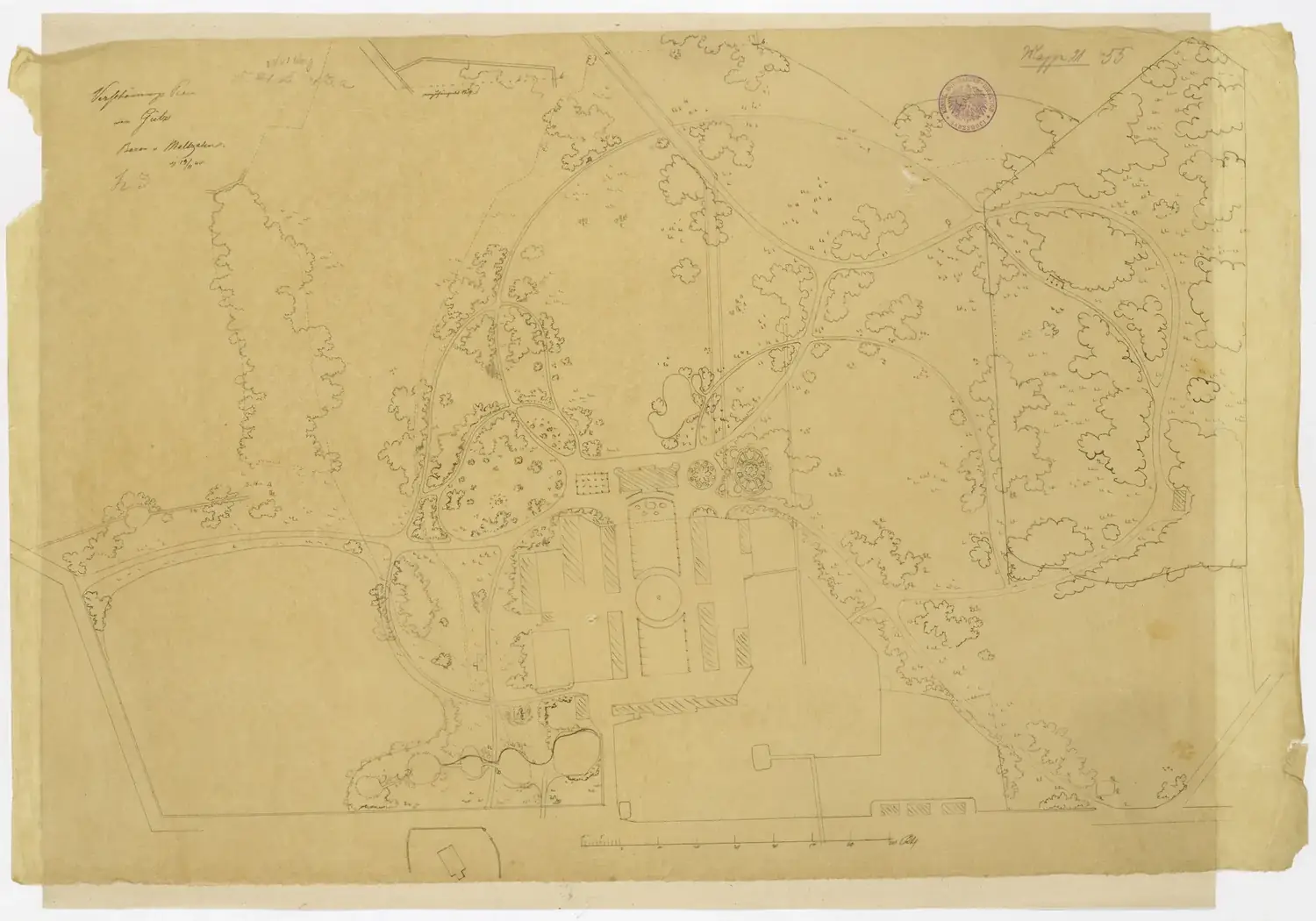
It all begins with a sheet of paper. Dated 19 November 1840 and inscribed “Embellishment plan of Gültz – Baron v. Maltzahn”, it has survived in the plan archive of the royal gardens of Sanssouci. It was commissioned by Axel von Maltzahn, the father of our later builder; the design is by Peter Joseph Lenné. Winding paths, loosely placed groups of trees and broad meadows around the estate courtyard – this is the basic form of the landscape park through which our guests still stroll today. The manor house itself did not yet exist: it was only built between 1868 and 1872 under Helmuth Freiherr von Maltzahn, who had been born at Gültz on 6 January 1840, the year of the park plan. More about the Lenné park.
1856 to 1867 – Heidelberg, Koblenz, Wetzlar
Long before Gültz became the centre of his life, Helmuth von Maltzahn travelled a great deal. After his father’s early death in 1841, his mother married Hermann von Heyden of Leistenow and Cadow in 1849; the boy thus gained two older stepbrothers, Ernst and Wilhelm von Heyden. At 16 he had already passed his Abitur in Wittenberg and went on to study law, first for two semesters in Erlangen, then in Heidelberg. There he became an active member of the Corps Vandalia, a student fraternity whose members at the time came mainly from the Mecklenburg nobility and the upper bourgeoisie of Lübeck and Hamburg – and at just 18 he was its Senior, that is, its spokesman. Both his stepbrothers also wore the Vandal colours; Wilhelm von Heyden-Cadow became active in 1858, precisely during Helmuth’s time in Heidelberg.
Helmuth started a family tradition: after him, his sons Axel and Helmuth became Vandals, then three of his grandsons, and later also his grandson-in-law Ernst-August von der Wense. Corps brothers often remained connected to the family for life – as friends, wedding witnesses and godparents.
After his studies in Berlin, his training for the civil service took him right across Prussia – and, in the holidays, on study trips to Switzerland, the south of France and Italy; in 1862 he used a period of leave for a three-month journey through England and Scotland together with Robert von Puttkamer, later Prussian Minister of the Interior and Oberpräsident (Governor) of the Province of Pomerania. The stages: 1860 Auskultator (trainee judge), 1861 Referendar at the Kammergericht, from 1862 government trainee in Koblenz and Wetzlar, then three months at the district administrator’s office in Anklam to learn about land tax, and finally Stettin (Szczecin), where he gained insight into the administration of state domains. He sat his assessor’s examination in 1866 in uniform at the outbreak of the war against Austria and then took the field with the Pasewalk cuirassiers. In 1867 he left the civil service as a Regierungsassessor, married Anna von Rohrscheidt and devoted himself entirely to his estates – the beginning of the new Gültz.
1871 to 1893 – Between Gültz and Berlin
With his election to the first Reichstag in 1871, a life on two stages began. For their periods in Berlin, the family had a villa built in 1872/73 on Derfflingerstraße in the Tiergarten quarter – it still stands today and bears a commemorative plaque; it was not sold until 1901. The journey between Gültz and the capital was short: after his appointment as State Secretary, a telephone call to Berlin was enough and the express train would stop specially at Gültz. A touching detail reveals how often the family travelled: Anna von Maltzahn knew the porters at Berlin’s Stettiner Bahnhof by name and sent each of them a parcel at Christmas – and when she died in 1913, a large wreath arrived for her funeral with the ribbon “In gratitude, the porters of the Stettiner Bahnhof in Berlin”.
1888 – From Gültz to the Imperial Treasury
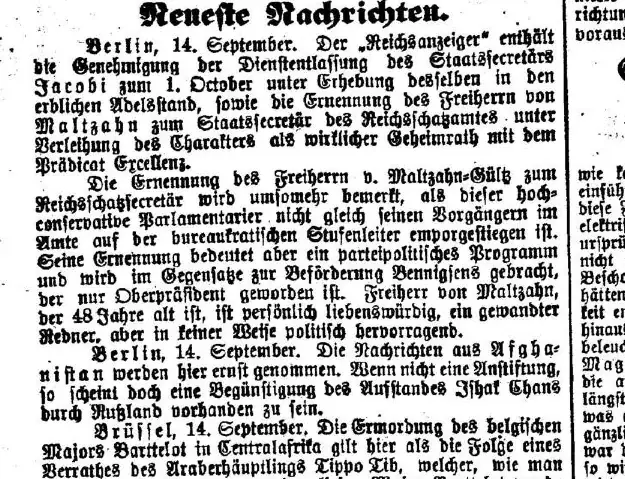
In September 1888 the news travelled as far as Austria: “Freiherr v. Maltzahn-Gültz” was to become State Secretary of the Imperial Treasury – finance minister of the German Empire – with the title of Wirklicher Geheimer Rat (Privy Councillor) and the style of “Excellency”. The “Linzer Tages-Post” remarked that the “highly conservative parliamentarian” had not climbed the bureaucratic ladder as his predecessors had, and judged the 48-year-old to be “personally amiable, an accomplished speaker”. The name is noteworthy: even then, Maltzahn bore his estate in his name – Maltzahn-Gültz.
1890 – A letter from Berlin: “later at Gültz in Pomerania”
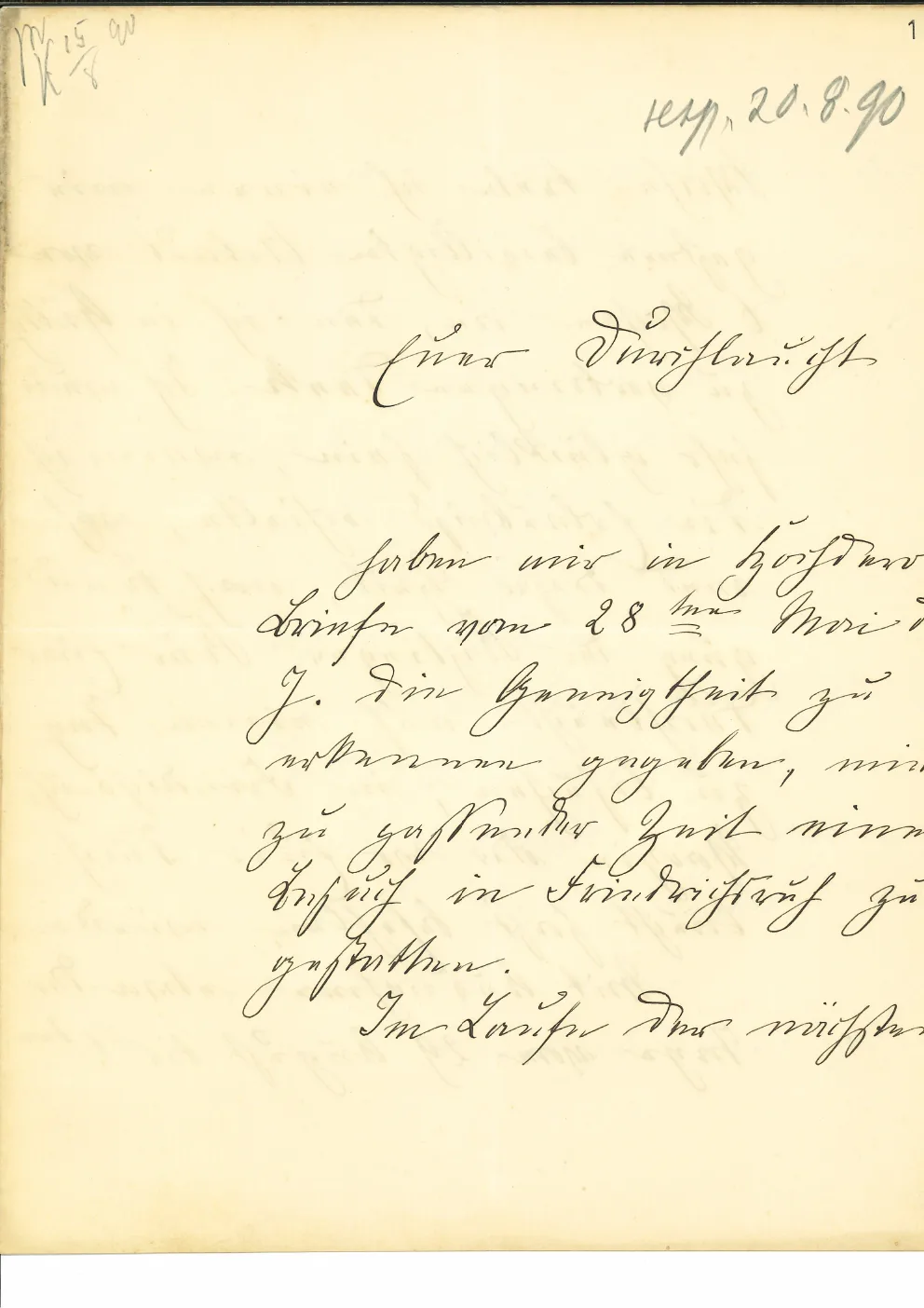
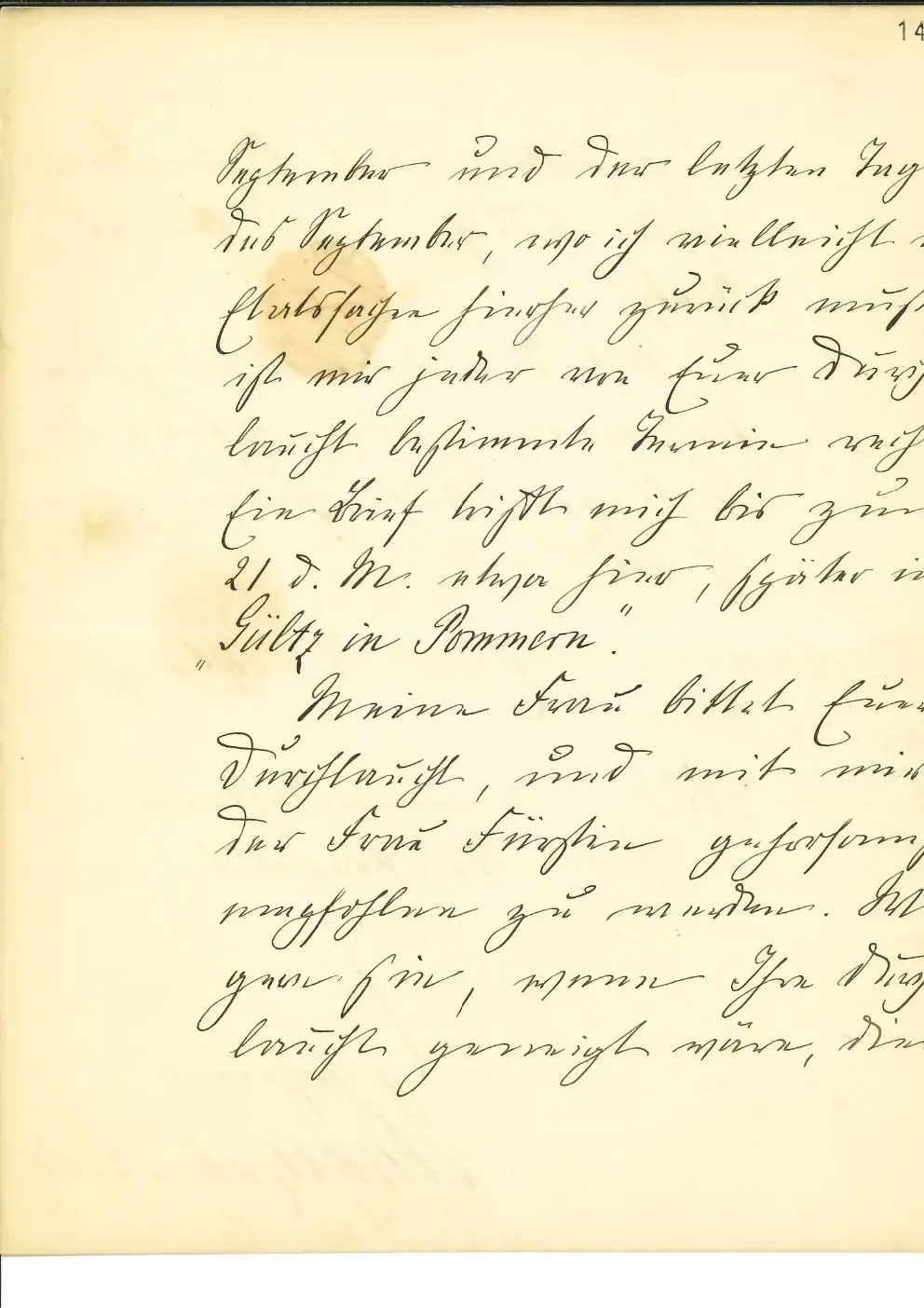
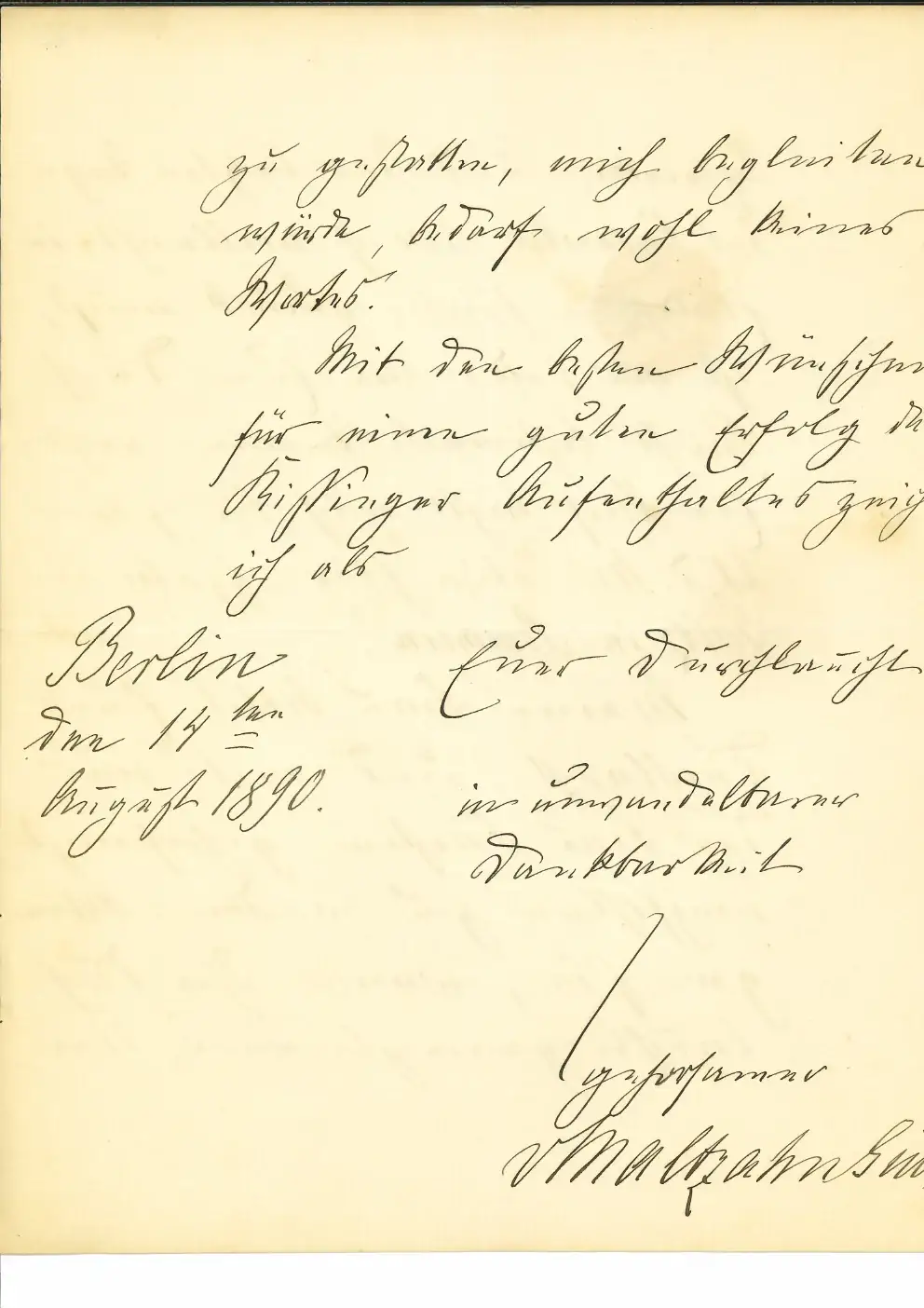
Letter from Helmuth von Maltzahn-Gültz to Prince Otto von Bismarck, Berlin, 14 August 1890 – pages 1, 3 and 4. Bismarck-Archiv, Friedrichsruh, fols. 141–144.
In March 1890 Bismarck had been dismissed as Imperial Chancellor. At the end of May he had invited Maltzahn to Friedrichsruh, “if we could let social intercourse follow upon the official”. On 14 August 1890 the State Secretary took up the invitation: he would be starting six weeks’ leave the following week and would gladly visit the Prince after his cure at Kissingen, “at Friedrichsruh, Varzin or wherever Your Serene Highness should otherwise command”. Only at the end of August and the end of September might he have to return to Berlin on “budget matters”.
Then comes the line that particularly delights us:
“A letter will reach me here until the 21st of this month, however, and later at ‘Gültz in Pomerania’.”
The finance minister’s summer leave thus took him home – to Gültz. Anna von Maltzahn is mentioned too: she sends her respects to the Princess, and how gladly she would accompany her husband “surely needs no words”. The letter is signed “in unchanging gratitude” as “v. Maltzahn-Gültz”; a note at the top right (“exp. 20.8.90”) records that a reply was sent on 20 August. On 10 September 1890 an invitation followed from Varzin to Bismarck’s Pomeranian estate – complete with travel plan: Maltzahn should spend the night not in Köslin but preferably in Stettin, and announce himself by telegram beforehand so that he could be collected at Hammermühle station. “In any case, we look forward warmly to seeing you here.” The visit to Varzin did take place, as family tradition records. More about the friendship between Maltzahn and Bismarck.
1897 – Spring in Karlsbad

On 9 April 1897 Helmuth and Anna von Maltzahn arrived in the world-famous Bohemian spa of Karlsbad. The official spa guest list records: “Mr State Secretary (retd.) Helmuth Freiherr von Maltzahn with wife and servant” – place of residence Gültz, lodging at the “Quisisana” house on Marienbaderstraße, three persons. A few days later the journal “Hygiea” picked up the arrival in its overview of distinguished spa guests, among counts, generals and an Actual State Councillor from Moscow: “State Secretary Freih. v. Maltzahn with spouse, Gültz”. In June of the same year Maltzahn travelled with his sons to Friedrichsruh. Bismarck’s doctor asked that the visit to the ailing Prince be kept short and specifically suggested the express train from Hamburg, which was to stop at Friedrichsruh. It was to be the two men’s last meeting. Otherwise, after leaving imperial service in 1893, Helmuth and Anna von Maltzahn lived entirely at Gültz for seven years.

1900 to 1911 – In Stettin Castle
At the end of 1899 Helmuth von Maltzahn was appointed Oberpräsident (Governor) of the Province of Pomerania – an office in his home province that he had long wished for. With it came the obligation to reside there: the Maltzahns now lived in Stettin Castle and every winter gave large balls in the royal apartments. When Emperor Wilhelm II and Empress Auguste Viktoria came to visit on the court train, they too stayed in the castle; the Oberpräsident collected them with his own carriage and horses. On seeing the horses, the Emperor is said to have exclaimed: “Good heavens, Maltzahn drives better horses than I do!” Several times Maltzahn travelled down the Oder in the Emperor’s retinue aboard the imperial ship – in the 1890s during the visit of Emperor Franz Joseph, and again in 1900.
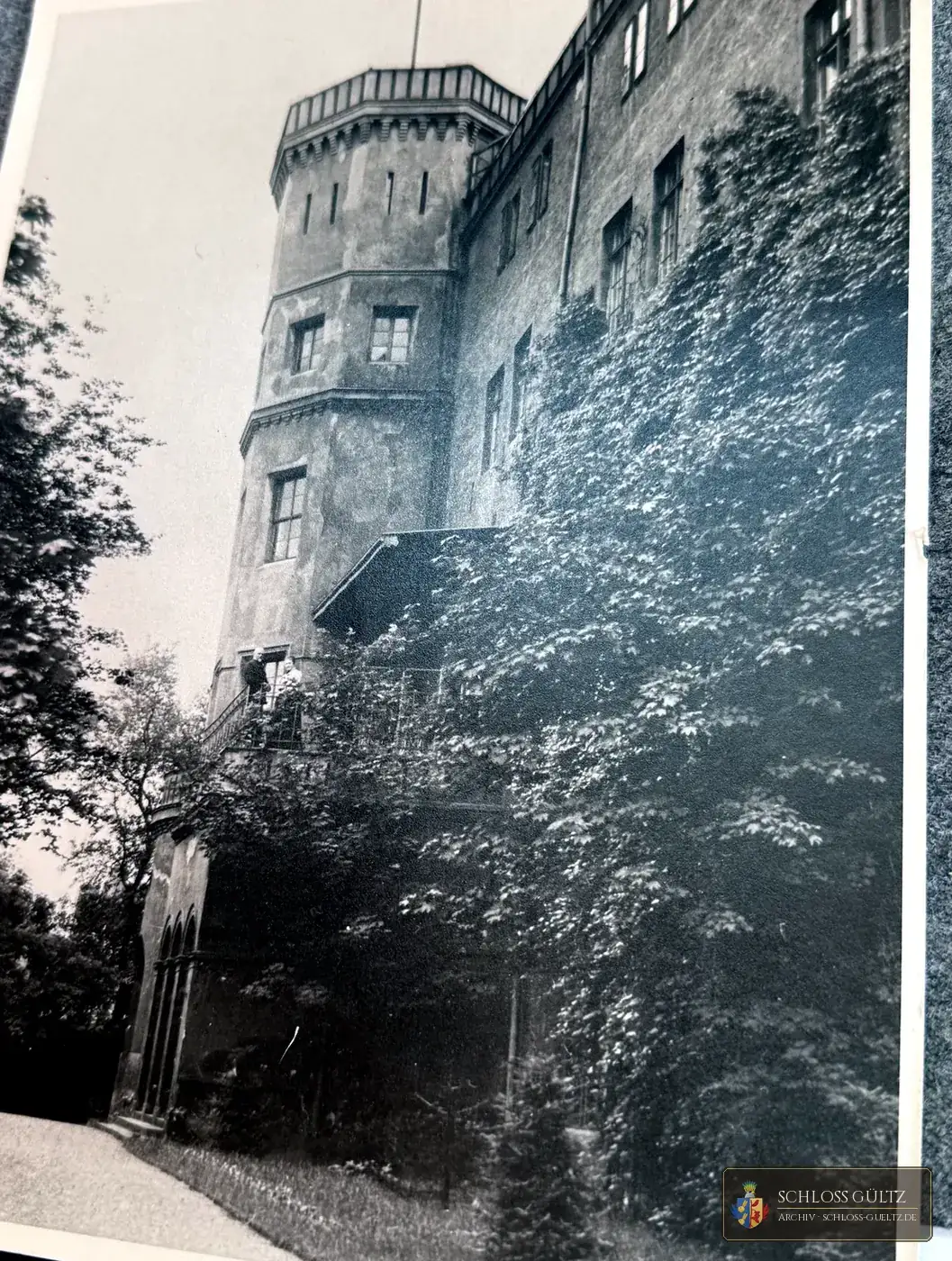
A common cuirassier at the Emperor’s table
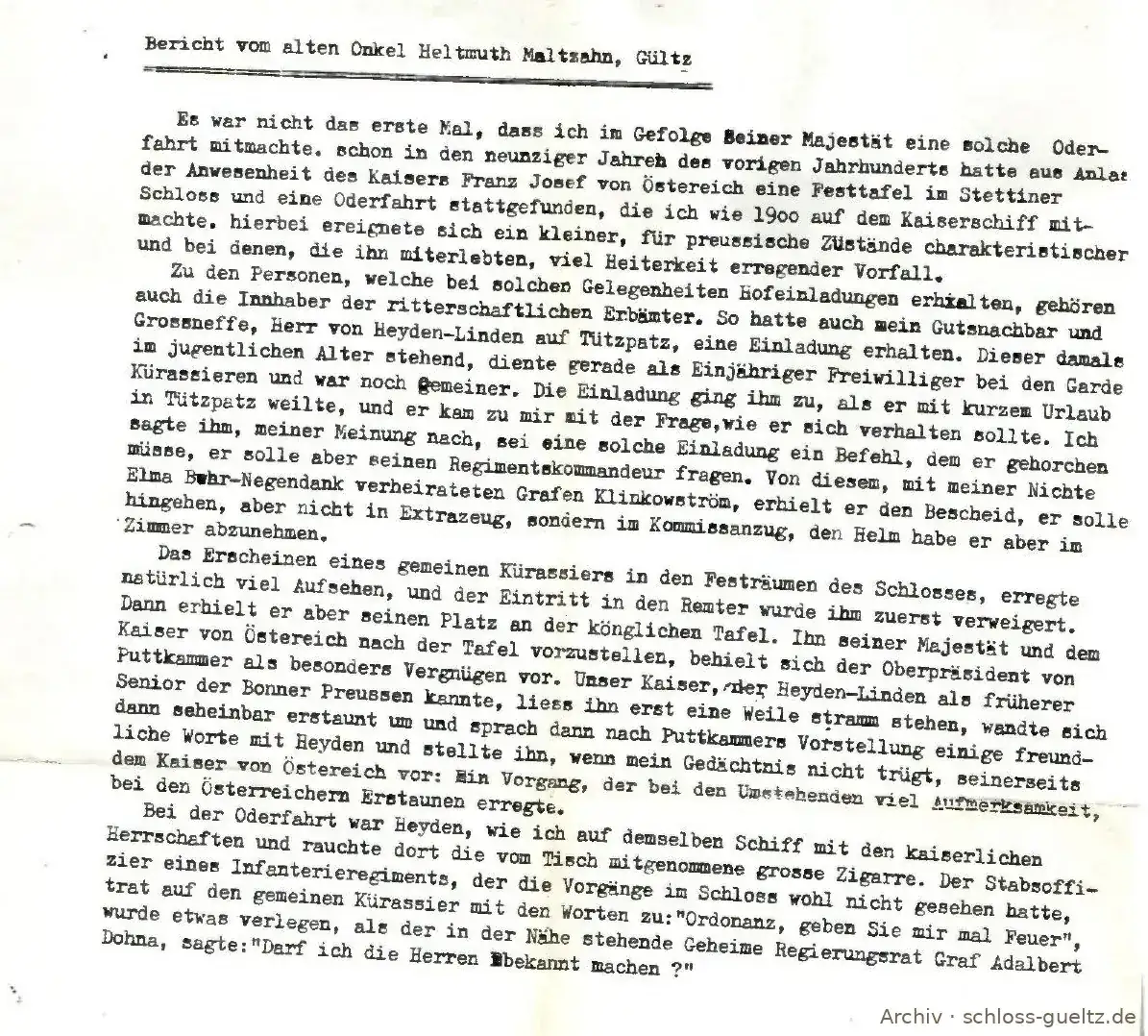
Helmuth von Maltzahn himself wrote down a story from one of these Oder voyages, which he called “characteristic of Prussian conditions”. During Emperor Franz Joseph’s visit in the 1890s, a banquet was held in Stettin Castle. Among those invited were the holders of the hereditary offices of the knighthood, including Maltzahn’s estate neighbour and great-nephew, Herr von Heyden-Linden of Tützpatz. The young man was serving at the time as a one-year volunteer with the Guard Cuirassiers – and still as a private soldier. He asked Maltzahn for advice. Maltzahn said that such an invitation was an order, but that he should ask his regimental commander. The commander, Count Klinkowström (married to Maltzahn’s niece Elma Behr-Negendank), decided: go, but in service dress, not in a special uniform; and take off your helmet in the room.
A common cuirassier in the state rooms caused a stir; at first they would not let him into the great hall. Then he was given his place at the royal table after all. After the meal, Oberpräsident von Puttkamer presented him to Their Majesties. Wilhelm II knew Heyden-Linden as a former Senior of the Bonn Corps Borussia, of which he himself was a member. He first left him standing to attention for a while, then spoke kindly to him and, as Maltzahn recalled, introduced him to Emperor Franz Joseph. The Austrians were astonished.
On the Oder voyage, Heyden sat on the ship carrying the imperial party, smoking a large cigar that he had taken from the table. A staff officer who had missed the scene at the castle called out to the ordinary cuirassier: “Orderly, give me a light!” He became somewhat embarrassed when Privy Councillor Count Adalbert Dohna stepped up and asked: “May I introduce you gentlemen?” Tützpatz, incidentally, lies only a few kilometres from Gültz and is today one of our tour destinations.
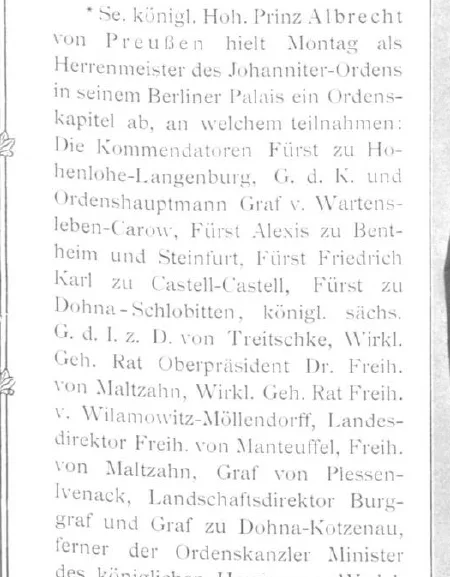
Even as Oberpräsident he remained a presence in Berlin – for instance in January 1905 at the chapter of the Order of Saint John, which Prince Albrecht of Prussia, as Herrenmeister (Grand Master), held in his Berlin palace. The Viennese magazine “Sport & Salon” lists among the participants “Wirkl. Geh. Rat Oberpräsident Dr. Freih. von Maltzahn”. The Order remained a lifelong concern for him: in the 1890s he took over the leadership of the Pomeranian association as Kommendator, and in 1916 he became Chancellor of the Order, remaining so until his death.
He also met the Emperor outside Stettin: in early September 1910 newspapers as far away as Linz reported on his speech at the banquet in the Schützenhaus in Stolp, which Wilhelm II attended. In 1911 Maltzahn retired and returned to Gültz for good.
1911 to 1925 – Home again
Anna von Maltzahn died in 1913 after 46 years of marriage; her husband thereafter kept her rooms at Gültz locked and opened them only rarely – for instance to show the grandchildren the old musical box. One last great journey took the whole family to Berlin in 1920: for his 80th birthday, Helmuth von Maltzahn invited all his children and grandchildren to the Hotel Adlon, some 38 people at a huge round table at which everyone could see everyone else. He died on 11 February 1923 at Gültz – where he had been born and to which his travels had always brought him back. The Herrenmeister of the Order of Saint John came to the funeral, and the Emperor sent a wreath from exile in Doorn.

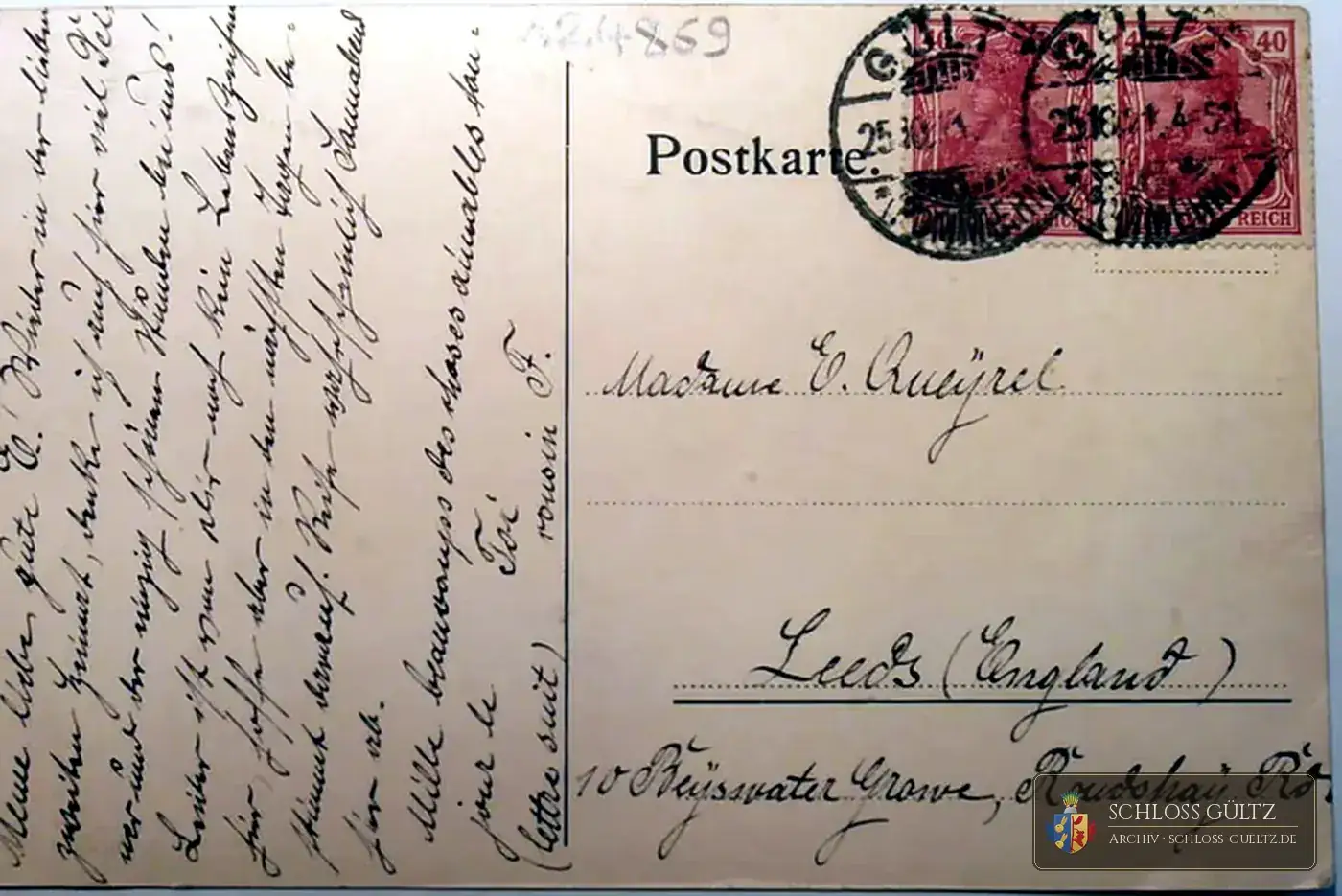
The house’s own postcard “Gültz in Pommern, den …” – written on 24 October 1921, postmarked at Gültz on 25 October 1921, addressed to Leeds (England).
A small postcard shows how open the house was in those years. Gültz had its own cards printed, for example a lithograph of the courtyard side with the two cannons on the circular lawn and the pre-printed heading “Gültz in Pommern, den …” (“Gültz in Pomerania, the …”). In October 1921 a guest – he signs himself “cousin F.” – wrote on one such card to a relative in Leeds: he was “back in my dear second home”, was thinking of the lovely hours spent there and would be leaving again “probably on Saturday”. He closes his greeting in French. Gültz was not only the family’s home but also a place to which relatives gladly returned time and again.

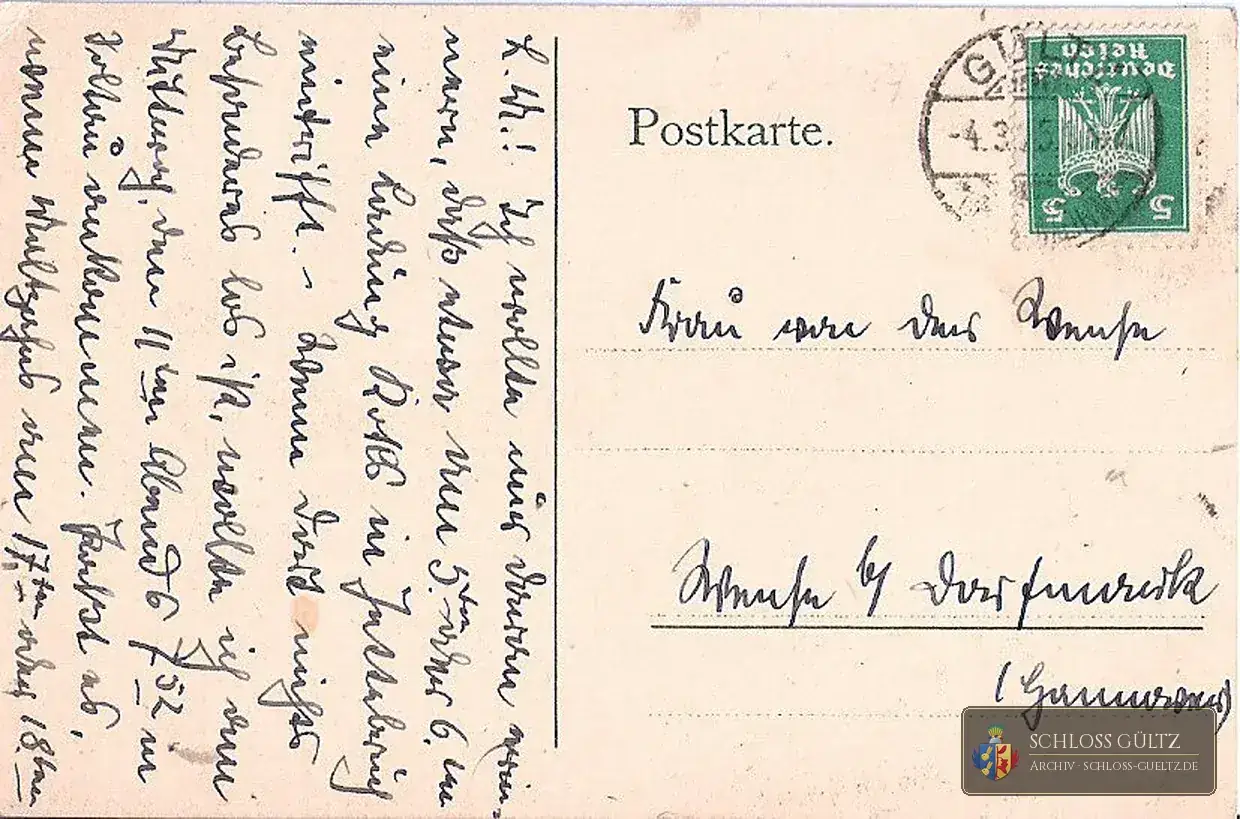
The second motif of the house’s own cards: the park side across the manor pond – postmarked at Gültz on 4 March 1925, addressed to Frau von der Wense at Wense near Dorfmark.
There were at least two such house cards: besides the courtyard side with the cannons, there was also a view from the park side across the manor pond. One of them was sent on 4 March 1925 from Gültz to Wense near Dorfmark on the Lüneburg Heath, to Frau von der Wense. The writer reveals only an initial; the arrival is announced for “Wednesday the 11th, evening 7.52”, along with greetings “also from Mechthild”. Mechthild von Maltzahn (1906–1998), the builder’s granddaughter, soon became part of that family herself: in 1926 she married Ernst-August von der Wense, who had taken over the family estate at Wense in 1924 – the recipient of the card was probably his mother. Like Mechthild’s grandfather, he too was a Heidelberg Vandal. Almost twenty years later, Ellerbruch on the Wingst, where the von der Wenses later lived, became a refuge for the Gültz children when they were brought to safety in the spring of 1945 before the end of the war.
The stations at a glance
| Date | Place | Station | Source |
|---|---|---|---|
| 19.11.1840 | Gültz | Embellishment plan for the park, commissioned by Axel v. Maltzahn | SPSG, Plansammlung 3483 |
| 1856–1860 | Erlangen, Heidelberg, Berlin | Law studies; Corps Vandalia in Heidelberg, Senior at the age of 18 | Family chronicle; Kulturstiftung |
| 1860–1867 | Berlin, Koblenz, Wetzlar, Anklam, Stettin | Auskultator, Referendar, 1866 Regierungsassessor; 1866 war with the Pasewalk cuirassiers | Wikipedia; Kulturstiftung |
| 1862 | England, Scotland | Three-month journey with Robert von Puttkamer | Pommersche Lebensbilder II (1936) |
| 1868–1872 | Gültz | Construction of the manor house under Helmuth Frhr. v. Maltzahn | Literature |
| 1872/73–1901 | Berlin | Villa on Derfflingerstraße (Tiergarten) for stays in Berlin | Memorial plaque; family chronicle |
| 14.09.1888 | Berlin | Appointment as State Secretary of the Imperial Treasury | Linzer Tages-Post, 16 September 1888 |
| 14.08.1890 | Berlin → Gültz | Letter to Bismarck; six weeks’ leave, post “later to Gültz in Pomerania” | Bismarck-Archiv Friedrichsruh |
| after 10 September 1890 | Varzin (Farther Pomerania) | Visit to Bismarck, travelling via Stettin | Bismarck’s letter of 10 September 1890; family chronicle |
| 1893–1899 | Gültz | After his resignation, seven years spent entirely at Gültz | Family chronicle |
| 09.04.1897 | Karlsbad (Bohemia) | Spa cure with his wife Anna and servants, “Quisisana” house | Karlsbader Kurliste no. 10/1897; Hygiea no. 8/1897 |
| June 1897 | Friedrichsruh | Visit to Bismarck with his sons | Maltzahn, Erinnerungen an Bismarck (1915) |
| 1900–1911 | Stettin | Oberpräsident (Governor) of the Province of Pomerania; residence in Stettin Castle, winter balls, imperial visits, trips on the Oder | Literature; family chronicle |
| Jan. 1905 | Berlin | Chapter of the Order of St John in the palace of the Herrenmeister (Grand Master), Prince Albrecht of Prussia | Sport & Salon, 1905 |
| Early Sept. 1910 | Stolp (Pomerania) | Ceremonial speech at the banquet with Kaiser Wilhelm II | Linzer Volksblatt, 8 September 1910 |
| 1911–1923 | Gültz | Retirement at Gültz, died on 11 February 1923 | Literature |
| 1920 | Berlin | 80th birthday with children and grandchildren at the Hotel Adlon | Family chronicle |
| 24./25.10.1921 | Gültz → Leeds | A guest of the family writes on the house’s own postcard from their “second home” | Postcard, Gültz postmark |
| 04.03.1925 | Gültz → Wense (Lüneburg Heath) | House postcard showing the park side, greetings “also from Mechthild” to Frau von der Wense | Postcard, Gültz postmark |
Do you have further finds relating to the von Maltzahn-Gültz family – letters, photographs, postcards, newspaper cuttings? We are grateful for every lead: schlossgueltz@gmx.de · “Family archive” gallery
Sources: “Bericht vom alten Onkel Helmuth Maltzahn, Gültz”, typewritten transcript with a handwritten covering note dated 7 January 1987 (Archiv Schloss Gültz), paraphrased in our own words; Karlsbader Kurliste no. 10 of 13 April 1897; Hygiea no. 8 (1897), p. 6; Linzer Tages-Post of 16 September 1888, p. 5; Linzer Volksblatt no. 205 of 8 September 1910, p. 3; Sport & Salon (Vienna), January 1905, “Von fremden Höfen” (digitised copies: ANNO – Historische österreichische Zeitungen, Österreichische Nationalbibliothek); letter from H. Frhr. v. Maltzahn-Gültz to O. Fürst v. Bismarck, Berlin, 14 August 1890, Bismarck-Archiv Friedrichsruh, fols. 141–144; P. J. Lenné, Verschönerungsplan für Gültz, 19 November 1840, SPSG Plansammlung 3483; H. Frhr. v. Maltzahn in: E. Marcks / K. A. v. Müller (eds.), Erinnerungen an Bismarck, Stuttgart/Berlin 1915, pp. 89–118; Pommersche Lebensbilder vol. II, Stettin 1936, pp. 266–280; unpublished family chronicle “Gültz – Aus dem Leben meiner Vorfahren” (private collection), containing excerpts from the memoirs of Helmuth von Maltzahn.