

✦ Historic garden since 1840 ✦
Lenné Park
A masterpiece of Prussian garden design by Peter Joseph Lenné
Who owns the park – and who looks after it?
Today only a very small part of the historic Lenné park belongs to Schloss Gültz: the manor house and its immediate surroundings. According to the land register, the manor property covers around 2.2 hectares – the house, courtyard and garden areas and a small pond. By far the larger part of the former estate park belongs to the municipality of Gültz and to private owners; to the north and east, the old park has been built over with houses for decades.
The state of the listed garden has been examined in detail by Neubrandenburg University of Applied Sciences. The master’s thesis by Lutz Mecke and Norman Kühn (survey 2010, published 2011) found that the former deer park has become woodland through afforestation and uncontrolled growth, the “ha-ha” survives only in fragments, the wind-harp pond has almost silted up, the lime-tree rondel is barely recognisable, the ice cellar is falling into ruin, and most of Lenné’s sightlines can no longer be traced. On maintenance, it states that “planned maintenance measures, let alone thinning of the tree stock” are “not discernible”. The thesis recommended reopening the sightlines, dredging the wind-harp pond, restoring the ice cellar and the poultry house, and developing the deer park as grazed wood pasture. In autumn 2023 the university returned: students of landscape architecture (historic garden conservation) revised the on-site survey in the winter semester 2023/24 and updated the conservation objectives for the park. In the summer semester 2024 Hochschule Wismar (Faculty of Design, module “Renovation and Conservation”) also chose Gültz as a place of study: the students analysed the village’s uses and building types, the transformation of the place on maps from 1888 to 1995, and its landscape and economy – from the manor via the ice cellar and poultry house to the stables. The knowledge of what needs to be done is therefore there. In our observation, hardly any of it has been put into practice to this day.
The municipality itself is under great financial pressure: its 2026 budget shows a deficit of around 333,000 euros, and in June 2026 the district administrator ordered that it may finance voluntary tasks only to the extent that they cannot be postponed. Under these conditions, there is hardly any scope left for the upkeep of the park.
“I look after our part of the park on my own and at my own expense. At present I see no discernible will on the part of the municipality to preserve this gem as a whole. A Lenné park is a historic garden of distinction – it needs people who care for it. Anyone who would like to help, with time, knowledge or money, is warmly welcome.”
— Michael Schneider, Schloss Gültz · Support & friends’ association
Sources: Mecke/Kühn 2011 (see below), pp. 6, 24–40, 46–56; budget statute of the municipality of Gültz for 2026 with the supervisory order of the district administrator of the Mecklenburgische Seenplatte district dated 11 June 2026 pursuant to § 82 (1) KV M-V, published via the Amt Treptower Tollensewinkel.
Peter Joseph Lenné
In 1840 Axel Freiherr von Maltzahn commissioned Prussia’s most famous garden architect to design the manor park: Peter Joseph Lenné, Director-General of the Royal Gardens at Potsdam and creator of the Tiergarten in Berlin.
Lenné designed a landscape park in the English style, extending to the south and east of the manor house built later. The picturesque ponds structure the grounds and create reflecting expanses of water in the Romantic spirit.
The park is part of the largest concentration of Lenné parks in Germany – together with the neighbouring estates of Broock, Kartlow, Kruckow, Plötz, Tentzerow and Wietzow, it forms a unique garden landscape in the Tollense valley.

Peter Joseph Lenné
1789–1866
Director-General of the
Royal Gardens at Potsdam
“Peter Joseph Lenné and the estate owners thus created in the Tollense valley an outstanding example, preserved to this day, of the Prussian ‘embellishment of the land’ of the 19th century. It must be recognised as the Pomeranian counterpart to the palace landscape of Potsdam and preserved undisturbed.”
— Prof. Dr.-Ing. Sabine Bock: “Peter Joseph Lenné und das pommersche Tollensetal – Ein Frühwerk der preußischen Landesverschönerung”, in: Pommern – Zeitschrift für Kultur und Geschichte, issue 2/2025, p. 23
The three ponds
Central design elements of the Lenné park
Manor pond
The largest of the three ponds lies directly south of the manor house. Colorado firs and old lime trees line its banks. Swans bring the water to life.
Wind Harp Pond
With its distinctive spit of land, this pond creates picturesque views. Its name refers to an Aeolian harp that once stood here – a romantic musical instrument played by the wind.
Rose Pond
The smallest pond has a little island – a typical element of romantic garden design. In summer, water lilies cover its surface.
The park from the air · 1925
The Lenné grounds in an aerial photograph
Oblique aerial photograph, 1925 – Lenné’s “Beautification Plan for Gültz” (1840) is kept in the plan collection of the Stiftung Preußische Schlösser und Gärten Berlin-Brandenburg
Lines of sight
Sweeping “points de vue” across the Tollense valley
Winding paths
Natural-looking paths in the English style
Groups of trees
Picturesquely composed plantings of trees and shrubs
Historic trees
Many of the trees and shrubs planted by Lenné have stood the test of time
Colorado fir
Abies concolor
Several stately specimens by the manor pond. Their silvery-blue needles contrast picturesquely with the dark water.
Swamp cypress
Taxodium distichum
Right on the pond’s edge. Its characteristic “knees” rise out of the mud when the water is low.
Copper beech
Fagus sylvatica 'Purpurea'
Several mighty specimens standing as solitary trees. Their dark red foliage sets dramatic accents amid the green of the park.
Plane tree
Platanus × hispanica
Trees over 150 years old with characteristic flaking bark. Popular solitary trees in Lenné parks.
Tulip tree
Liriodendron tulipifera
A North American exotic with tulip-shaped flowers in June. Evidence of the park’s refined design ambitions.
Cypress oak
Quercus robur 'Fastigiata'
A columnar oak as a striking vertical accent – typical of Lenné gardens.
History of the park
Lenné’s beautification plan
Axel Freiherr von Maltzahn commissions Peter Joseph Lenné to draw up a “beautification plan” for the Gültz estate. In this year Lenné produces eleven beautification plans for Pomeranian estates – those recorded by name are Broock, Gültz, Kartlow, Kruckow, Neuensund, Rottmannshagen, Sarow and Zarrenthin (Sabine Bock, Pommern 2/2025, p. 19).
Laying out the park
The landscape park is laid out to Lenné’s plans. The three ponds are dug, lines of sight are cut and the first trees and shrubs are planted.
Building the manor house
Helmuth Freiherr von Maltzahn has the present manor house built by the building officer (Baurath) Georg Daniel. The park is adapted to the new manor.
The builder as gardener
After resigning as State Secretary, Helmuth von Maltzahn lives entirely at Gültz for seven years. The garden above all is close to his heart: “he hardly ever went into the park without a handsaw, blazed trees, cut out branches” (Pommersche Lebensbilder, 1936). Beyond the Aeolian Harp or Wind Harp Pond began the fenced deer park.
The last months of the war
In February 1945 the skittle alley in the park is requisitioned to store 1.5 million pension files from East Prussia; after the Red Army marches in, it burns down. Chests of family silver are buried in the deer park. More in the archive
Expropriation
The von Maltzahn family is expropriated in the course of the land reform. Over the following decades the park falls increasingly into decay.
Listed monument protection
The Landkreis Mecklenburgische Seenplatte district holds a hearing on placing the manor park under protection as a listed garden monument under § 2 DSchG M-V (25 March 2021). To this day there is no maintenance and restoration plan for the park as a whole.
New survey
Students of Hochschule Neubrandenburg (landscape architecture, historic garden conservation) survey the park again in the 2023/24 winter semester and update the 2010/11 conservation objectives.
Reawakening
On the small part that belongs to Schloss Gültz, we are caring for the park step by step, using our own resources. For the large remainder there is as yet no maintenance plan – more on this above.
The park in the family album
A family photo album shows the park as it looked before 1945. The captions are those written in the album itself and are reproduced here verbatim. Who compiled the album and when the photographs were taken is not recorded.
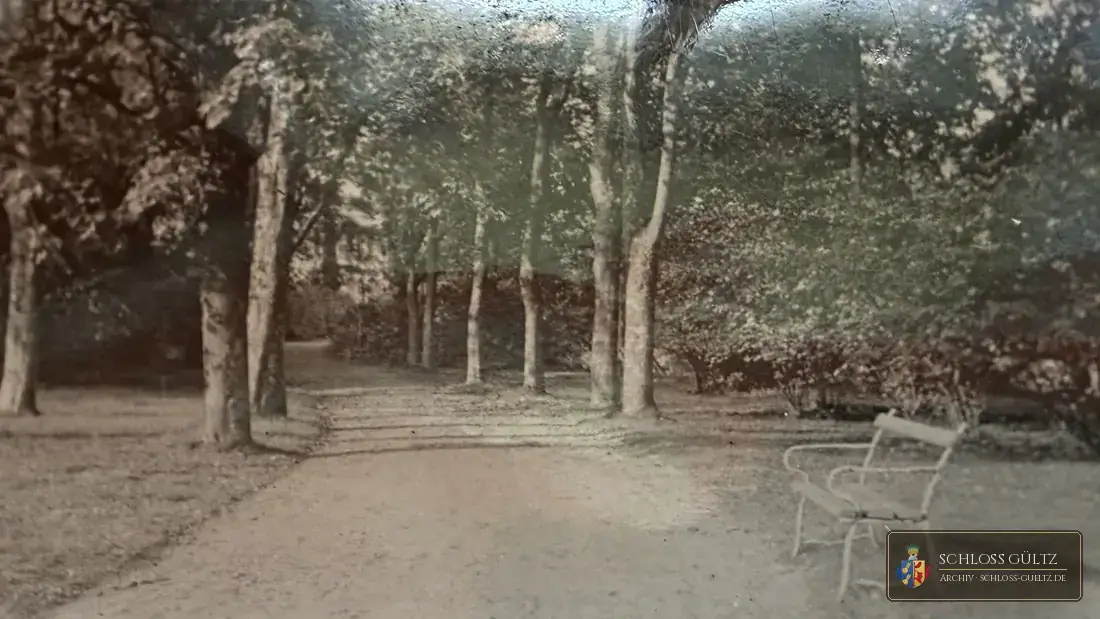
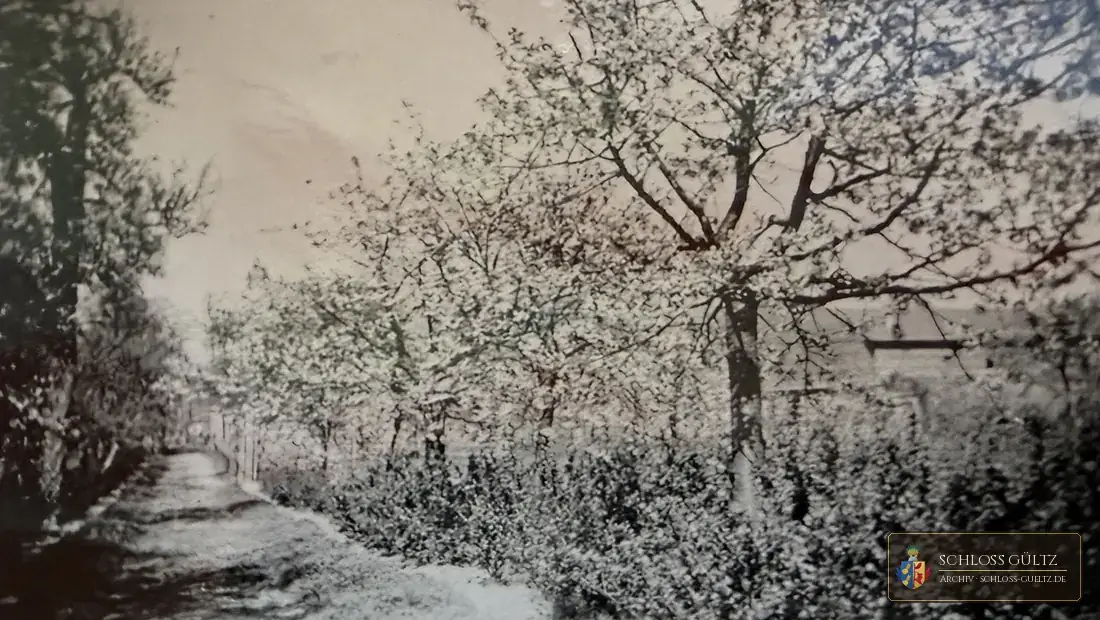


The places can still be found today. If you would like to see them: tours of the manor and park on request.
The park in pictures


Experience the park
The Lenné park is part of the Schloss Gültz ensemble and can be visited on guided tours or during events.
Sources & literature
• Prof. Dr.-Ing. Sabine Bock: Peter Joseph Lenné und das pommersche Tollensetal – Ein Frühwerk der preußischen Landesverschönerung, in: Pommern – Zeitschrift für Kultur und Geschichte, vol. 64, issue 2/2025, pp. 18–23
• Harri Günther, Sibylle Harksen: Peter Joseph Lenné. Pläne für Stadt und Land. Bestandskatalog der Lennépläne in der Plankammer der Staatlichen Schlösser und Gärten Potsdam-Sanssouci, part III: Stadt und Land, Potsdam 1990
• Lutz Mecke, Norman Kühn: Gültz – Schlosspark. Bestandserfassung – Entwurf – Erhaltung, master’s thesis, Hochschule Neubrandenburg, Department of Landscape Sciences and Geomatics (supervised by Prof. Dr.-Ing. Elke Mertens, Dipl.-Ing. Stefan Pulkenat), January 2011 – online
• Hochschule Neubrandenburg, Landscape Architecture programme, Historic Garden Conservation: update of the conservation objectives for the Gültz manor park, winter semester 2023/24 (on-site survey in September 2023; unpublished)
• Budget by-law of the municipality of Gültz for the 2026 financial year (adopted 10 March 2026) with supervisory order of 11 June 2026, Amt Treptower Tollensewinkel
• Alexander Duncker: „Die ländlichen Wohnsitze, Schlösser und Residenzen", vol. XIII, sheet 763 (1873)
• Pommersche Lebensbilder, vol. II, pp. 266–280 (1936)
• Real property cadastre of Mecklenburg-Vorpommern: parcel record, cadastral district of Gültz, Flur 14 (manor property, official area 22,103 m²)
• Unpublished family chronicle “Gültz – Aus dem Leben meiner Vorfahren” (private collection)
• Lenné plan, Stiftung Preußische Schlösser und Gärten Berlin-Brandenburg, SPSG 3483 (1840)
• Ordnance survey map (Messtischblatt) 2245 Gültz, Königlich Preußische Landesaufnahme (1886)
• Hearing of the Landkreis Mecklenburgische Seenplatte district on listed monument protection (25 March 2021)