

Gültz lies between two garrisons: to the west rode the Demmin uhlans, while to the east, in Pasewalk, the Queen’s cuirassiers were stationed for almost two centuries. The von Maltzahn-Gültz family was connected with the Pasewalk regiment over three generations – from the builder of the manor through his sons to a grandson who still served in the successor regiment. We have gathered together what can be documented, and we openly indicate what still needs to be clarified.
The Queen’s Regiment
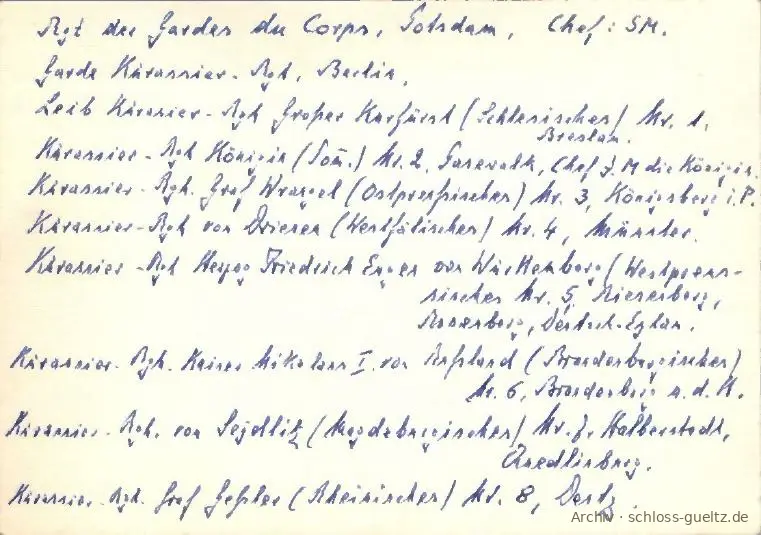
The regiment was raised by cabinet order of 2 April 1717 and commissioned at Halberstadt on 1 June 1717; its first colonel-in-chief was Colonel Achaz von der Schulenburg. From 1721 to 1919, with brief interruptions, it was stationed in Pasewalk – for so long that “the Pasewalk cuirassiers” became an established term. Its names mirror Prussian history: under colonels-in-chief from the House of Brandenburg-Bayreuth it was called the “Bayreuth Dragoons”, later the “Ansbach-Bayreuth Dragoons”. In 1806 Queen Louise became its colonel-in-chief, and the regiment was now called the “Queen’s Dragoons”; after her death the King decreed on 4 August 1810 that it should bear the name “Queen’s Regiment” “for ever”. In 1819 it was converted into a cuirassier regiment, and from 4 June 1860 it was named the Cuirassier Regiment “Queen” (Pomeranian) No. 2. Its colonels-in-chief were the Prussian queens in succession, among them Elisabeth (1840–1861), Augusta (1861–1888) and Auguste Viktoria (1888–1919).
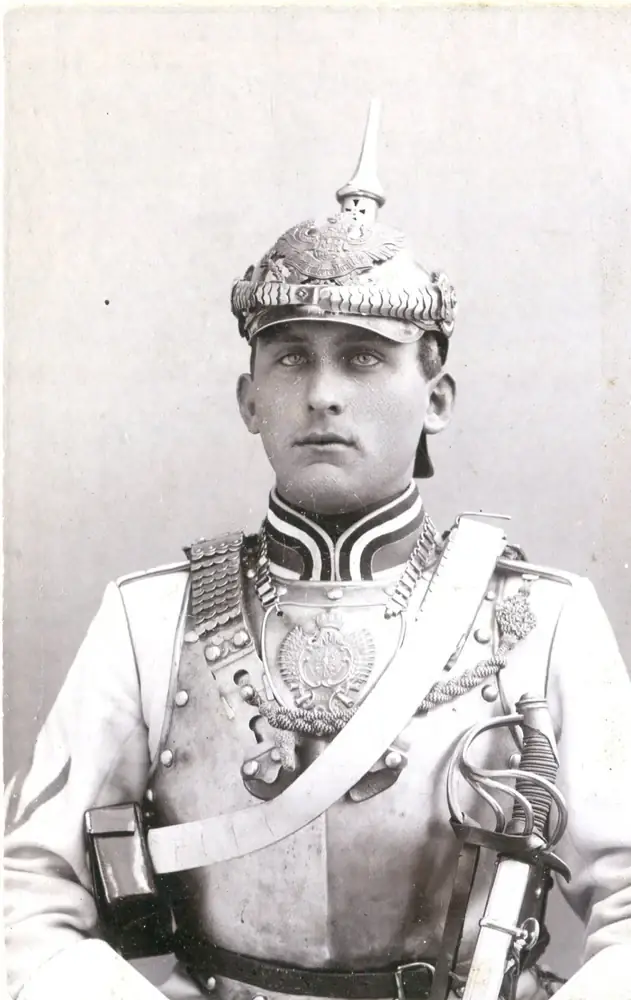
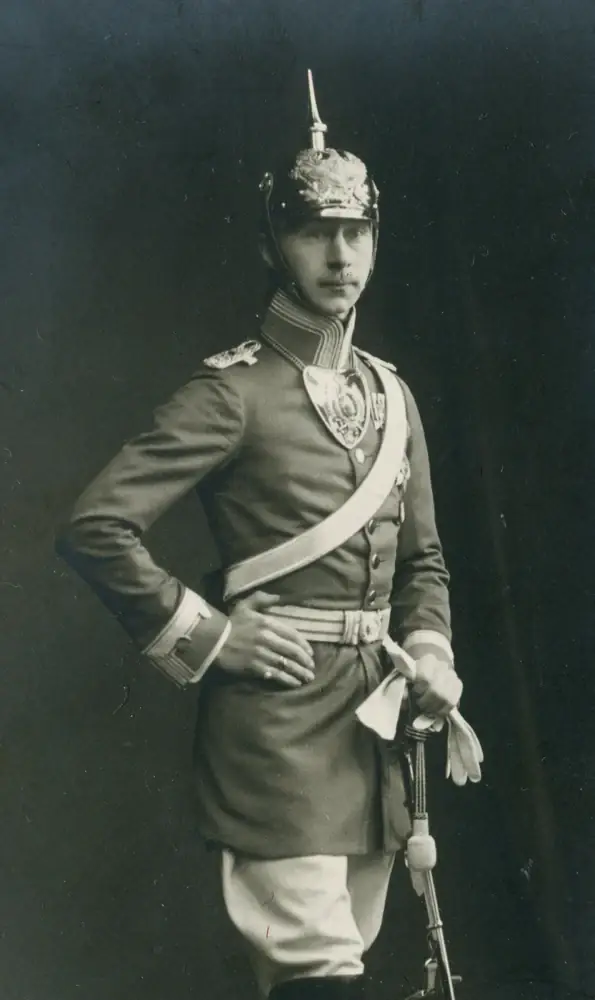
Its fame was founded on 4 June 1745. At the Battle of Hohenfriedberg the Bayreuth Dragoons rode a charge that is regarded as one of the most famous in the history of the Prussian cavalry: they captured 67 colours, five cannon and 2,500 prisoners. From then on the date was borne on the bandeau of the helmet – “Hohenfriedberg 4 June 1745” – and the regimental song “Up, Ansbach Dragoons, up, Ansbach-Bayreuth” was sung to the tune of the Hohenfriedberger March. The peacetime uniform was magnificent: a white tunic (Koller), crimson facings, silver buttons and braid, together with the cuirassier helmet of tombac.
The regiment fought in the Silesian Wars and the Seven Years’ War, was almost wiped out at Jena and Auerstedt in 1806, and stood at Ligny and Belle-Alliance in 1815. In 1866 it marched into Bohemia and fought at Königgrätz and before Pressburg; in 1870/71 it fought at Colombey-Nouilly (14 August) and Gravelotte–St. Privat (18 August) as well as before Metz and Thionville. In peacetime the Pasewalk cuirassiers formed the 3rd Cavalry Brigade in Stettin together with the Demmin uhlans; both regiments went to war together in 1914. The regiment was disbanded in 1919.
The source: the “Gedenkblätter der Königin-Kürassiere”
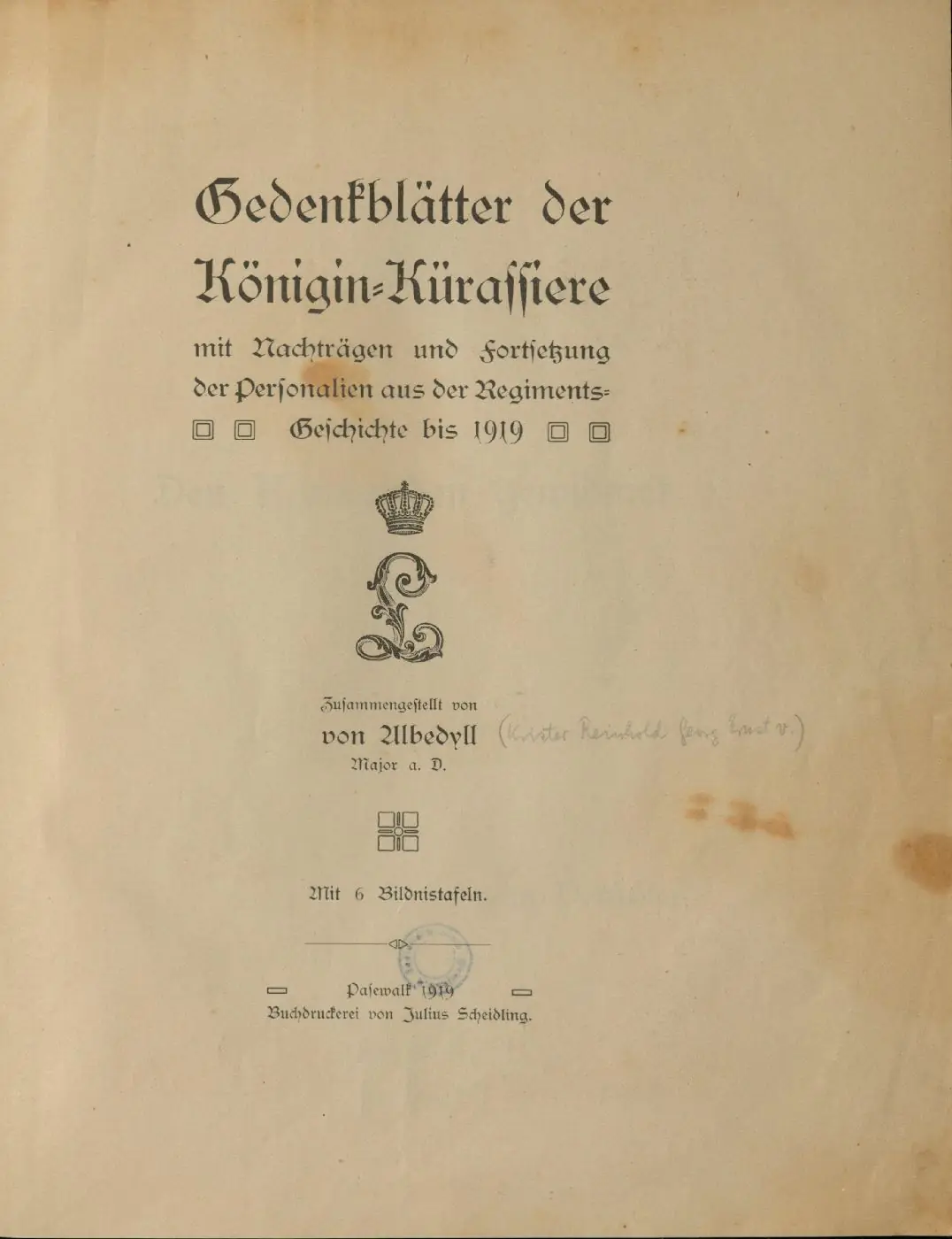
In 1919, after the regiment was disbanded, Major (retd) Krister von Albedyll published the “Gedenkblätter der Königin-Kürassiere” in Pasewalk – a continuation of Georg von Albedyll’s great regimental history, with the personal details of all officers, including the reserve officers since 1868. Greifswald University Library has digitised the booklet. It names the Maltzahns of Gültz with their full baptismal names and service dates, and thus settles what had previously been open.
The builder: with the Queen’s Cuirassiers in 1866 and 1870/71
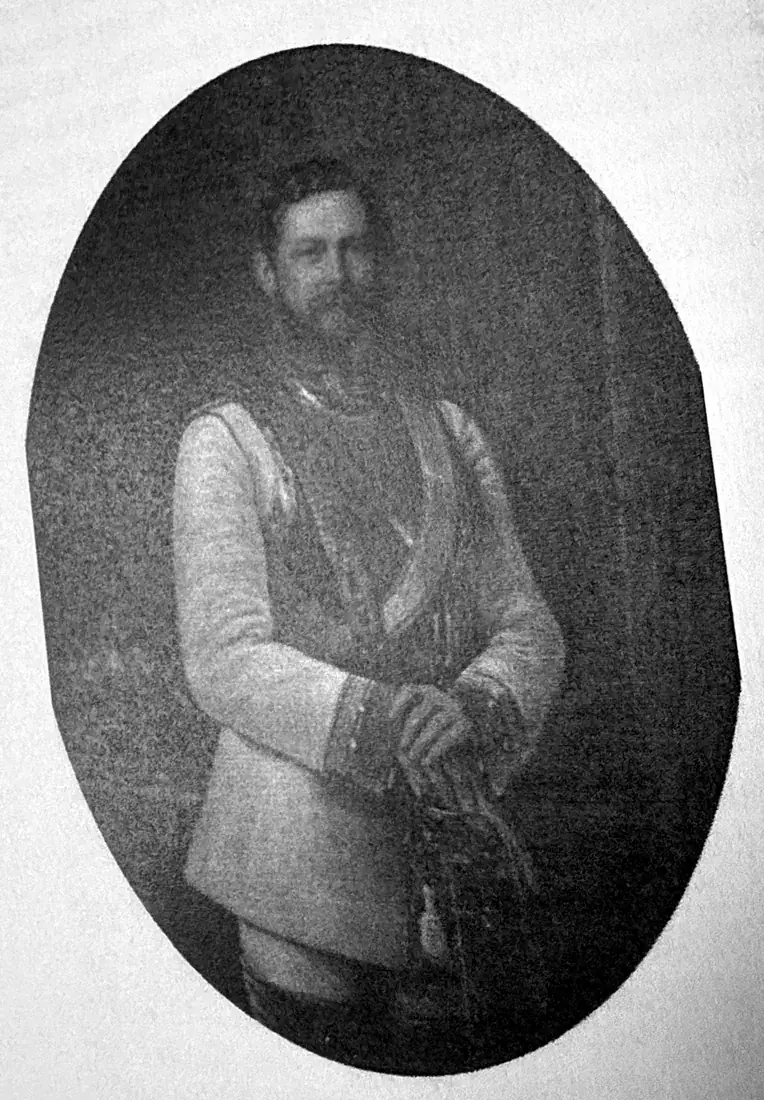
Helmuth Ludwig Wilhelm Freiherr von Maltzahn (1840–1923), the builder of Schloss Gültz, served his year as a one-year volunteer in 1859/60 with the 2nd Guard Uhlan Regiment in Berlin and became a lieutenant of the Landwehr cavalry in 1861. When the Cuirassier Regiment “Queen” was mobilised on 4 May 1866, he was called up to the regiment that very day; on 23 May the cuirassiers rode out of Pasewalk, entrained at Angermünde and fought in Bohemia, returning on 10 September. In 1868 Maltzahn was transferred to the regiment’s reserve officers.
On 16 July 1870 he was again called up to the regiment and went with it to France. On 28 November 1870 he was severely wounded at Beaune-la-Rolande – hence the stiffness in his arm that remained with him. For the campaign he received the Iron Cross 2nd Class; in November 1871 he left military service with a pension. While he was in the field, work on the building site at Gültz was suspended: the house had its roof on and the windows were bricked up. In 1895 he was granted permission to wear the uniform of his regiment’s reserve officers again.
The sons: three reserve officers
The Gedenkblätter record a fine detail: in 1897 the father and his three sons were all wearing the regiment’s uniform at the same time. All three sons served with the Queen’s Cuirassiers and became officers there:
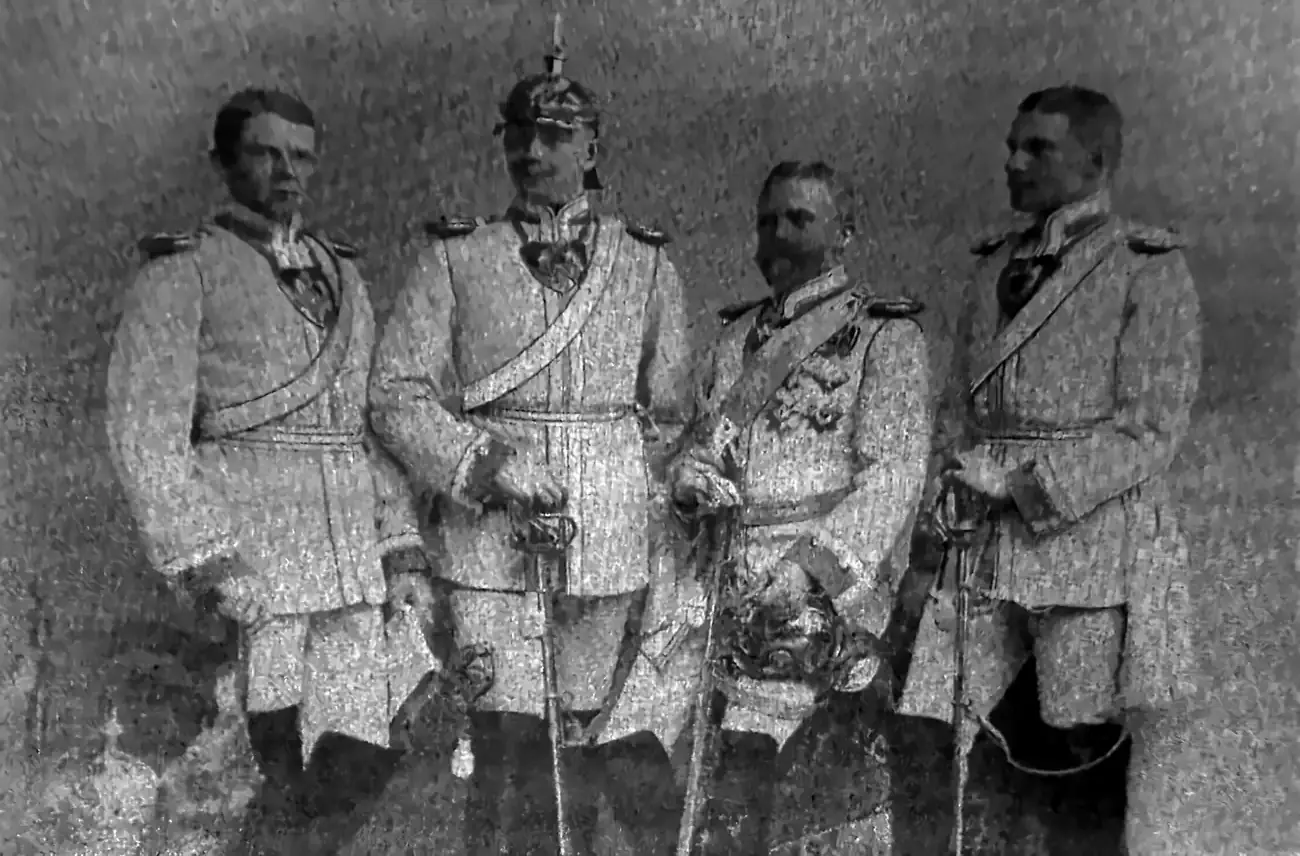
- Axel Ludwig Julius (1868–1931), later Landrat (district administrator) in Grimmen and lord of Gültz: one-year volunteer 1890/91, lieutenant of the reserve 1891, first lieutenant 1900, Rittmeister (cavalry captain) 1908. In August 1914 he took over Infantry Ammunition Column 2 of II Army Corps and for a time commanded the combat train of the 3rd Infantry Division; in 1915 he was released for service with the Ministry of Agriculture (stages in Axel von Maltzahn’s life).
- Helmuth Gustav Ferdinand Friedrich (1870–1959), Landrat in Prenzlau and later lord of Schossow: one-year volunteer 1893/94, lieutenant of the reserve 1895, first lieutenant 1906, Rittmeister 1912. In 1914/15 he was commander of the staff guard and commandant of the headquarters of XXIII Reserve Corps in Flanders.
- Gerhard Adolf (1877–1945), lord of Wodarg: he was a regular officer in the regiment and transferred to the reserve officers in 1904; Rittmeister in 1913. In the First World War he was an orderly officer on the staff of the 3rd Infantry Division, then with General Command 56, and from 1917 commanded a battalion of Landwehr Infantry Regiment 74. He received the Iron Cross 1st Class and the Knight’s Cross with Swords of the Royal House Order of Hohenzollern. This also confirms that the “Gerhard Adolph” in the list of officers is the son from Gültz.
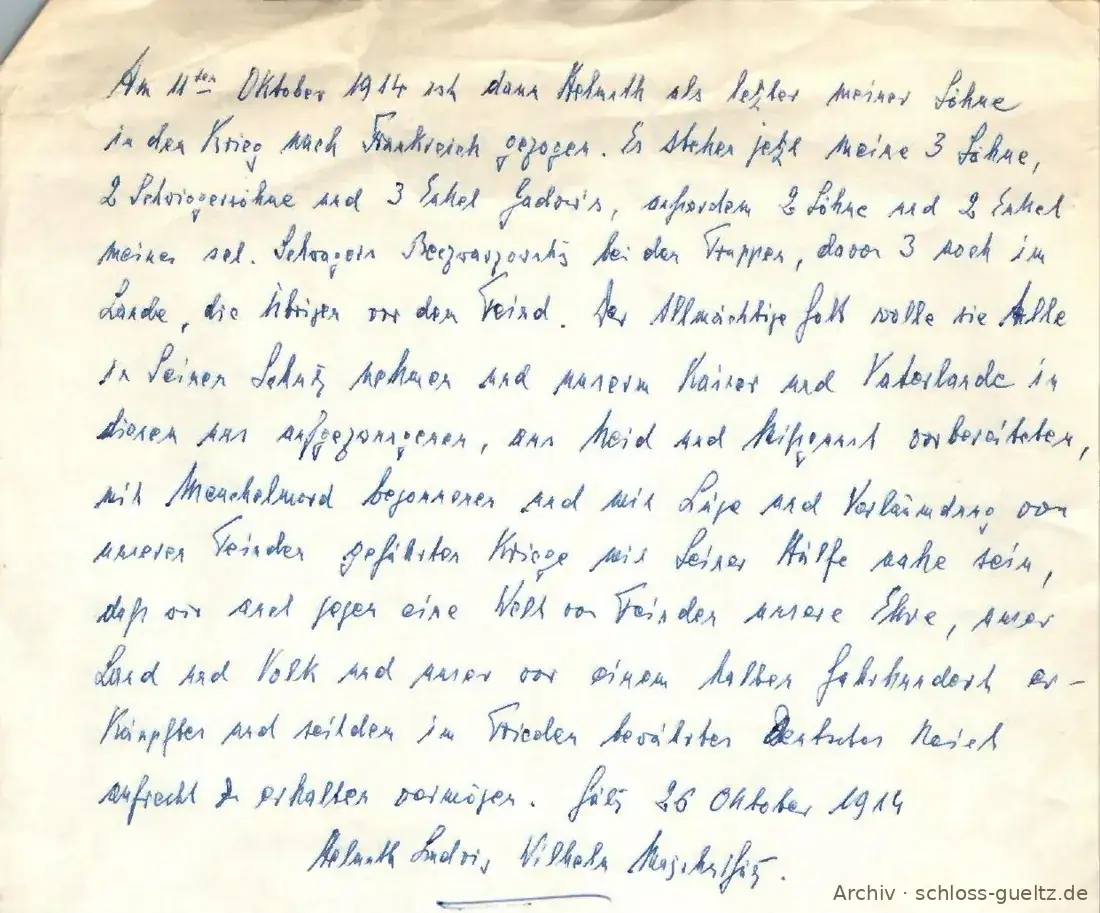
In the autumn of 1914 the father recorded at Gültz how many members of the family were in the field: “On 11 October 1914 Helmuth, the last of my sons, then went off to the war in France. There are now my 3 sons, 2 sons-in-law and 3 Gadow grandsons, as well as 2 sons and 2 grandsons of my late sister-in-law Beczwarzowsky serving with the troops, 3 of them still at home, the others facing the enemy.” The entry closes entirely in the tone of those first months of the war: “May Almighty God take them All into His protection and with His help be near to our Emperor and Fatherland in this war forced upon us …, so that even against a world of enemies we may uphold our honour, our land and people, and our German Empire, won by fighting half a century ago and preserved in peace ever since.” It is signed “Gültz 26 October 1914, Helmuth Ludwig Wilhelm Maltzahn-Gültz”.
The grandsons: to the very last day – and beyond
The third generation also served in the regiment: among the officer cadets (Fahnenjunker) who were with the regiment on 9 November 1918, the Gedenkblätter name Helmuth Ludwig Joachim Freiherr von Maltzahn – Axel’s eldest son (1900–1984), later the last lord of the manor at Gültz. Three generations of the Gültz family thus served with the Queen’s Cuirassiers.
After 1919, in the Reichswehr, the 1st Squadron of the 6th (Prussian) Cavalry Regiment in Pasewalk took over the regiment’s traditions. It was here, in 1931, that Günther Freiherr von Maltzahn (1910–1953) began his military career – a son of Gerhard, born at Wodarg. In 1935 he transferred to the Luftwaffe.
Maltzahns in Pasewalk – a widely branched family
The regiment’s list of officers names thirteen members of the family between 1717 and 1919. At least five of them belong to the Gültz line – the builder, his three sons and his grandson. The others came from other branches of the large family; the list shows how closely the nobility of Western Pomerania was bound to “its” regiment in Pasewalk.
Pictures from the Pasewalk garrison
Further historical photographs show the barracks with their Neo-Gothic brick architecture, the horsemen in parade and service uniform, and a picture that can be identified with certainty with the help of the Gedenkblätter.
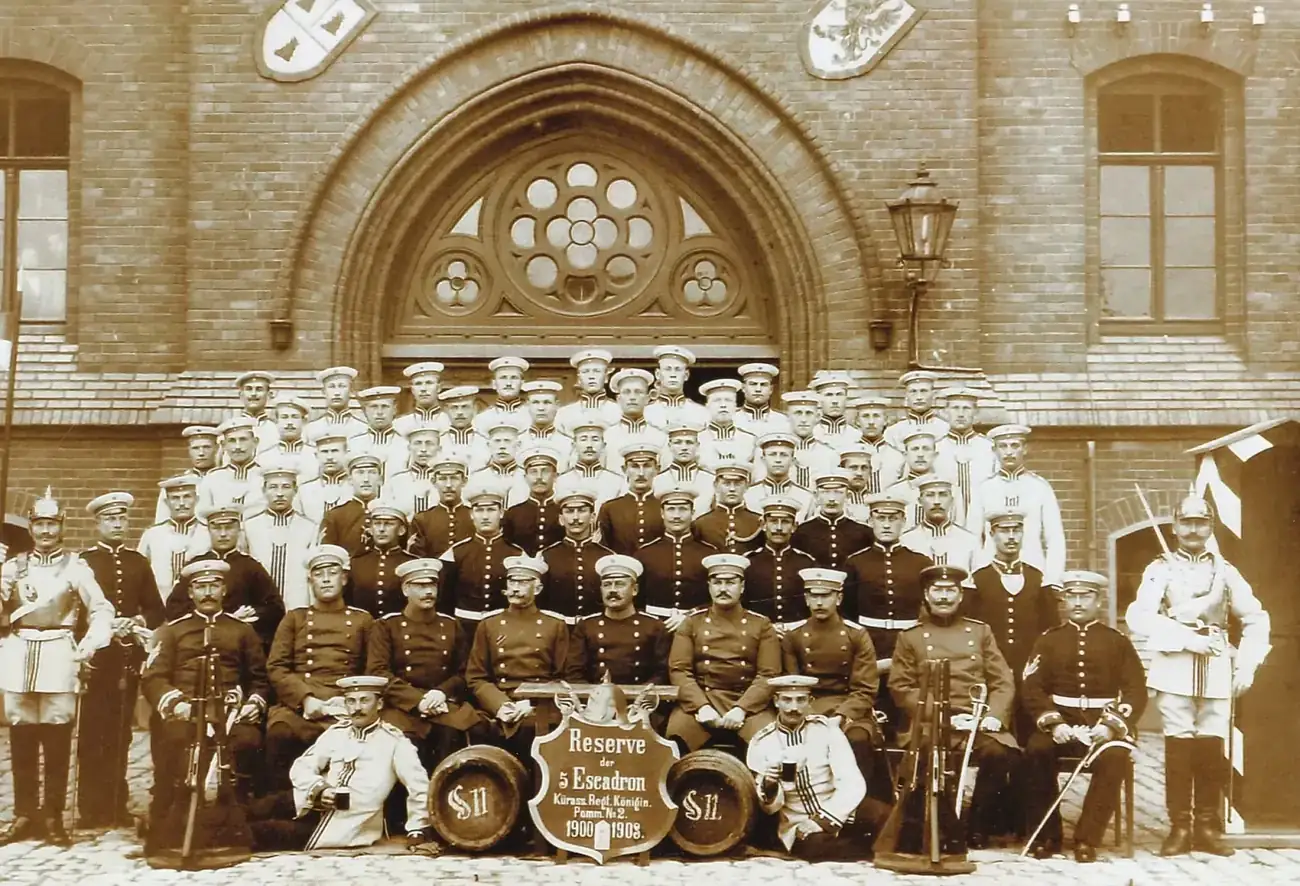
Every year’s intake had such reservist pictures made as a farewell: in the cavalry, active service lasted three years, after which the men went “into the reserve”. A sign, barrels and tankards are standard features of these pictures – the photograph was a keepsake for each individual and later hung in many farmhouse parlours across Western Pomerania.
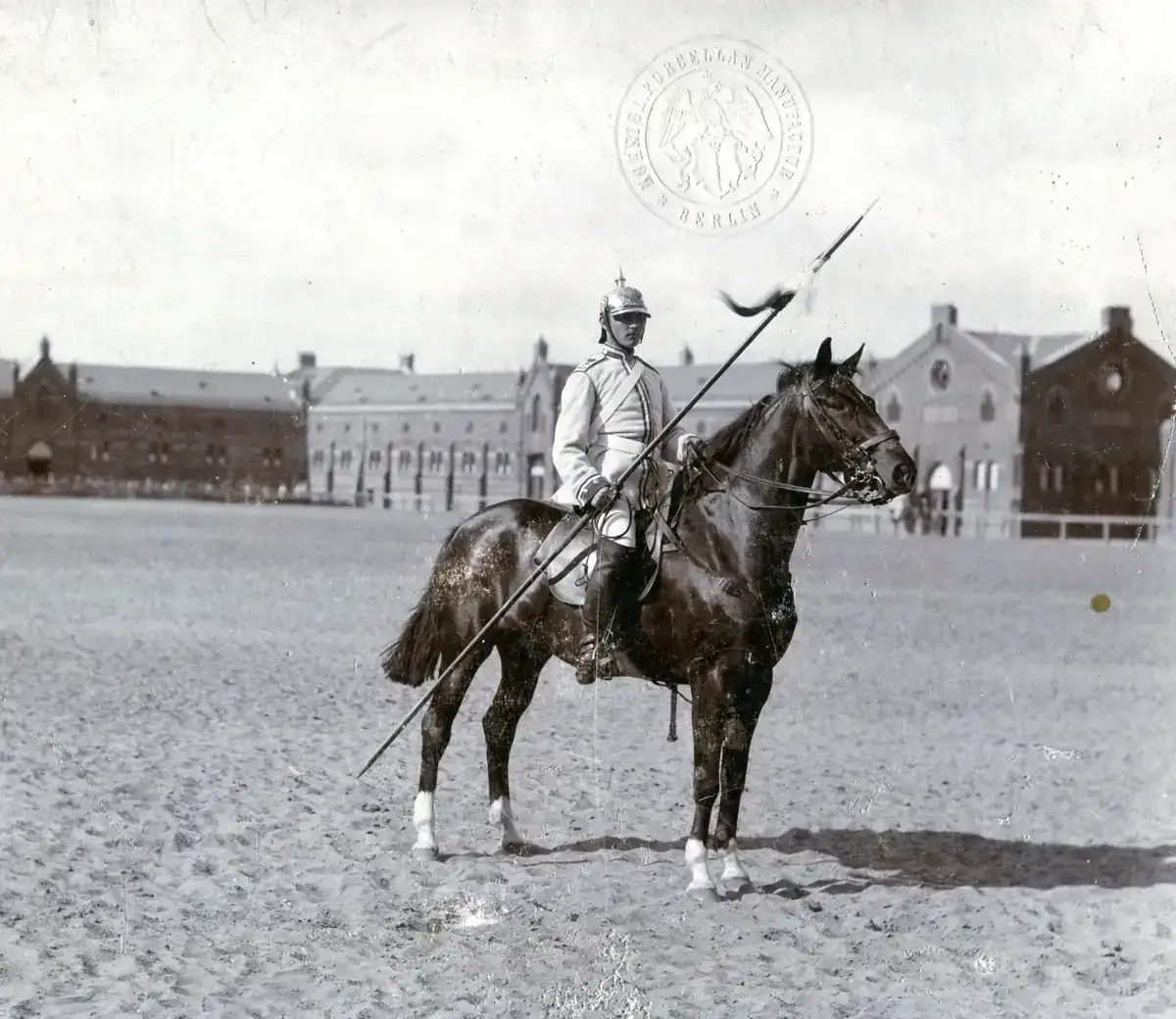
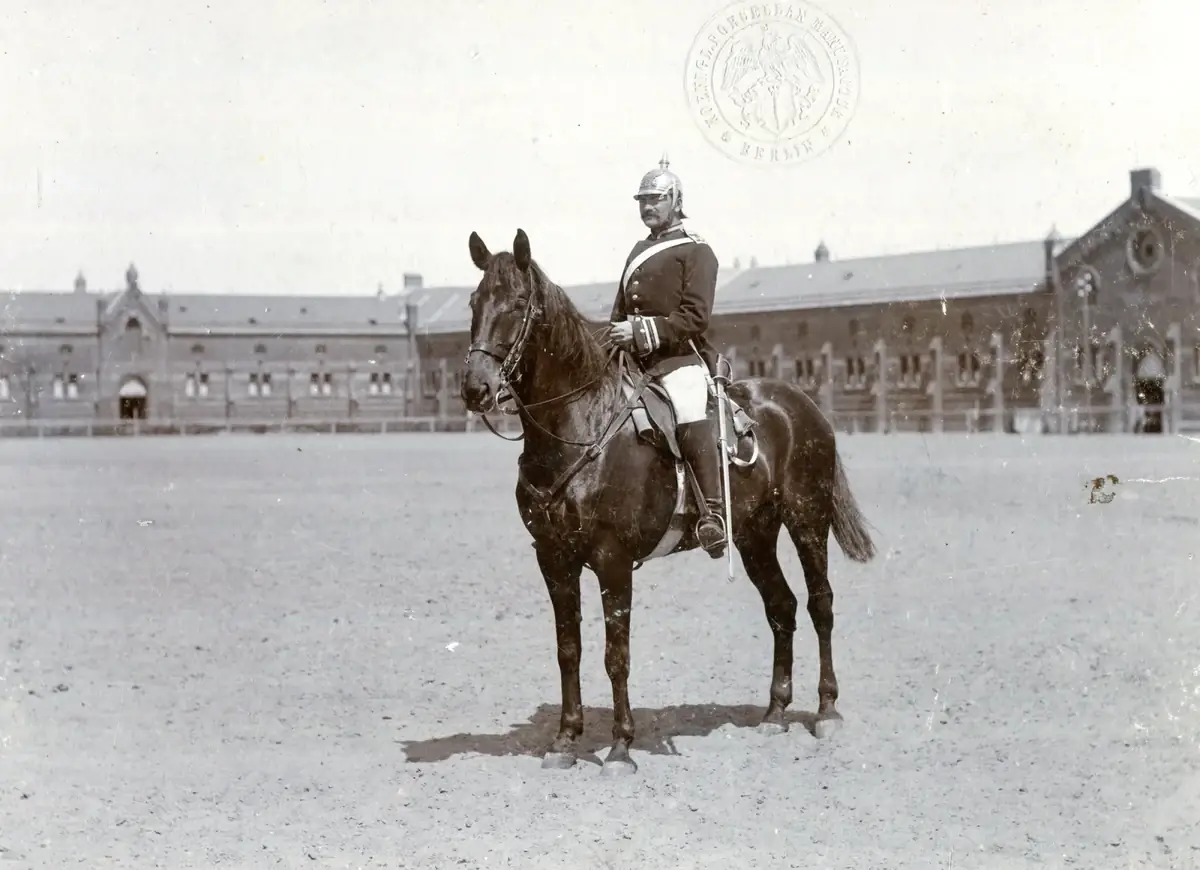
The two equestrian pictures bear the round embossed stamp of the Königliche Porzellan-Manufaktur Berlin with the Prussian eagle. This suggests that the prints come from the KPM’s holdings. The manufactory also produced porcelain with military motifs, and photographs served the painters as models. Whether these two photographs were taken for a particular piece is not documented. Nor is the location expressly identified: the long brick buildings with round windows in the gables match the Pasewalk cuirassier barracks as seen in the photographs of 1911.
The lance in a cuirassier’s hand is remarkable. From 1890 the entire German cavalry – no longer only the uhlans – was issued with the tubular steel lance. The photograph therefore cannot have been taken before 1890.
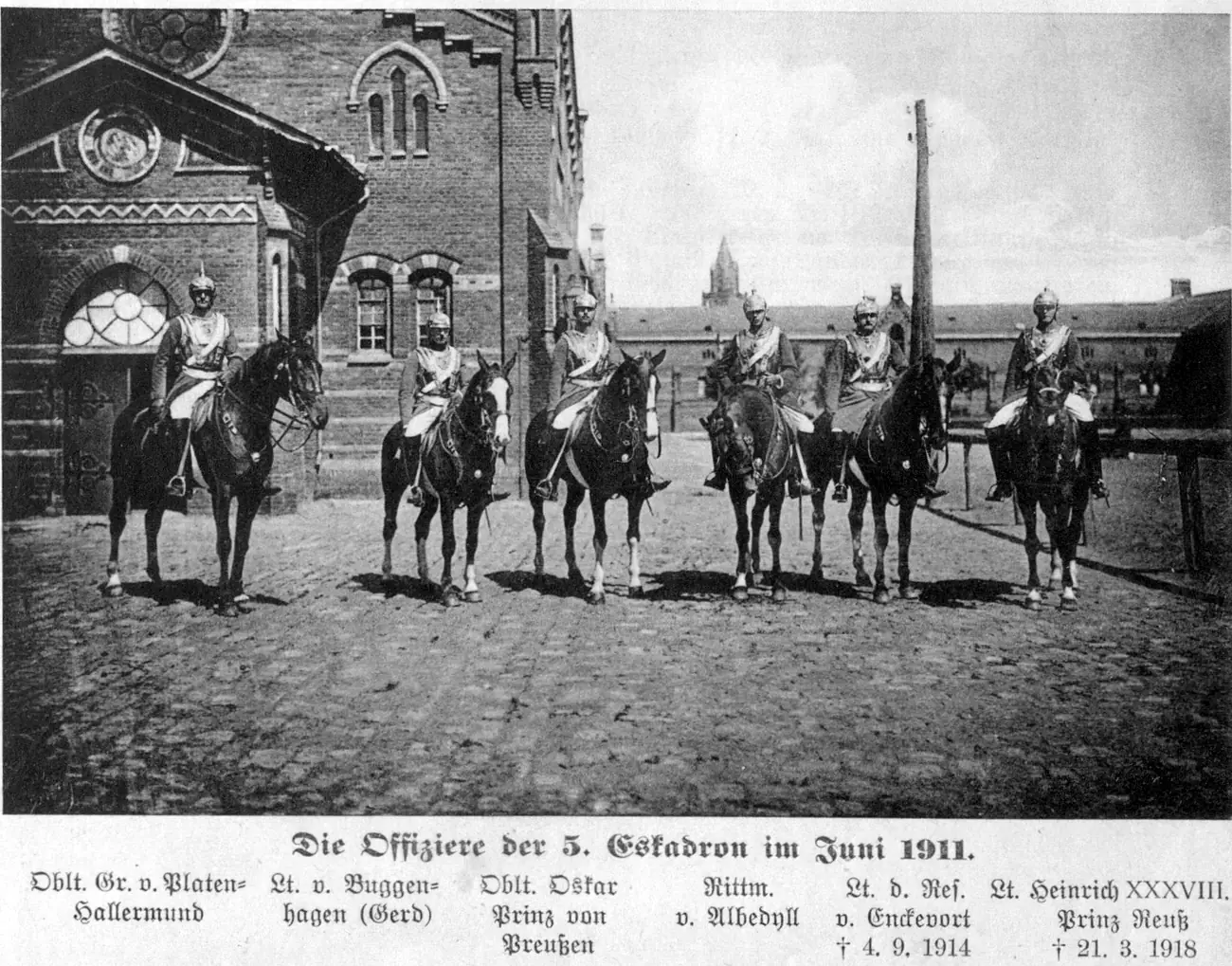
The memorial pages contain two further photographs from regimental life, shown here from the digitised copy held by Greifswald University Library. The first shows the officers of the 5th Squadron in June 1911 in front of the barracks. Among them is First Lieutenant Prince Oskar of Prussia, a son of Kaiser Wilhelm II, who was then serving in the squadron.
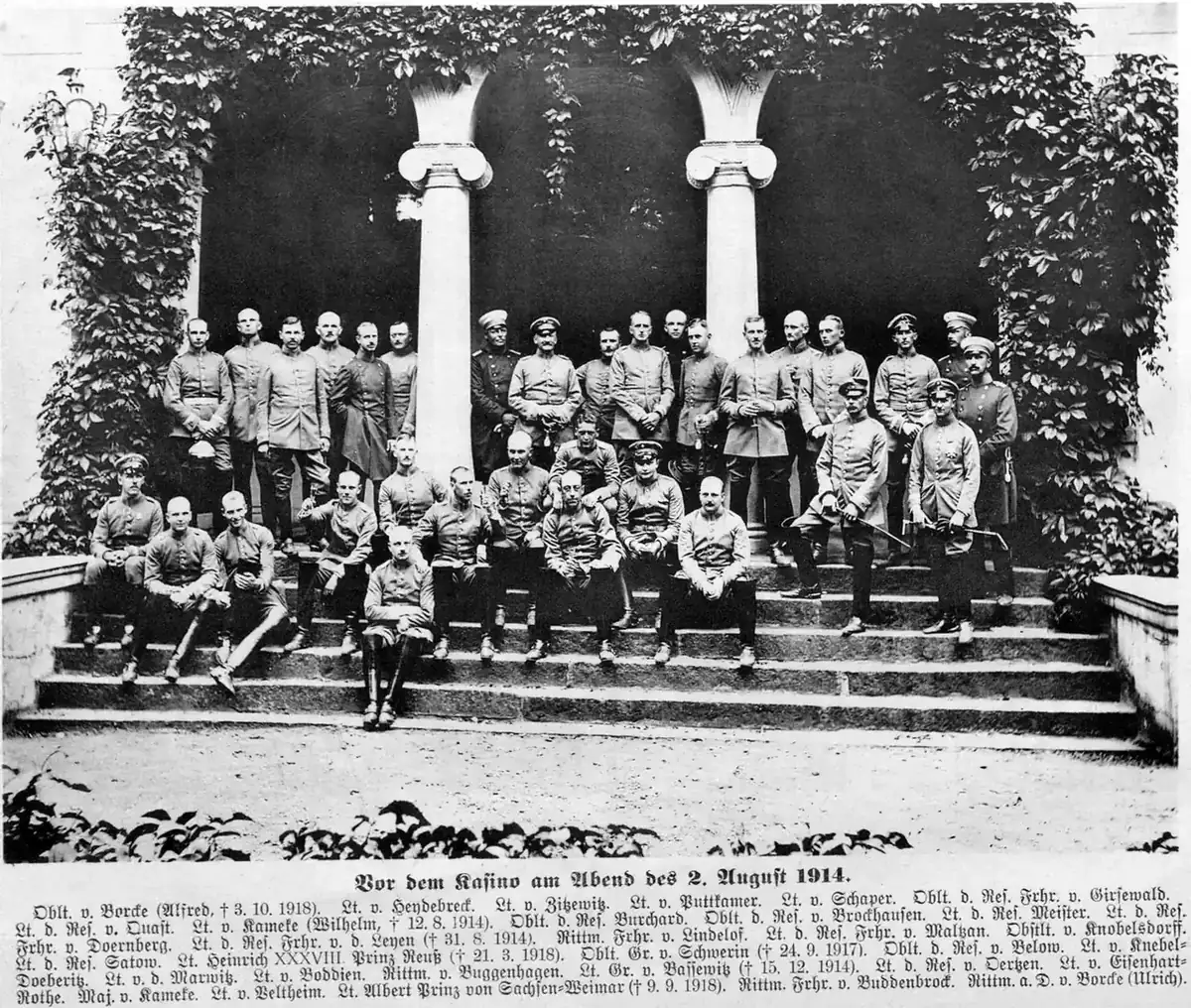
The second photograph was taken on the evening of 2 August 1914, the second day of mobilisation, in front of the officers’ mess. The list of names beneath it also includes a “Lt. d. Res. Frhr. v. Maltzan” (lieutenant of the reserve). This cannot be one of the sons of Gültz: by 1914 Axel, Helmuth and Gerhard were already captains of horse in the reserve. The man in question belonged to another branch of the family. Many names on the list are followed by a cross and the date of death – a large proportion of the officers on the steps fell in the war.
Traces today
In Viereck near Pasewalk, the barracks of Armoured Infantry Battalion 411 bear the name “Kürassier-Kaserne” (Cuirassier Barracks), and on the anniversary of the battle the battalion marks “Hohenfriedberg Day”. Anyone planning an outing from Gültz to the old garrison towns will find in Pasewalk and Demmin two towns whose history cannot be told without their cavalrymen – more on Demmin in our article The Demmin Uhlans and Schloss Gültz.
Do you have photographs, rank lists or letters of the Pasewalk cuirassiers connected with the von Maltzahn-Gültz family – perhaps further pictures of the Gültz Maltzahns in the white tunic, or information on the people in the photographs above? We welcome every piece of information: schlossgueltz@gmx.de
Sources: entry by Helmuth Frhr. v. Maltzahn-Gültz, Gültz 26 October 1914, later handwritten copy (Archiv Schloss Gültz); [Krister] von Albedyll (comp.), Gedenkblätter der Königin-Kürassiere mit Nachträgen und Fortsetzung der Personalien aus der Regimentsgeschichte bis 1919, Pasewalk 1919 (digitised copy: Universitätsbibliothek Greifswald / Digitale Bibliothek Mecklenburg-Vorpommern, PPN1832524388, Public Domain Mark 1.0) – list of reserve officers 1868–1919, personal records II nos. 4, 58, 69, 91 and I no. 775, officer cadets 1918, plates “Wilhelm, Kronprinz des Deutschen Reiches und von Preußen”, “Vor dem Kasino am Abend des 2. August 1914” and “Die Offiziere der 5. Eskadron im Juni 1911”; the same, Die alte Garnisonstadt Pasewalk, Pasewalk 1925 (ibid., PPN1932650121); Georg von Albedyll, Geschichte des Kürassier-Regiments Königin (Pommersches) Nr. 2, 2 parts, Berlin 1896–1904; Friedrich Birkholz, “Maltzahn-Gültz, Helmuth Freiherr von”, Kulturstiftung der deutschen Vertriebenen; Pommersche Lebensbilder II, Stettin 1936, pp. 266–280; Institut Deutsche Adelsforschung, “Offizierkorps des Kürassier-Regiments Königin 1717–1919”, adelsquellen.de; Wikipedia, articles “Kürassier-Regiment ‚Königin‘ (Pommersches) Nr. 2” and “Günther von Maltzahn” (accessed 2 October 2026); Bundeswehr, Panzergrenadierbataillon 411, Viereck.