
West of the village, by the boundary ditch towards Seltz, lies a plot of land with the uninviting name of Jammertal.The soil is stony and was never willingly ploughed. In 1909 it came to light why the stones lay so thickly there: beneath them was a burial ground some three thousand years old. The “Monatsblätter” of the Gesellschaft für Pommersche Geschichte und Altertumskunde reported on it in detail; Greifswald University Library has digitised the volume.
How the Jammertal “saved” Gültz
The report begins with a village tale told in the area: in the revolutionary year of 1848, the democrats of the whole district were said to have gathered in neighbouring Seltz and resolved to divide up the surrounding noble estates. Gültz, too, had supposedly already been shared out – except for the Jammertal, which nobody wanted. A quarrel broke out over it, the meeting ended in a proper brawl, and nothing came of the division. “Thus the Jammertal saved the possession of Gültz for the Lords v. Maltzahn.”
Summer 1909: stone blasters find urns
Stone was a sought-after building material at the time. When boulders were being blasted and broken out in the Jammertal, the workers came across urn sherds. The lord of the estate – Helmuth Freiherr von Maltzahn, then Oberpräsident (Governor) of the Province of Pomerania – learnt of it only when the work was almost finished. In mid-July 1909 he personally showed the site to the Stettin antiquarian A. Stubenrauch, who secured the finds for the Provincial Museum.
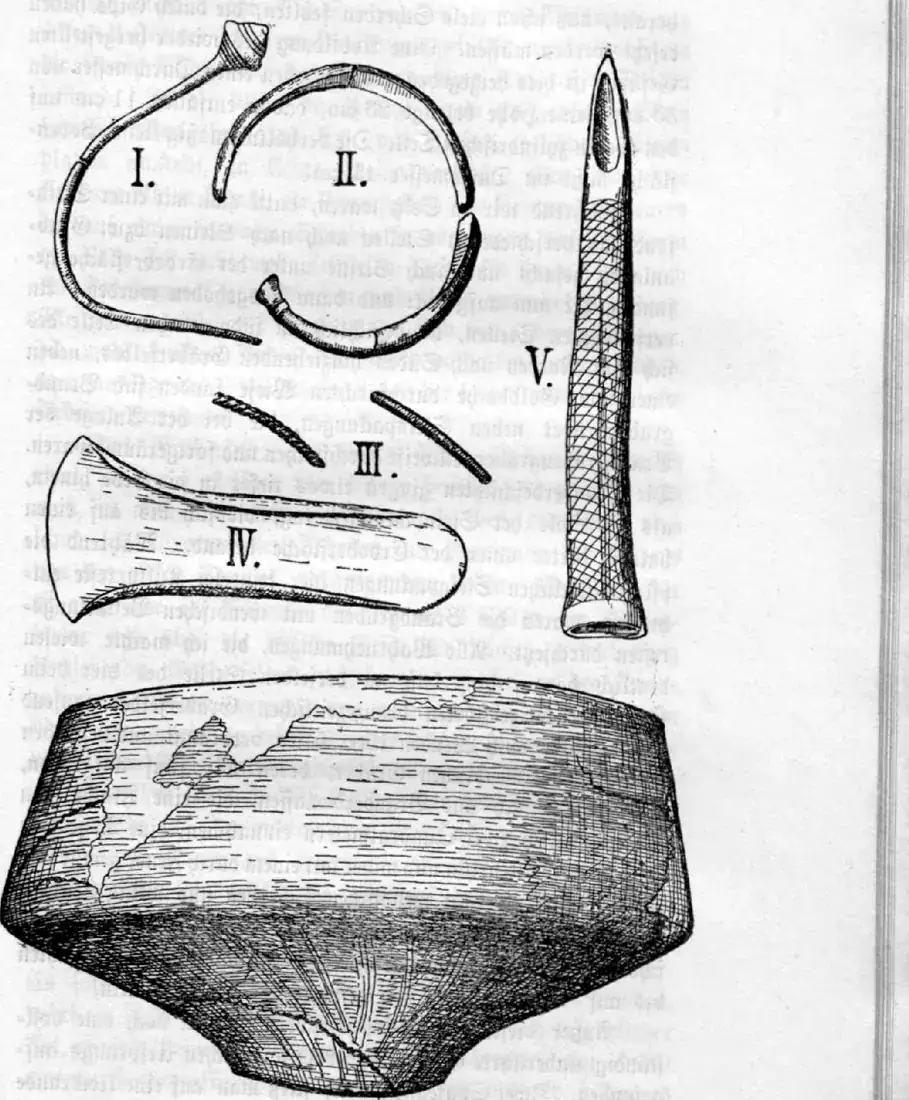
Most of the stone settings had already been destroyed, but what was found was remarkable: a large Bronze Age urn with a cylindrical neck, some 33 centimetres in diameter – the teacher in nearby Seltz had kept the sherds, and it was reassembled at the Stettin museum. Inside lay grave goods: a bronze pin with a biconical head, fragments of an arm ring and bronze wires. In his follow-up excavation Stubenrauch found five Wendish cremation graves and an undisturbed Bronze Age grave structure: a stone circle four metres across made of heavy boulders, paved inside, with the urn placed in the centre. His conclusion: at the same spot where urns were buried in the Bronze Age, Slavs had also cremated and buried their dead some thousand years later. According to the workers, the burial ground, which extended a good 500 metres along the edge of the meadow, is likely to have contained a hundred urns or more.
An Oberpräsident as local historian
After the researcher had left, Maltzahn had the digging continued, found another undisturbed Bronze Age grave and sent all the finds to the Stettin museum. In a letter printed by the Monatsblätter he also corrected the map: the ditch east of the burial ground was not the “Goldbeck”, but only flowed into it at the south-eastern end of his land – and this mattered to him, because the name Goldbeck was “at precisely this spot the oldest German place name” in the area, already mentioned in a medieval charter as the boundary of the monastic estate of Treptow. For thirty years, he wrote, he had been trying in vain to have an error in the General Staff map corrected.
In the manor itself, the master of the house kept at that time a small collection of prehistoric finds from the Gültz fields: flint and granite axes, including a rare perforated granite axe, spindle whorls, bone spearheads and a bronze celt from the bog. What of it survived after 1945 is not known. The finds given to Stettin went to what was then the Provincial Museum, whose collections were scattered after 1945. Whether the pieces from Gültz have survived is something we still hope to establish.
Historical research ran in the family: in the same year Maltzahn, as Oberpräsident, opened the general assembly of the Gesellschaft für Pommersche Geschichte, and in 1911 he founded the Historical Commission for Pomerania. As the family history by Berthold Schmidt notes, the Gültz estate archive even held parts of the handwritten papers of Friedrich Lisch, the great Schwerin archivist and editor of the charters of the Maltzan family. The estate archive was lost in 1945.
Do you know more about the finds from the Jammertal or the prehistoric collection in the manor? We welcome any information: schlossgueltz@gmx.de
Sources: A. Stubenrauch, “Ein bronzezeitliches Gräberfeld mit wendischen Gräbern und Einzelfunde in Gültz, Kreis Demmin”, in: Monatsblätter der Gesellschaft für Pommersche Geschichte und Altertumskunde 23 (1909), pp. 150–156, addendum p. 180 f.; ibid., report on the general assembly of 22 May 1909 – digitised copy: Universitätsbibliothek Greifswald / Digitale Bibliothek Mecklenburg-Vorpommern (PPN883720280_1909), Public Domain Mark 1.0; Berthold Schmidt, Geschichte des Geschlechts von Maltzan und von Maltzahn, Part I vol. 1 (1900) and Part II vols. 1–2 (1907–1915), references to Lisch’s papers in the Gültz archive (digitised copies ibid.).