
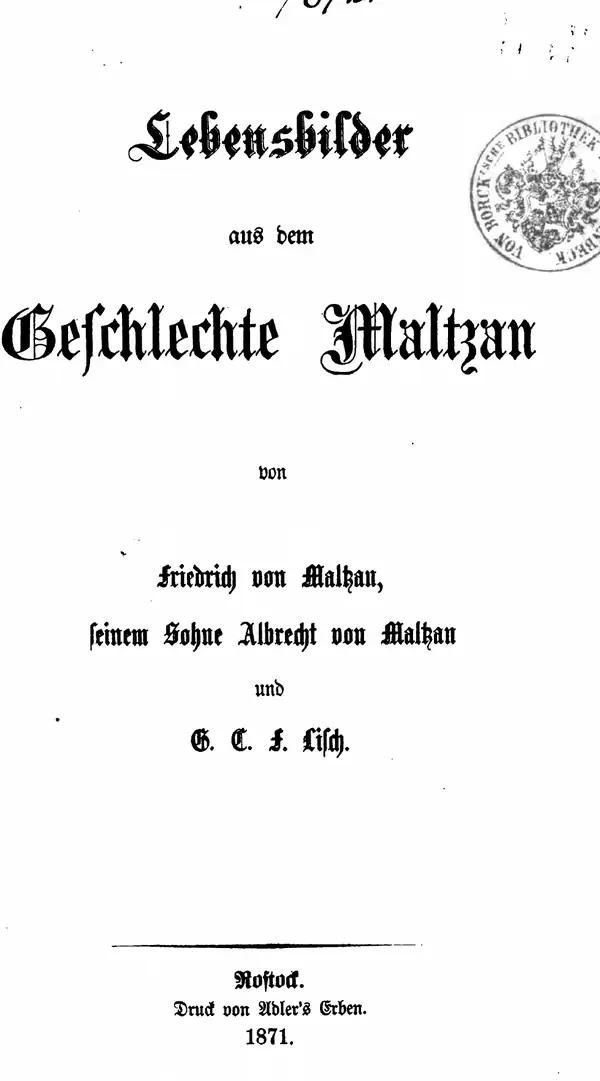
How did Gültz come to the Maltzahns? The answer leads back to the turbulent years around 1490, to a feud between a Pomeranian duke and one of his most powerful knights. It is told in a book the family had printed in Rostock in 1871: the Lebensbilder aus dem Geschlechte Maltzan (Portraits from the Maltzan Family), written by District Administrator Friedrich von Maltzan of Rothenmoor, his son Albrecht and the Schwerin archivist Friedrich Lisch.
Sir Berend of Wolde
At the centre of the story stands Sir Berend (Bernd) Maltzan, hereditary marshal of Pomerania and lord of the castle of Wolde near Stavenhagen – a fortress “such as the Duke had nowhere in the whole land”. Berend was a wealthy and self-assured man. He lent money, built himself a house in Demmin which, under a settlement of 27 September 1483, he was permitted to build “more handsomely than those of the burghers” and keep free of municipal charges, and he bought land.
1484: The village of Gültz is purchased
The first acquisition in Gültz falls in these years. According to the Lebensbilder, Berend “bought the village of Gülz from Schmecker for 1200 Sundish marks” in 1484. This fits with a deed of 3 October 1484 under which a woman of the house of Bülow pledged her property in Gültz to Berend Maltzan. Our timeline, following the family chronicle, names Claus Smecker and his wife Gertrud Bylow. “Schmecker” and “Bülow” in the Lebensbilder therefore evidently refer to the same married couple.

The farmstead of Gültz burns
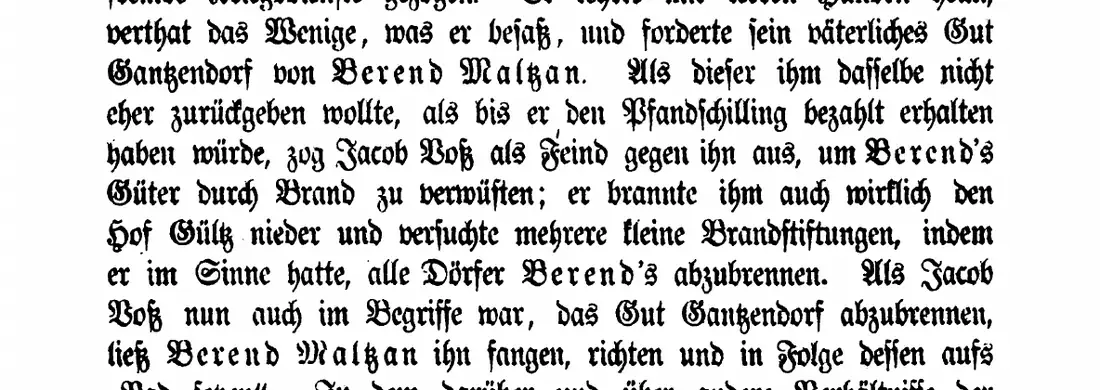
A little later Gültz was drawn into a family feud. Berend’s nephew Jacob Voß, the last of his line, had pledged his estate of Gantzendorf to his uncle. He returned penniless from military service abroad and demanded the estate back without paying the sum pledged. When Berend refused, Voß “set out against him as an enemy, to lay waste Berend’s estates by fire; and he did indeed burn down his farmstead at Gülz”. Berend had him captured, executed and “set upon the wheel”. The authors of 1871 call the proceedings “very harsh, but just according to the legal views and customs of the time”. Even so, the Duke held it against Berend in his written justification of December 1491.
1491: The fall of Wolde
The real conflict, however, was the one with the sovereign, Duke Bogislaw X of Pomerania. In 1491 Bogislaw called up the towns of Greifswald, Stralsund, Anklam and Demmin and besieged Wolde for eight days. The walls withstood the bombardment. Then, during the night, the gunpowder in the castle caught fire and “overturned half the castle”. Berend escaped. On 29 August 1491 the Duke had the castle stormed and “razed to the ground”. Berend fled to his wife and children at his castle of Neuburg in the Mark and brought a complaint against the Duke before the Emperor. His Pomeranian fiefs were deemed forfeit.
1496/97: Gültz passes to Berend
In 1496 Berend, allied with relatives from the Mark, invaded Pomerania and on the way back was ambushed in Mecklenburg and taken prisoner. His younger stepbrother Otto Maltzan, who had lived with him at Wolde, wanted to avenge him. To raise the means to do so, he sold “his rights to Gülz, Schorßow and Wolde to the co-owner of these estates, his cousin Berend, son of old Lüdecke, for 2150 gold guilders”. With this sale, which our timeline, following the Landeshauptarchiv Schwerin, dates to 1496, Gültz was finally in the hands of the family. It was to remain so for almost 450 years. On 21 May 1497 Otto then captured the Mecklenburg councillor Claus Hahn of Basedow and dragged him all the way to Franconia – a story in itself.
The dispute ended with money. On 24 October 1498 Bogislaw issued to his “councillor and marshal” Berend a bond for 4000 Rhenish guilders, “a clear sign”, according to the Lebensbilder, “that Berend Maltzan’s guilt was not great”. The Duke and his knight never fully trusted each other again.
Open questions
- The sources give differing figures for the purchase price of 1496/97: 2150 gold guilders in the Lebensbilder, 2250 guilders in the figure we have previously cited from the Landeshauptarchiv Schwerin. Which figure is correct can only be settled from the deed itself.
- The Lebensbilder know of two Berends: the knight of Wolde and his cousin of the same name, “son of old Lüdecke”, to whom Otto sold. How the Gültz property was divided between the two, the book does not say precisely.
- Exactly when Jacob Voß set fire to the farmstead at Gültz is not stated; it must have been before December 1491.
Sources: Friedrich von Maltzan, Albrecht von Maltzan, G. C. F. Lisch, Lebensbilder aus dem Geschlechte Maltzan, Rostock: Adler’s Erben 1871, chapter “Ritter Bernd”, pp. 70 ff., here pp. 77, 81–84, 86, 89 (copy held by Harvard College Library, digitised by Google Books, public domain; reading of the Fraktur texts checked against the scan by Schloss Gültz); Landeshauptarchiv Schwerin, 9.1-1 no. 200 (according to the family chronicle).