
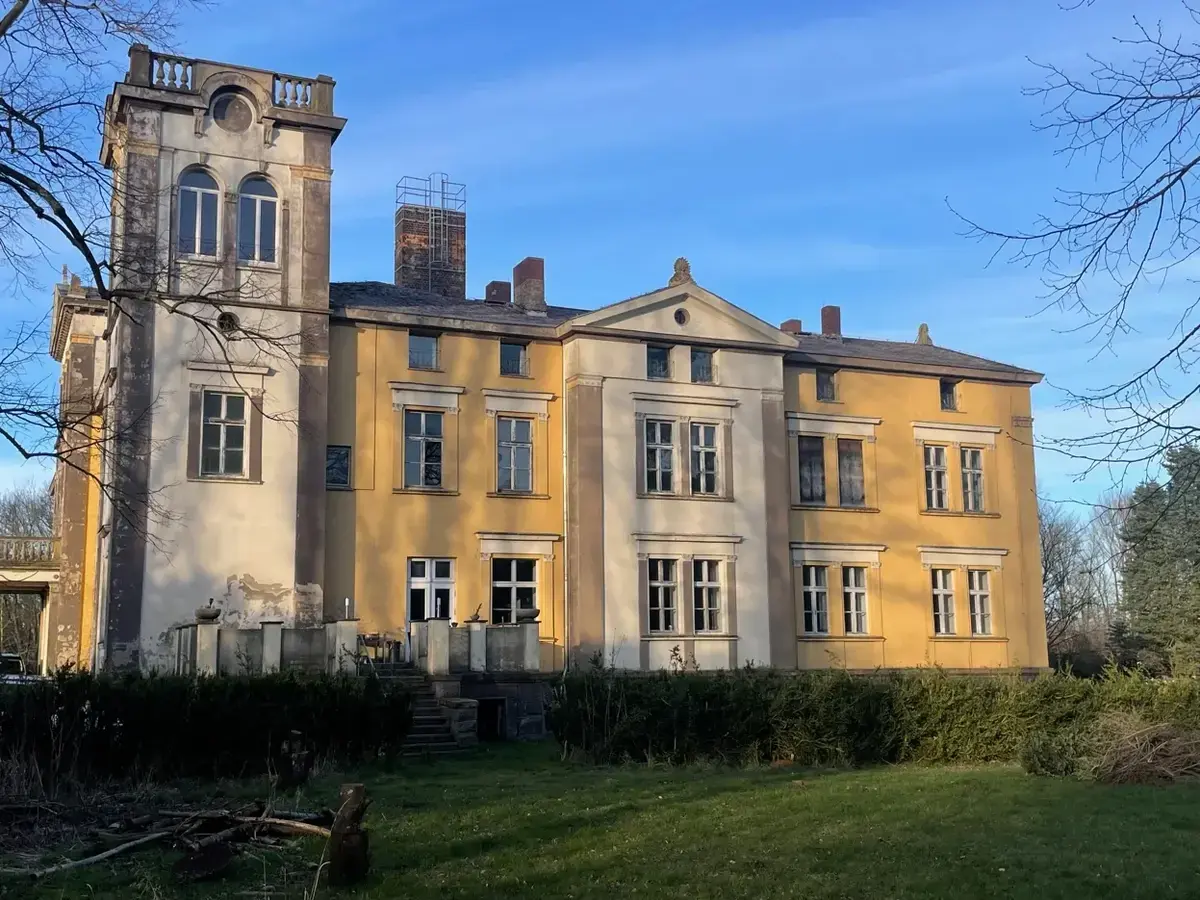
Schloss Gültz is one of more than thirty buildings that the Mecklenburg architect Georg Daniel (1829–1913) designed, remodelled or restored. Anyone who knows his other buildings will recognise many of their features in the manor house at Gültz. Here all his known works are brought together, along with his life story and the judgements of his contemporaries.
An architect for both Mecklenburgs
Georg Benedict Friedrich Wilhelm Daniel was born on 15 January 1829 in Rehna, the son of the lawyer and mayor Carl Ludwig Daniel. He studied at the Polytechnic School in Hanover from 1846 to 1848, worked from 1849 in Friedrich Bürklein’s office in Munich and from 1851 studied at the Munich Academy of Fine Arts. In 1854 he entered the Mecklenburg civil service and until 1857 was a site supervisor during the remodelling of Schwerin Palace. After a study trip to Italy he worked from 1858 to 1861 in Franz Jakob Kreuter’s office in Vienna, among other things as site manager at the Palazzo Grassi in Venice.
In 1861 he returned to Schwerin as a Baukondukteur (assistant building officer), became assistant to Theodor Krüger and in 1867 building official for the Schwerin district; from 1870 to 1874 he was district architect for the administrative districts of Hagenow and Wittenburg. Gültz and Vanselow fall within these years. From 1874 he headed the building administration in Mecklenburg-Strelitz, and from 1880, as Oberbaurat and later Geheimer Oberbaurat, that of Mecklenburg-Schwerin. From 1887 to 1911 he was a member of the Commission for the Preservation of Architectural and Artistic Monuments. He retired on 1 July 1911 and died in Schwerin on 8 April 1913.
Even while working on Schwerin Palace, the young Daniel caught the attention of Grand Duke Friedrich Franz II. The files state that he was “known to H(is) R(oyal) H(ighness) in a very favourable light …, having proved himself, through the work he carried out on the palace building here, to be a most capable and skilful architect”. The court expressly approved his move to Strelitz in 1874 on condition that Daniel could return to Schwerin “if so desired”. He took up this option in 1880, at the age of 51, and became head of the building authority of Mecklenburg-Schwerin. Daniel’s work received great acclaim at the 1878 World’s Fair in Paris. At the rededication of Ratzeburg Cathedral he was awarded the Knight’s Cross of the Mecklenburg House Order of the Wendish Crown. The manor house at Bernstorf, which he built from 1880 for the von Bernstorff family, still stands but is in very poor condition.
Why Daniel for Gültz?
Helmuth von Maltzahn had sketched the floor plans of his new house himself. He found his architect after visiting the newly completed Schloss Tressow near Wismar, which Daniel had built in 1862–1865 for Count Werner von der Schulenburg. Tressow has eleven bays, is designed “in the Florentine / late neoclassical style” and has a stately mews. Anyone who sees Tressow and Gültz side by side will recognise the same hand.
Almost at the same time as Gültz, and not far away, also in the Demmin district, the manor house at Vanselow (1870–1871, occupied in October 1872) was built for Hans Ludwig von Maltzahn – a neoclassical rendered building on an H-shaped plan. Daniel was thus building for two branches of the same family at the same time. In 1879 he also remodelled the village church in Gültz. This is independently confirmed by the 1898 inventory of monuments: the Gültz pulpit had been “excellently restored in 1879 by Baurath Daniels in Neustrelitz” – Daniel was based in Neustrelitz at the time as head of the Strelitz building administration (more about the church).
How his contemporaries saw him
In 1924 Geheimer Oberbaurat Johann Friedrich Pries, who had deputised for Daniel in office in his later years, paid tribute to him as “a man who, like few others, dominated the entire field of building construction in the state for decades, or more accurately in both states of Mecklenburg”.
“Daniel did not follow any particular artistic movement exclusively, but rather sought in each individual case to adapt the style to the task.”
This explains the range of his work: manor houses in the Florentine or neoclassical style such as Tressow, Gültz and Vanselow, neo-Gothic churches and restorations such as those in Malchow, Remplin and at Schwerin Cathedral, and the neo-Renaissance of the court theatre. Pries also emphasises that Daniel promoted traditional local brick building.
The Schwerin theatre
His best-known work in the state capital is the Grand Ducal Court Theatre on the Alter Garten, built 1882–1886 and today the Mecklenburgisches Staatstheater. Since 2018 the architectural practice fachwerkler has been responsible, on behalf of the Staatliches Bau- und Liegenschaftsamt Schwerin, for the maintenance of the listed ensemble of theatre, engine house and former scenery store. There, as at Gültz, the careful treatment of the historic fabric comes first (project page with photos).
All known buildings by Georg Daniel
| Year | Place | Building | Type | Condition |
|---|---|---|---|---|
| 1856–1857 | Löwitz near Rehna | Manor house | Remodelling | Ruin |
| 1862–1865 | Tressow near Wismar | Manor house (Schloss) with mews for Count Werner von der Schulenburg | New build | preserved |
| 1863–1869 | Schwerin, Am Packhof | St Paul’s Church (Paulskirche) | New build (as site manager) | preserved |
| 1863–1871 | Ivenack | Palace and palace church | Remodelling | preserved |
| 1865 | Vietlübbe near Gadebusch | Village church | Restoration | preserved |
| 1866 | Schwerin, Schlachterstraße | Synagogue | Remodelling | Destroyed in 1938 |
| 1866–1867 | Groß Eichsen | Church of St John the Baptist | Restoration | preserved |
| 1868–1869 | Schwerin, Am Packhof 1 | Main customs office | New build | — |
| 1868–1872 | Gültz in Pomerania | Manor house (Schloss Gültz) for Helmuth Frhr. von Maltzahn | New build | preserved |
| 1870–1871/72 | Vanselow near Demmin | Manor house for Hans Ludwig von Maltzahn | New build | preserved |
| 1870–1873 | Malchow | Town church of St John | New build | preserved |
| 1873–1880 | Bistrow | Church, manor house and family chapel | Restoration / buildings | — |
| 1876 | Güstrow, ramparts | War memorial | Design | Replaced in 1910 |
| 1876–1877 | Groß Quassow | Village church | New build | preserved |
| 1876–1878 | Remplin | Church | New build | preserved |
| 1876–1878 | Buchholz near Rostock | Church | New build | preserved |
| 1876–1881 | Ratzeburg | Cathedral, 1st construction phase | Restoration | preserved |
| 1877–1878 | Penzlin | Town church of St Mary and St Nicholas | Restoration | preserved |
| 1877–1880 | Bernstorf | Manor house | New build | preserved |
| 1879 | Gültz | Village church | Remodelling | preserved |
| 1880–1881 | Beseritz | Church with new tower | Restoration | preserved |
| from 1880 | Beseritz | Manor house | New build | preserved |
| 1880–1883 | Güstrow | Parish church of St Mary | Conversion and restoration | preserved |
| 1882–1883 | Schwerin, Platz der Jugend | Anna Hospital (children’s hospital) | New build | preserved |
| 1882–1886 | Schwerin, Alter Garten | Grand Ducal Court Theatre (today the Mecklenburgisches Staatstheater) | New build | preserved |
| 1883–1885 | Schwerin, Friedensstraße | Grand Ducal Realgymnasium | New build | preserved |
| 1883–1886 | Schwerin | Cathedral | Restoration and conversion | preserved |
| 1888–1890 | Malchow, convent | Convent church | Restoration | preserved |
| 1889 | Güstrow, Pferdemarkt | Borwin Fountain | Design | preserved |
| 1889 | Toitenwinkel near Rostock | Church of St Lawrence and St Catherine | Restoration and conversion | preserved |
| 1889–1892 | Schwerin | Cathedral tower (endowed by Count Bernstorff of Wedendorf) | New build | preserved |
| 1890–1892 | Schwerin, Schloßstraße | Kollegiengebäude II (government offices) | New build | preserved |
| 1890–1894 | Rostock | St Nicholas’ Church | Restoration | — |
| 1892–1893 | Schwerin, Lübecker Straße | Old-age and invalidity insurance institution | New build | preserved |
| 1893–1899 | Ratzeburg | Cathedral, 2nd construction phase | Restoration | preserved |
| 1905–1907 | Schwerin | State insurance institution | New build | — |
| n.d. | Waren (Müritz) | St Mary’s Church | Restoration | — |
| n.d. | Parchim | Grammar school (according to Pries 1924) | New build | — |
| n.d. | Schwerin | Residential buildings | New build | — |
“Condition” according to the catalogue of works in the Architektenbiografien (as of 2022); “—” means: not stated there. Where the years differ slightly between sources (for instance Malchow 1870/71 in Pries, 1870–1873 in the catalogue of works), the longer period is given. Do you know of further buildings by Daniel, especially manor houses in Western Pomerania? We will gladly add them to the list: schlossgueltz@gmx.de
Sources: short biography “Georg Daniel (1829–1913)” (source text in the Archiv Schloss Gültz, origin not recorded; it gives “Kreutzer” instead of Kreuter and Malchow as “completed in 1870”); Architektenbiografien (glass-portal), “Daniel, Georg”, with catalogue of works; Wikipedia, articles “Georg Daniel”, “Schloss Tressow” and “Herrenhaus Vanselow” (accessed 4 October 2026); Joh. Friedr. Pries, “Die Baumeister Mecklenburgs und ihre Werke”, in: Mecklenburg. Zeitschrift des Heimatbundes Mecklenburg 19 (1924), no. 1, pp. 17 f.; fachwerkler, project “Theater Schwerin”; Helmuth Frhr. von Maltzahn-Gültz, Erinnerungen, 1916 (choice of architect).