
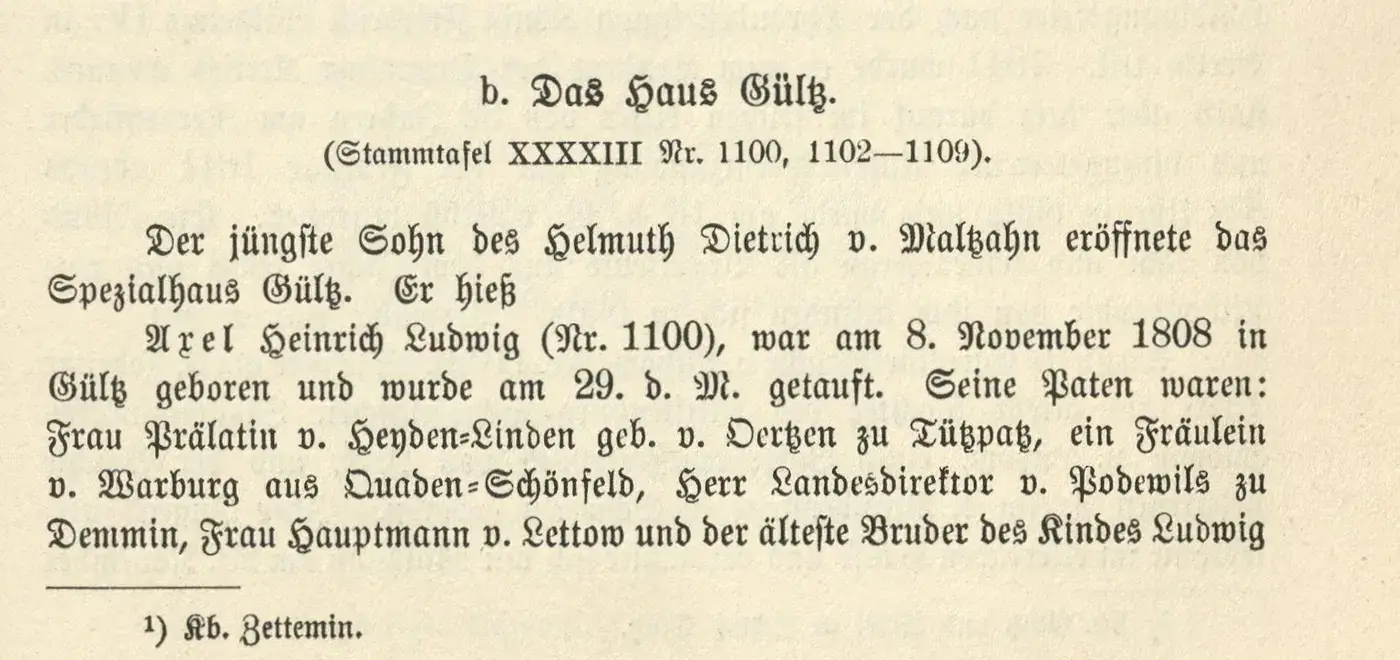
In 1925 the fourth and final volume of the great family history Geschichte des Geschlechts von Maltzan und von Maltzahn appeared. Its author was the archivist Dr Berthold Schmidt (born in 1856 in Ivenack, the son of the local pastor, later Privy Archival Councillor to the Princes Reuss in Schleiz). The work had been initiated by the man who built the manor at Gültz himself. The chapter “b. Das Haus Gültz” (pp. 93–108) is the most important printed source on the family at Gültz. Much of the information on our website comes from it; here we bring together what has so far been missing.
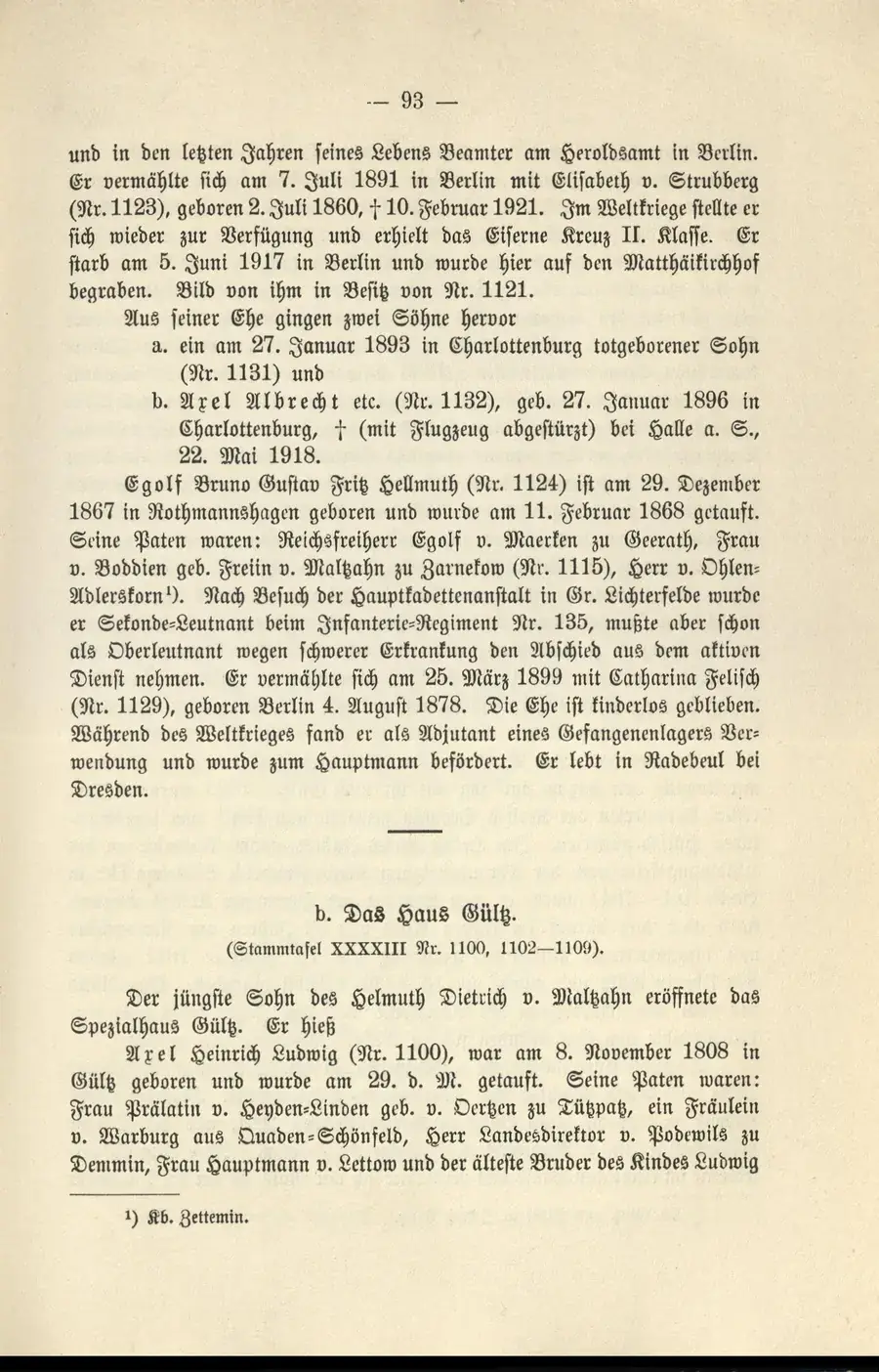
Axel Heinrich Ludwig (1808–1841), the founder
The youngest son of Helmuth Dietrich von Maltzahn was born at Gültz on 8 November 1808 and baptised on 29 November. One of his godmothers was the prelate’s wife von Heyden-Linden, née von Oertzen, of Tützpatz. He attended the grammar school in Neustrelitz and boarded with Professor Kämpffer. A fellow pupil described him as an excellent student, “cheerful, musical and a lively gymnast”. He took his school-leaving examination in Berlin. From 1827 he studied in Bonn, where he was an active member of the Corps Borussia, finishing with two semesters in Berlin.
In 1831 he joined the Justizkommission in Schwedt as a trainee (Auskultator); in 1833 he passed the Referendar examination and worked at the Higher Regional Court in Frankfurt (Oder). Together with his cousin Gustav Robert of the Sarow line, he worked through the records of the Stettin feudal archive. In this way the two prepared the reacquisition of the Schmarsow estates (Osten, Borgwall, Schmarsow, Roidin and Teusin), which had become possible after the extinction of the von Parsenow family. In 1839 the district of Demmin elected him its first deputy, and in 1840 he became an assistant deputy of the Landschaft (provincial credit institution). In the autumn of 1840 he took part in the act of homage to King Frederick William IV in Berlin. He died at Gültz on the evening of 12 February 1841 at 8:45 pm and was buried there on 16 February. An oil portrait of the engaged couple from 1838 and a lithograph of him were still at Gültz in 1925.
“Aunt Auguste” (1820–1891)
Auguste Caroline Sophie von Lützow was born in Schwerin on 9 February 1820, the eldest daughter of the minister of state Ludwig von Lützow and Sophie Freiin von Brandenstein. At first she did not have an easy time at Gültz: her mother-in-law, née von Brockhusen, still lived in the house “and was really the mistress of the house”. After the early death of her husband she initially remained at Gültz with Miss Thornton, a former governess of her younger sisters. On 28 July 1849 she married, at Gültz, Hermann von Heyden of Leistenow, Gatschow and Kadow (1810–1851), government councillor and district administrator. After his death she brought up her own son and two stepsons at Leistenow. At the end of the 1850s she bought a house with a garden in Demmin and moved there in 1866/67, when her three sons married.
Schmidt describes her as intellectually alert, shaped by the religious “Awakening”, “loyal to the king and conservative to her fingertips”, frugal and strict with herself, “but at the same time really a born ruler”. For this reason “Aunt Auguste” was loved by many and “regarded by some with a somewhat fearful respect”. She died of pneumonia in Demmin on 9 May 1891 and was laid to rest on 12 May in the family burial vault at Gültz beside her first husband. The Demminer Kreisblatt published an anonymous poem about her at the time: “Lay wreaths of honour, ye women, / On the grave of the noblest of wives! / A model we were granted to see, / Who gave faith and love to our lives.” An oil portrait of her as an old woman went to Schossow when the estate was divided among the heirs.
Helmuth (1840–1923): youth and guardians
Helmuth Ludwig Wilhelm was born at Gültz at 10:30 am on 6 January 1840 and baptised on 10 February. His grandfather, Minister von Lützow in Schwerin, had a great influence on him. From 1847 he was taught by the private tutor Julius Lappe, who was pastor at Gültz from 1851 to 1887 and a loyal friend until his death. At the age of eleven, at Easter 1851, Helmuth entered the Tertia (third form) of the grammar school in Wittenberg and lodged with the director of the preachers’ seminary, Professor von Schmieder. Until 1851 his guardian was his cousin Helmuth von Maltzahn of Zettemin, and thereafter Freiherr Carl von Sobeck of Zarrenthin, who administered the estates “very successfully” for a further two years beyond his coming of age.
In Heidelberg Helmuth was an active member of the Corps Vandalia, together with his two stepbrothers von Heyden and his cousin Hans Ludwig von Maltzahn of Vanselow. After the Referendar examination he worked for a few months at the district office in Anklam. He sat the oral Assessor examination in 1866 in field uniform while his regiment was marching to Bohemia. He had done his officer training with the 2nd Rhenish Hussar Regiment No. 9 in Trier; in 1864 he became a lieutenant. A bullet wound to the elbow at Beaune-la-Rolande in 1870 left him with a permanently stiff right arm.
Estate purchases
With his marriage in 1867, Helmuth took over the management of the estates himself and enlarged them step by step:
- in 1868 the outlying farm of Marienhöhe (Gnevkow parish lands, adjoining Hermannshöh) from Wilhelm Bülle for 56,000 thalers,
- in 1869 the old Maltzahn estate of Schossow from the heirs of the bailiff Johann Friedrich Heydemann for 222,500 thalers,
- in 1881 Wodarg and Werder from Count Zieten-Schwerin for 1,500,000 marks,
- in 1881 the Crampe estate in the district of Arnswalde, on which he held the first mortgage, at a compulsory auction for 148,000 marks. He restored the neglected estate, reforested it and handed it over to his daughter Elsbeth von Gerlach in 1909.
Politics, Bismarck and Caprivi
In the Reichstag, of which he was a member for eighteen years from 1871, Helmuth founded the German Conservative Party together with several colleagues. He dealt above all with military questions, the budget and social legislation. In Berlin he lived in a house he had built himself at Derfflingerstraße 9. As Secretary of the Imperial Treasury he served for a year and a half under Bismarck and two and a half years under Caprivi. In 1893 he resigned over a dispute about the beer tax, although the Chancellor wished to keep him. The two parted on good terms; Maltzahn later stood by Caprivi when he came under fierce attack.
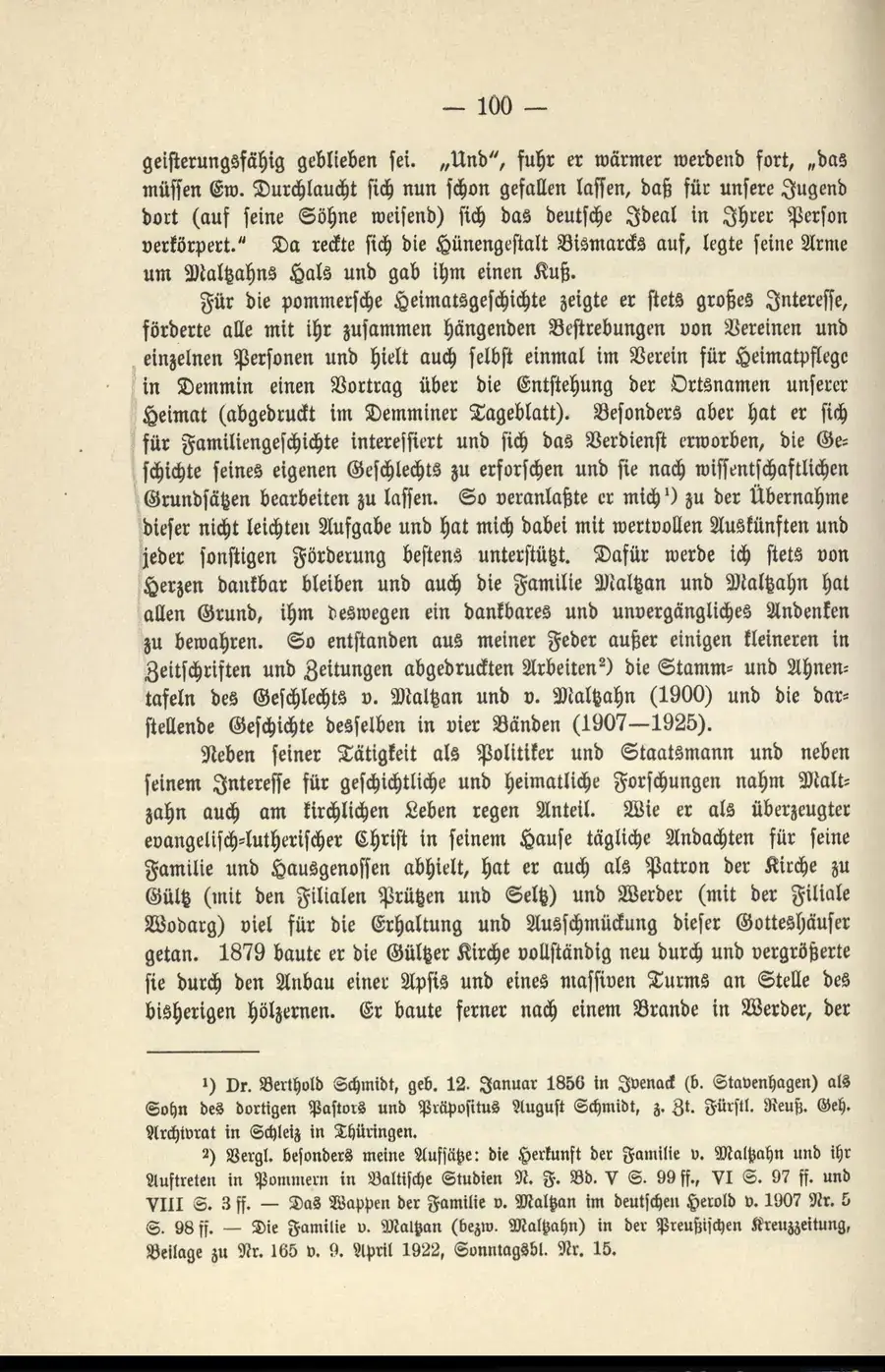
He also visited Bismarck several times after his dismissal, once with his wife at Varzin and in 1897 with his three sons at Friedrichsruh. Bismarck’s personal physician, Professor Schweninger, wanted to prevent the visit, but Bismarck said: “What? Maltzahn wants to introduce his boys to me – I must get to know them.” At breakfast Maltzahn said that for the young, the German ideal was embodied in Bismarck’s person. “At that, Bismarck’s giant frame drew itself up; he put his arms around Maltzahn’s neck and gave him a kiss.”
Church and local history
Helmuth held daily devotions in his house for his family and household. As patron of the churches of Gültz (with Prützen and Seltz) and Werder (with Wodarg), in 1879 he had the church at Gültz completely remodelled, with an apse and a solid masonry tower in place of the wooden one. After the fire of 1889, which had destroyed all the farm buildings in Werder and the church down to its outer walls, he rebuilt the church at his own expense, with new bells and a new organ. From 1869 he sat in the provincial synod, was its president for many years and was a member of the general synod. Until 1888 he led the confessional Lutheran group within the Prussian regional church, the “Augustkonferenz”.
At the Verein für Heimatpflege in Demmin he gave a lecture on the origins of the local place names. Above all, however, he commissioned the scholarly family history: Schmidt’s genealogical and ancestral tables (1900) and the four volumes (1907–1925). The dignity of Hereditary Marshal of Hither Pomerania (Altvorpommern) should in fact have passed in 1909 to Freiherr Albrecht von Maltzahn of Roidin; he renounced it in favour of his “much older cousin at Gültz”. Helmuth was particularly fond of bearing the title.
World War and revolution
Three sons, two sons-in-law and four grandsons took part in the World War; all returned without serious wounds. Helmuth, very much a child of his time, was a resolute opponent of the revolution. His appeal “Preußen heraus!” (“Prussia, stand up!”) of 18 January 1919 was printed by the daily newspapers and earned him the honorary presidency of the Preußenbund. In 1919 he handed the estates over to his sons.
Chancellor of the Order of Saint John
As Chancellor of the Order from 1916, he conducted the negotiations when, after the war, the Dutch knights (Commanderij Nederland) and, in 1920, the Swedish knights formed their own associations. He received both as guests at Gültz, where he also held other conferences of the Order. Among his last tasks, together with the Captain of the Order, Field Marshal von Hindenburg, was a new code of honour-court procedure for the Order. Before a chapter meeting in Potsdam on 8 February 1923 he fell ill with influenza. He died on Sunday, 11 February 1923, at 12:15 pm, “at the age of 83 years and 36 days”. In his obituary the Herrenmeister (Master of the Order), Prince Eitel Friedrich, called him “this most faithful of the faithful”. The Grand Duke of Mecklenburg-Schwerin, to whom Maltzahn had had the third volume of the family history presented only a few weeks earlier, wrote a personal letter to the family. An oil portrait from 1871 hung at Gültz, a later one at Wodarg.
Anna, née von Rohrscheidt (1847–1913): “Uns’ Mudding”
Luise Auguste Anna von Rohrscheidt was born in Annaburg on 10 October 1847, the daughter of the Prussian colonel Friedrich Julius von Rohrscheidt and Auguste von Hagen. She grew up in her father’s garrison towns (Halle, Wohlau, Breslau, Erfurt) and attended the Moravian Church girls’ boarding school in Gnadau. Helmuth met her at a friend’s wedding in Erfurt; they became engaged on 23 October 1866.
At Gültz, older uncles and aunts initially tried to patronise her, but with intelligence and quick wit she held her own. A neighbour, proud of his financial dealings, greeted the young couple with the words: “You thought, my dear lady, that you were coming into the house of a nobleman; you are mistaken – you are coming into the house of a merchant.” Anna replied with a smile: “But that does not matter at all, as long as the merchant has the mind of a nobleman!” As lady of the estate she knew almost every household on the Gültz property and helped with advice and practical support. The people loved her as “Uns’ Mudding” (“our mother”). The pastor of Gültz began his funeral sermon for her with the words: “Uns’ Mudder ist dod” (“Our mother is dead”). She died in Stralsund at 1 am on 26 November 1913 during an emergency operation and was laid to rest on 30 November in the family burial vault at Gültz. She left five children, seventeen grandchildren and one great-grandchild.
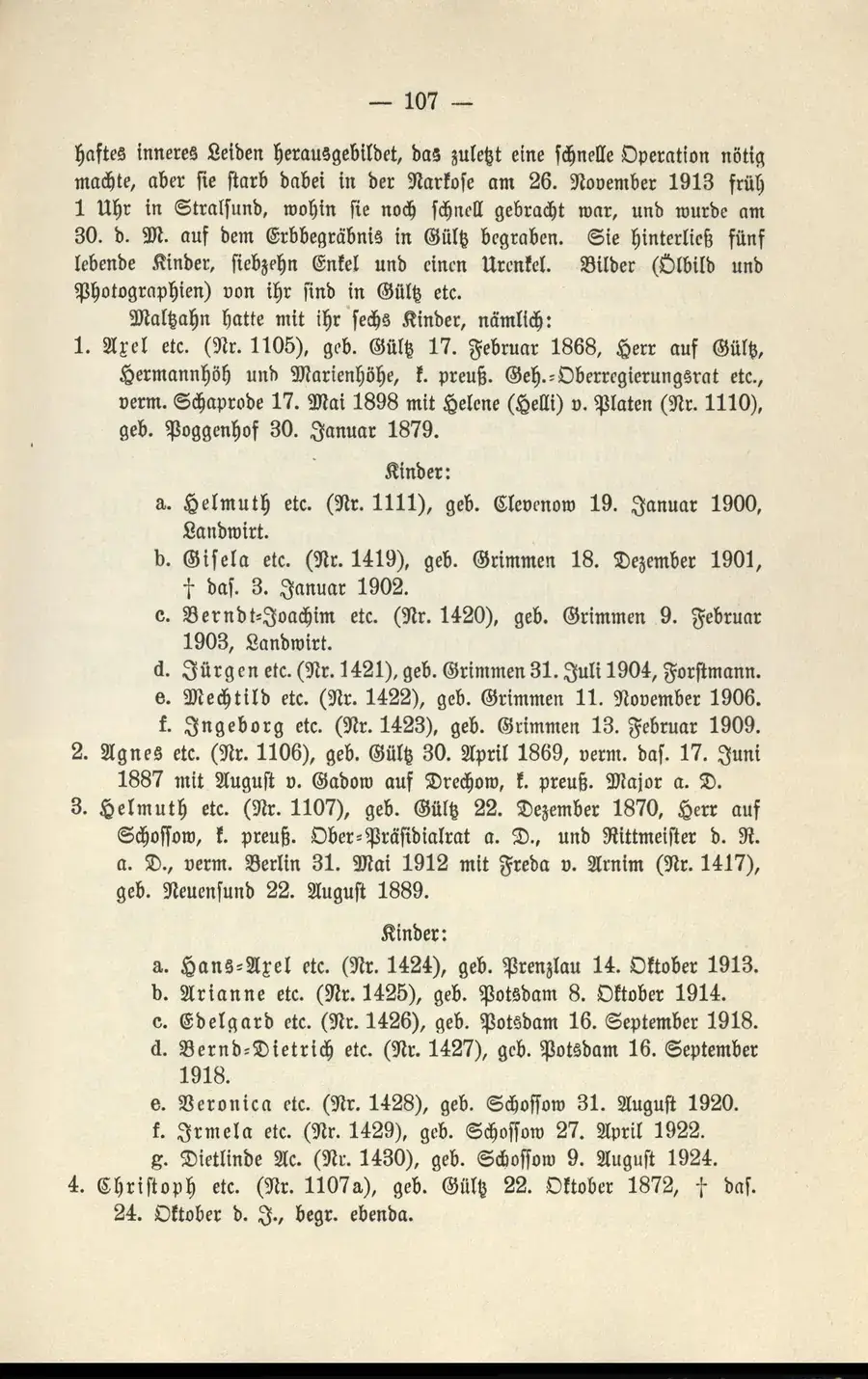
The children of the builder of the manor
- Axel (* 17 February 1868 at Gültz), lord of Gültz, Hermannshöh and Marienhöhe, ⚭ 17 May 1898 at Schaprode Helene von Platen (more about Axel)
- Agnes (* 30 April 1869 at Gültz), ⚭ 17 June 1887 at Gültz August von Gadow of Drechow, retired major
- Helmuth (* 22 December 1870 in Gültz), lord of Schossow, Oberpräsidialrat (retd.), ⚭ 31 May 1912 in Berlin Freda von Arnim
- Christoph (* 22 October 1872 in Gültz, † two days later, buried there)
- Elsbeth (* 24 January 1874 in Gültz), lady of Crampe, ⚭ 12 October 1893 in Gültz Servatius von Gerlach of Rohrbeck, Major (retd.)
- Gerhard (* 25 June 1877 in Gültz), lord of Wodarg and Werder, ⚭ 15 November 1907 in Berlin Helene von Borcke
Schmidt also names Axel’s children: Helmuth (* 19 January 1900 in Clevenow), Gisela (* 18 December 1901 in Grimmen, † 3 January 1902), Berndt-Joachim (* 9 February 1903), Jürgen (* 31 July 1904, forester), Mechtild (* 11 November 1906) and Ingeborg (* 13 February 1909), all born in Grimmen except the eldest.
Source: Berthold Schmidt, Geschichte des Geschlechts von Maltzan und von Maltzahn, vol. IV, 1925, section “b. Das Haus Gültz”, pp. 93–108 (digitised copy: Digitale Bibliothek Mecklenburg-Vorpommern). Quotations verbatim, otherwise in our own words. Illustrations: pages 93, 100 and 107 of the digitised copy.